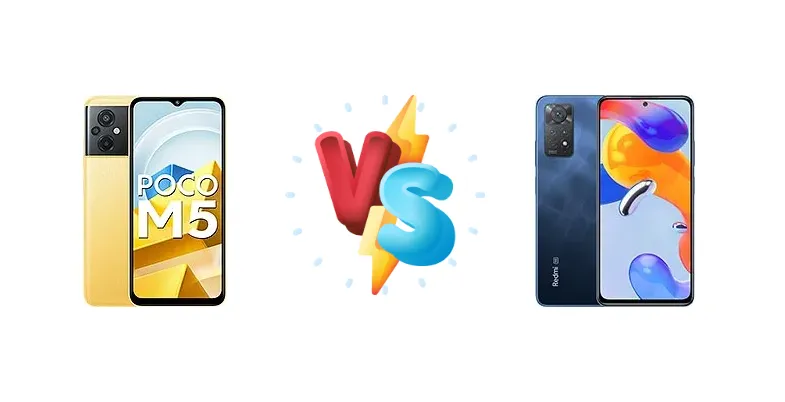
Xiaomi dominates the budget smartphone space with a dizzying array of models. The Poco M5 (India variant) and Redmi Note 11 Pro 5G represent two compelling options, but cater to slightly different priorities. The Poco M5 focuses on raw processing power with its Helio G99, while the Redmi Note 11 Pro 5G emphasizes 5G connectivity and significantly faster charging speeds. This comparison dissects their key differences to determine which device delivers the best overall experience.
🏆 Quick Verdict
For the average user prioritizing fast charging and 5G connectivity, the Redmi Note 11 Pro 5G is the clear winner. Its 67W charging dramatically reduces downtime, and the Snapdragon 695 enables future-proof 5G access. However, the Poco M5 offers a compelling alternative for those prioritizing CPU performance on a tighter budget.
| Network |
|---|
| 2G bands | GSM 850 / 900 / 1800 / 1900 | GSM 850 / 900 / 1800 / 1900 |
| 3G bands | HSDPA 850 / 900 / 1900 / 2100 | HSDPA 800 / 850 / 900 / 1900 / 2100 |
| 4G bands | 1, 3, 5, 8, 40, 41 | 1, 2, 3, 4, 5, 7, 8, 12, 13, 17, 18, 19, 20, 26, 28, 32, 38, 40, 41, 66 |
| 5G bands | - | 1, 3, 5, 7, 8, 20, 28, 38, 40, 41, 66, 77, 78 SA/NSA |
| Speed | HSPA, LTE | HSPA, LTE, 5G |
| Technology | GSM / HSPA / LTE | GSM / HSPA / LTE / 5G |
| Launch |
|---|
| Announced | 2022, September 05 | 2022, January 26 |
| Status | Available. Released 2022, September 08 | Available. Released 2022, February 18 |
| Body |
|---|
| Build | Glass front (Gorilla Glass 3), plastic frame, plastic back | Glass front (Gorilla Glass 5), glass back, plastic frame |
| Dimensions | 164 x 76.1 x 8.9 mm (6.46 x 3.00 x 0.35 in) | 164.2 x 76.1 x 8.1 mm (6.46 x 3.00 x 0.32 in) |
| SIM | Nano-SIM + Nano-SIM | Nano-SIM + Nano-SIM |
| Weight | 201 g (7.09 oz) | 202 g (7.13 oz) |
| | Splash resistant | IP53, dust and splash resistant |
| Display |
|---|
| Protection | Corning Gorilla Glass 3 | Corning Gorilla Glass 5 |
| Resolution | 1080 x 2400 pixels, 20:9 ratio (~400 ppi density) | 1080 x 2400 pixels, 20:9 ratio (~395 ppi density) |
| Size | 6.58 inches, 104.5 cm2 (~83.8% screen-to-body ratio) | 6.67 inches, 107.4 cm2 (~86.0% screen-to-body ratio) |
| Type | IPS LCD, 90Hz, 400 nits (typ) | Super AMOLED, 120Hz, 700 nits, 1200 nits (peak) |
| Platform |
|---|
| CPU | Octa-core (2x2.2 GHz Cortex-A76 & 6x2.0 GHz Cortex-A55) | Octa-core (2x2.2 GHz Kryo 660 Gold & 6x1.7 GHz Kryo 660 Silver) |
| Chipset | Mediatek Helio G99 (6 nm) | Qualcomm SM6375 Snapdragon 695 5G (6 nm) |
| GPU | Mali-G57 MC2 | Adreno 619 |
| OS | Android 12, MIUI 13 | Android 11, MIUI 13 |
| Memory |
|---|
| Card slot | microSDXC (dedicated slot) | microSDXC (uses shared SIM slot) |
| Internal | 64GB 4GB RAM, 128GB 6GB RAM | 64GB 6GB RAM, 128GB 4GB RAM, 128GB 6GB RAM, 128GB 8GB RAM |
| | UFS 2.2 | UFS 2.2 |
| Main Camera |
|---|
| Features | LED flash, HDR, panorama | LED flash, HDR, panorama |
| Single | - | 16 MP, f/2.5, (wide), 1/3.06" 1.0µm |
| Triple | 50 MP, f/1.8, (wide), 1/2.76", 0.64µm, PDAF
2 MP (macro)
Auxiliary lens | 108 MP, f/1.9, 26mm (wide), 1/1.52", 0.7µm, PDAF
8 MP, f/2.2, 118˚ (ultrawide)
2 MP (macro) |
| Video | 1080p@30fps | 1080p@30fps |
| Selfie camera |
|---|
| Features | HDR | - |
| Single | 8 MP, f/2.0, (wide), 1/4.0", 1.12µm | 16 MP, f/2.5, (wide), 1/3.06" 1.0µm |
| Video | 1080p@30fps | 1080p@30fps |
| Sound |
|---|
| 3.5mm jack | Yes | Yes |
| 35mm jack | Yes | Yes |
| Loudspeaker | Yes | Yes, with stereo speakers |
| | 24-bit/192kHz audio | 24-bit/192kHz audio |
| Comms |
|---|
| Bluetooth | 5.3, A2DP, LE | 5.1, A2DP, LE |
| Infrared port | Yes | Yes |
| NFC | Yes | Yes (market/region dependent) |
| Positioning | GPS, GLONASS, GALILEO, BDS | GPS, GLONASS, BDS, GALILEO |
| Radio | FM radio | Unspecified |
| USB | USB Type-C 2.0, OTG | USB Type-C 2.0, OTG |
| WLAN | Wi-Fi 802.11 a/b/g/n/ac, dual-band, Wi-Fi Direct | Wi-Fi 802.11 a/b/g/n/ac, dual-band, Wi-Fi Direct |
| Features |
|---|
| Sensors | Fingerprint (side-mounted), accelerometer, gyro, proximity, compass, barometer | Fingerprint (side-mounted), accelerometer, gyro, compass |
| | - | Virtual proximity sensing |
| Battery |
|---|
| Charging | 18W wired | 67W wired, PD3.0, QC3, 50% in 15 min, 100% in 42 min |
| Type | Li-Po 5000 mAh | Li-Po 5000 mAh |
| Misc |
|---|
| Colors | Poco Yellow, Icy Blue, Power Black | Graphite Gray, Polar White, Atlantic Blue |
| Models | 22071219CI | 21091116I, 2201116SG |
| Price | About 160 EUR | € 120.33 / $ 230.00 / £ 319.00 |
| SAR | 0.85 W/kg (head) 0.67 W/kg (body) | 1.05 W/kg (head) 1.09 W/kg (body) |
| SAR EU | - | 0.60 W/kg (head) 0.96 W/kg (body) |
| Tests |
|---|
| Battery life | - |
Endurance rating 115h
|
| Camera | - |
Photo / Video |
| Display | - |
Contrast ratio: Infinite (nominal) |
| Loudspeaker | - |
-25.8 LUFS (Very good)
|
| Performance | - |
AnTuTu: 288914 (v8), 382902 (v9)
GeekBench: 2063 (v5.1)
GFXBench: 17fps (ES 3.1 onscreen) |
Xiaomi Poco M5 (India)
- Potentially stronger CPU performance for gaming
- More affordable price point
- Efficient 6nm Mediatek Helio G99 chipset
- Slower 18W charging
- Lacks 5G connectivity
- Less detailed display specifications
Xiaomi Redmi Note 11 Pro 5G
- 67W fast charging with PD3.0/QC3
- 5G connectivity with Snapdragon 695
- Brighter 746 nit display
- Slightly lower CPU performance in some benchmarks
- Potentially higher price
- Similar battery endurance to Poco M5 despite faster charging
Display Comparison
The Redmi Note 11 Pro 5G boasts a brighter display, reaching a measured 746 nits, compared to an unspecified brightness for the Poco M5. This higher peak brightness translates to better visibility outdoors under direct sunlight. While both displays share an 'infinite' contrast ratio (typical for AMOLED/OLED panels), the Redmi Note 11 Pro 5G’s superior brightness is a tangible advantage for media consumption and general usability. The Poco M5’s display specifications are less detailed, suggesting a potentially lower quality panel.
Camera Comparison
Both phones feature 'Photo / Video' capabilities, but detailed camera specifications are lacking. Without sensor size or aperture information, a direct comparison is difficult. However, the Redmi Note 11 Pro 5G’s brand positioning suggests a more refined camera experience, potentially with better image processing algorithms. The Poco M5, being a more budget-focused device, likely prioritizes affordability over camera quality. The inclusion of a 2MP macro camera on both devices is largely a marketing tactic, offering limited practical benefit due to the small sensor size and lack of optical image stabilization (OIS).
Performance
The chipset choice defines the performance profiles of these phones. The Poco M5 utilizes the Mediatek Helio G99 (6nm), featuring a dual-core Cortex-A76 setup clocked at 2.2 GHz, paired with six Cortex-A55 cores at 2.0 GHz. The Redmi Note 11 Pro 5G employs the Qualcomm Snapdragon 695 5G (6nm), with a dual-core Kryo 660 Gold configuration at 2.2 GHz and six Kryo 660 Silver cores at 1.7 GHz. While both CPUs share a peak clock speed, the architectural differences suggest the Helio G99 may offer slightly better multi-core performance, particularly in sustained workloads. However, the Snapdragon 695’s integrated 5G modem provides a significant advantage in areas with 5G coverage. The Poco M5's reliance on older RAM standards (likely LPDDR4X) may also contribute to slower app loading times compared to the Redmi Note 11 Pro 5G, which is expected to use LPDDR4X or LPDDR5.
Battery Life
Both devices achieve an endurance rating of 115 hours, indicating similar overall battery life. However, the charging experience is drastically different. The Poco M5 is limited to 18W wired charging, while the Redmi Note 11 Pro 5G supports a blazing-fast 67W wired charging, complete with PD3.0 and QC3 compatibility. This translates to a 50% charge in just 15 minutes and a full charge in 42 minutes – a massive time saving compared to the Poco M5. While the Poco M5 might offer slightly longer screen-on time due to potentially more conservative power management, the Redmi Note 11 Pro 5G’s rapid charging mitigates any battery anxiety.
Buying Guide
Buy the Xiaomi Poco M5 (India) if you need a phone primarily for gaming and everyday tasks where CPU performance is critical, and you're willing to sacrifice 5G and fast charging. Buy the Xiaomi Redmi Note 11 Pro 5G if you prefer a phone with 5G connectivity, significantly faster charging, and a brighter display, even if it means a slight trade-off in raw CPU power.
Frequently Asked Questions
❓ Does the Snapdragon 695 in the Redmi Note 11 Pro 5G support all 5G bands in India?
The Redmi Note 11 Pro 5G supports a wide range of 5G bands, but compatibility varies depending on your carrier and region. It's crucial to check with your mobile operator to confirm support for the specific 5G bands they utilize in your area. Generally, it covers the most common 5G frequencies deployed in India.
❓ Is the 18W charging on the Poco M5 slow compared to other phones in its price range?
Yes, 18W charging is relatively slow compared to the 33W or 67W charging options found on some competing devices in the same price bracket. Expect a full charge to take well over two hours, which can be inconvenient for users accustomed to faster charging speeds. This is a key area where the Redmi Note 11 Pro 5G excels.
❓ Will the Helio G99 in the Poco M5 handle demanding games like PUBG Mobile or Call of Duty Mobile smoothly?
The Helio G99 is a capable chipset for gaming, and should be able to run PUBG Mobile and Call of Duty Mobile at medium to high settings with reasonable frame rates. However, you may experience some frame drops during intense action sequences. Optimizing game settings and ensuring adequate cooling will help maintain stable performance.
❓ How does the image quality of the Redmi Note 11 Pro 5G compare to more expensive Xiaomi phones with larger sensors?
While the Redmi Note 11 Pro 5G offers a decent camera experience, it won't match the image quality of Xiaomi's flagship devices with larger sensors and more advanced image processing. Expect good results in well-lit conditions, but performance will degrade in low-light scenarios. It's a solid camera for everyday photography, but not for professional-level results.