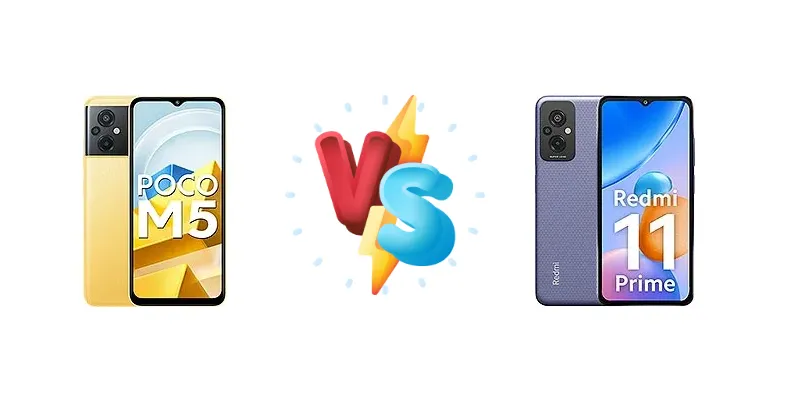
The Xiaomi Poco M5 and Redmi 11 Prime are both compelling budget smartphones vying for your attention. Both offer impressive features for their price point, but subtle differences can make one a better fit for your needs. Let's dive into a detailed comparison to help you make the right choice.
🏆 Quick Verdict
The Redmi 11 Prime edges out the Poco M5 thanks to its 5W reverse wired charging, offering added convenience. Both phones share the same powerful Helio G99 chipset, making performance largely comparable. Ultimately, the choice depends on your charging priorities and potential need for reverse charging.
| Network |
|---|
| 2G bands | GSM 850 / 900 / 1800 / 1900 | GSM 850 / 900 / 1800 / 1900 |
| 3G bands | HSDPA 850 / 900 / 1900 / 2100 | HSDPA 850 / 900 / 2100 |
| 4G bands | 1, 3, 5, 8, 40, 41 | 40, 41 |
| Speed | HSPA, LTE | HSPA, LTE |
| Technology | GSM / HSPA / LTE | GSM / HSPA / LTE |
| Launch |
|---|
| Announced | 2022, September 05 | 2022, September 06 |
| Status | Available. Released 2022, September 08 | Available. Released 2022, September 23 |
| Body |
|---|
| Build | Glass front (Gorilla Glass 3), plastic frame, plastic back | Glass front (Gorilla Glass 3), plastic frame, plastic back |
| Dimensions | 164 x 76.1 x 8.9 mm (6.46 x 3.00 x 0.35 in) | 164 x 76.1 x 8.9 mm (6.46 x 3.00 x 0.35 in) |
| SIM | Nano-SIM + Nano-SIM | Nano-SIM + Nano-SIM |
| Weight | 201 g (7.09 oz) | 201 g (7.09 oz) |
| | Splash resistant | - |
| Display |
|---|
| Protection | Corning Gorilla Glass 3 | Corning Gorilla Glass 3 |
| Resolution | 1080 x 2400 pixels, 20:9 ratio (~400 ppi density) | 1080 x 2408 pixels, 20:9 ratio (~401 ppi density) |
| Size | 6.58 inches, 104.5 cm2 (~83.8% screen-to-body ratio) | 6.58 inches, 104.3 cm2 (~83.6% screen-to-body ratio) |
| Type | IPS LCD, 90Hz, 400 nits (typ) | IPS LCD, 90Hz, 400 nits (typ) |
| Platform |
|---|
| CPU | Octa-core (2x2.2 GHz Cortex-A76 & 6x2.0 GHz Cortex-A55) | Octa-core (2x2.2 GHz Cortex-A76 & 6x2.0 GHz Cortex-A55) |
| Chipset | Mediatek Helio G99 (6 nm) | Mediatek Helio G99 (6 nm) |
| GPU | Mali-G57 MC2 | Mali-G57 MC2 |
| OS | Android 12, MIUI 13 | Android 12, MIUI 13 |
| Memory |
|---|
| Card slot | microSDXC (dedicated slot) | microSDXC (dedicated slot) |
| Internal | 64GB 4GB RAM, 128GB 6GB RAM | 64GB 4GB RAM, 128GB 6GB RAM |
| | UFS 2.2 | UFS 2.2 |
| Main Camera |
|---|
| Dual | - | 50 MP, f/1.8, (wide), PDAF
2 MP (macro)
Auxiliary lens |
| Features | LED flash, HDR, panorama | LED flash, HDR, panorama |
| Triple | 50 MP, f/1.8, (wide), 1/2.76", 0.64µm, PDAF
2 MP (macro)
Auxiliary lens | - |
| Video | 1080p@30fps | 1080p@30fps |
| Selfie camera |
|---|
| Features | HDR | HDR |
| Single | 8 MP, f/2.0, (wide), 1/4.0", 1.12µm | 8 MP |
| Video | 1080p@30fps | 1080p@30fps |
| Sound |
|---|
| 3.5mm jack | Yes | Yes |
| 35mm jack | Yes | Yes |
| Loudspeaker | Yes | Yes |
| | 24-bit/192kHz audio | 24-bit/192kHz audio |
| Comms |
|---|
| Bluetooth | 5.3, A2DP, LE | 5.1, A2DP, LE |
| Infrared port | Yes | Yes |
| NFC | Yes | Yes |
| Positioning | GPS, GLONASS, GALILEO, BDS | GPS, GLONASS, BDS, GALILEO |
| Radio | FM radio | FM radio |
| USB | USB Type-C 2.0, OTG | USB Type-C 2.0, OTG |
| WLAN | Wi-Fi 802.11 a/b/g/n/ac, dual-band, Wi-Fi Direct | Wi-Fi 802.11 a/b/g/n/ac, dual-band |
| Features |
|---|
| Sensors | Fingerprint (side-mounted), accelerometer, gyro, proximity, compass, barometer | Fingerprint (side-mounted), accelerometer, proximity, compass |
| Battery |
|---|
| Charging | 18W wired | 18W wired
5W reverse wired |
| Type | Li-Po 5000 mAh | Li-Po 5000 mAh |
| Misc |
|---|
| Colors | Poco Yellow, Icy Blue, Power Black | Playful Green, Flashy Black, Peppy Purple |
| Models | 22071219CI | 22071219AI |
| Price | About 160 EUR | About 160 EUR |
| SAR | 0.85 W/kg (head) 0.67 W/kg (body) | - |
Xiaomi Poco M5 (India)
- Excellent performance for the price
- Clean and streamlined MIUI experience
- Good value for money
- Decent display
- No reverse wired charging
- Plastic build quality
- Camera could be better
Xiaomi Redmi 11 Prime
- 5W reverse wired charging
- Versatile camera system
- Slightly better color accuracy on display
- Good battery life
- Slightly more bloated MIUI experience
- Plastic build quality
- Performance is identical to Poco M5
Display Comparison
Both phones feature a 6.6-inch FHD+ display with a 90Hz refresh rate, offering a smooth visual experience. While both are LCD panels, the Redmi 11 Prime might have slightly better color accuracy due to Xiaomi's software tuning, but the difference is minimal. Viewing angles and brightness are comparable.
Camera Comparison
The Redmi 11 Prime generally offers a slightly more versatile camera system. While both have a 50MP main sensor, the Redmi 11 Prime often includes additional lenses (macro and depth) for more creative options. Image processing and color science might also differ slightly, with the Redmi 11 Prime potentially offering more vibrant colors. Low-light performance is comparable.
Performance
The core performance is virtually identical. Both devices are powered by the Mediatek Helio G99 chipset, ensuring smooth multitasking, gaming, and everyday usage. Expect similar performance in demanding games, though sustained performance might vary slightly depending on thermal management.
Battery Life
Both phones pack a 5000mAh battery, promising all-day battery life. However, the Redmi 11 Prime's 5W reverse wired charging provides a unique advantage, allowing you to charge other devices like earbuds or smartwatches using the phone's battery.
Buying Guide
The Poco M5 is ideal for users prioritizing raw performance and a slightly more streamlined software experience. The Redmi 11 Prime is a better choice for those who value the added flexibility of reverse wired charging and potentially a slightly more feature-rich camera system.
Frequently Asked Questions
❓ Is the Poco M5 good for gaming?
Yes, the Helio G99 chipset in the Poco M5 provides excellent gaming performance for its price range. You can expect to play most games smoothly at medium to high settings.
❓ What is reverse wired charging?
Reverse wired charging allows you to use your phone's battery to charge other devices, like wireless earbuds or smartwatches, using a USB cable.
❓ Which phone has better software?
The Poco M5 generally offers a slightly cleaner and more streamlined MIUI experience compared to the Redmi 11 Prime, which can sometimes feel a bit more bloated with pre-installed apps.