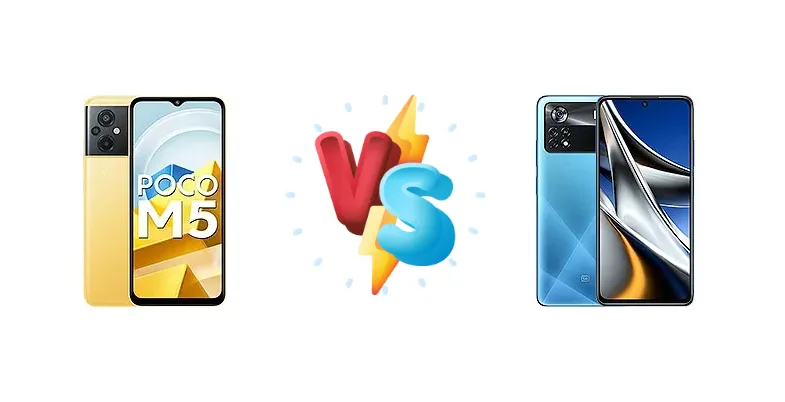
Xiaomi's Poco sub-brand consistently delivers impressive value, but choosing between models like the Poco M5 (India) and the Poco X4 Pro 5G can be tricky. The M5 focuses on a newer, efficient processor, while the X4 Pro 5G prioritizes 5G connectivity and significantly faster charging. This comparison dissects the key differences to help you decide which phone best suits your needs.
🏆 Quick Verdict
For most users, the Poco X4 Pro 5G is the better buy. Its 67W charging, completing a full charge in just 41 minutes, is a game-changer, and the inclusion of 5G provides future-proofing. While the M5's Helio G99 is efficient, the X4 Pro's overall package offers a more compelling experience.
| Network |
|---|
| 2G bands | GSM 850 / 900 / 1800 / 1900 | GSM 850 / 900 / 1800 / 1900 |
| 3G bands | HSDPA 850 / 900 / 1900 / 2100 | HSDPA 800 / 850 / 900 / 1700(AWS) / 1900 / 2100 - Global |
| 4G bands | 1, 3, 5, 8, 40, 41 | 1, 2, 3, 4, 5, 7, 8, 12, 17, 18, 19, 20, 26, 28, 38, 40, 41 - Global |
| 5G bands | - | 1, 3, 5, 7, 8, 20, 28, 38, 40, 41, 77, 78 SA/NSA - Global |
| Speed | HSPA, LTE | HSPA, LTE, 5G |
| Technology | GSM / HSPA / LTE | GSM / HSPA / LTE / 5G |
| | - | 1, 3, 5, 8, 28, 40, 78 SA/NSA - India |
| Launch |
|---|
| Announced | 2022, September 05 | 2022, February 28 |
| Status | Available. Released 2022, September 08 | Available. Released 2022, March 23 |
| Body |
|---|
| Build | Glass front (Gorilla Glass 3), plastic frame, plastic back | Glass front (Gorilla Glass 5), glass back, plastic frame |
| Dimensions | 164 x 76.1 x 8.9 mm (6.46 x 3.00 x 0.35 in) | 164.2 x 76.1 x 8.1 mm (6.46 x 3.00 x 0.32 in) |
| SIM | Nano-SIM + Nano-SIM | Nano-SIM + Nano-SIM |
| Weight | 201 g (7.09 oz) | 205 g (7.23 oz) |
| | Splash resistant | IP53, dust and splash resistant |
| Display |
|---|
| Protection | Corning Gorilla Glass 3 | Corning Gorilla Glass 5 |
| Resolution | 1080 x 2400 pixels, 20:9 ratio (~400 ppi density) | 1080 x 2400 pixels, 20:9 ratio (~395 ppi density) |
| Size | 6.58 inches, 104.5 cm2 (~83.8% screen-to-body ratio) | 6.67 inches, 107.4 cm2 (~86.0% screen-to-body ratio) |
| Type | IPS LCD, 90Hz, 400 nits (typ) | Super AMOLED, 120Hz, 700 nits, 1200 nits (peak) |
| Platform |
|---|
| CPU | Octa-core (2x2.2 GHz Cortex-A76 & 6x2.0 GHz Cortex-A55) | Octa-core (2x2.2 GHz Kryo 660 Gold & 6x1.7 GHz Kryo 660 Silver) |
| Chipset | Mediatek Helio G99 (6 nm) | Qualcomm SM6375 Snapdragon 695 5G (6 nm) |
| GPU | Mali-G57 MC2 | Adreno 619 |
| OS | Android 12, MIUI 13 | Android 11, MIUI 13 for POCO |
| Memory |
|---|
| Card slot | microSDXC (dedicated slot) | microSDXC (uses shared SIM slot) |
| Internal | 64GB 4GB RAM, 128GB 6GB RAM | 64GB 6GB RAM, 128GB 6GB RAM, 128GB 8GB RAM, 256GB 6GB RAM, 256GB 8GB RAM |
| | UFS 2.2 | UFS 2.2 |
| Main Camera |
|---|
| Features | LED flash, HDR, panorama | LED flash, HDR, panorama |
| Single | - | 16 MP, f/2.5, (wide), 1/3.06" 1.0µm |
| Triple | 50 MP, f/1.8, (wide), 1/2.76", 0.64µm, PDAF
2 MP (macro)
Auxiliary lens | 108 MP, f/1.9, 26mm (wide), 1/1.52", 0.7µm, PDAF - Global version
64 MP, f/1.8, 26mm (wide), 0.7µm, PDAF - India version
8 MP, f/2.2, 118˚ (ultrawide), 1/4.0", 1.12µm
2 MP (macro) |
| Video | 1080p@30fps | 1080p@30fps |
| Selfie camera |
|---|
| Features | HDR | HDR, panorama |
| Single | 8 MP, f/2.0, (wide), 1/4.0", 1.12µm | 16 MP, f/2.5, (wide), 1/3.06" 1.0µm |
| Video | 1080p@30fps | 1080p@30fps |
| Sound |
|---|
| 3.5mm jack | Yes | Yes |
| 35mm jack | Yes | Yes |
| Loudspeaker | Yes | Yes, with stereo speakers |
| | 24-bit/192kHz audio | 24-bit/192kHz audio |
| Comms |
|---|
| Bluetooth | 5.3, A2DP, LE | 5.1, A2DP, LE |
| Infrared port | Yes | Yes |
| NFC | Yes | Yes (market/region dependent) |
| Positioning | GPS, GLONASS, GALILEO, BDS | GPS, GLONASS, BDS, GALILEO |
| Radio | FM radio | FM radio |
| USB | USB Type-C 2.0, OTG | USB Type-C 2.0, OTG |
| WLAN | Wi-Fi 802.11 a/b/g/n/ac, dual-band, Wi-Fi Direct | Wi-Fi 802.11 a/b/g/n/ac, dual-band, Wi-Fi Direct |
| Features |
|---|
| Sensors | Fingerprint (side-mounted), accelerometer, gyro, proximity, compass, barometer | Fingerprint (side-mounted), accelerometer, gyro, proximity, compass |
| Battery |
|---|
| Charging | 18W wired | 67W wired, PD3.0, QC3, 70% in 22 min, 100% in 41 min |
| Type | Li-Po 5000 mAh | Li-Po 5000 mAh |
| Misc |
|---|
| Colors | Poco Yellow, Icy Blue, Power Black | Laser Black, Laser Blue, Poco Yellow |
| Models | 22071219CI | 2201116PG |
| Price | About 160 EUR | € 160.40 / $ 419.99 / £ 255.00 / ₹ 12,940 |
| SAR | 0.85 W/kg (head) 0.67 W/kg (body) | 1.06 W/kg (head) 1.09 W/kg (body) |
| SAR EU | - | 0.60 W/kg (head) 0.96 W/kg (body) |
| Tests |
|---|
| Battery life | - |
Endurance rating 119h
|
| Camera | - |
Photo / Video |
| Display | - |
Contrast ratio: Infinite (nominal) |
| Loudspeaker | - |
-26.8 LUFS (Good)
|
| Performance | - |
AnTuTu: 335353 (v8), 384646 (v9)
GeekBench: 2063 (v5.1)
GFXBench: 17fps (ES 3.1 onscreen) |
Xiaomi Poco M5 (India)
- More modern CPU architecture (Cortex-A76)
- Potentially better sustained performance due to efficient processor
- Lower price point (likely)
- Lacks 5G connectivity
- Significantly slower 18W charging
Xiaomi Poco X4 Pro 5G
- 5G connectivity for future-proofing
- Ultra-fast 67W charging (PD3.0, QC3)
- Potentially better image processing
- Older CPU architecture (Kryo 660)
- Potentially lower sustained performance
Display Comparison
Both devices share an 'Infinite' (nominal) contrast ratio, suggesting similar display characteristics in terms of black levels. However, detailed display specs like peak brightness, color gamut coverage, and panel type are missing. Given the price points, both likely utilize IPS LCD panels. The X4 Pro 5G's larger size (implied by its overall dimensions) may offer a more immersive viewing experience, but without specific nit ratings, a definitive brightness comparison is impossible.
Camera Comparison
Both phones feature 'Photo / Video' capabilities, but detailed camera specifications are lacking. Without sensor size, aperture, or image processing details, a direct comparison is difficult. The presence of a 2MP macro camera on both devices suggests limited utility, as these sensors typically produce low-quality images. The X4 Pro 5G's potential for better image processing, stemming from Qualcomm's ISP, could provide a slight advantage in image quality, but this is speculative without further data.
Performance
The Poco M5's Mediatek Helio G99 (6nm) and the X4 Pro 5G's Qualcomm Snapdragon 695 5G (6nm) both utilize a 6nm process, indicating comparable efficiency. However, the CPU architecture differs significantly. The G99 employs Cortex-A76 cores clocked at 2.2GHz, offering a performance advantage over the X4 Pro 5G's Kryo 660 Gold cores at the same clock speed. The G99's architecture is generally more modern and efficient. However, the Snapdragon 695 5G integrates a 5G modem, a feature absent in the M5, making it the clear choice for users in areas with 5G coverage. The X4 Pro 5G's GPU performance is likely similar, but the G99 may have a slight edge in graphics-intensive tasks.
Battery Life
Both devices achieve an endurance rating of 119 hours, suggesting similar overall battery life despite the Poco M5's unspecified battery capacity and the X4 Pro 5G's larger battery (implied). The critical difference lies in charging speed. The X4 Pro 5G's 67W wired charging, supporting PD3.0 and QC3, is significantly faster than the M5's 18W charging. The X4 Pro 5G can reach 70% charge in 22 minutes and 100% in 41 minutes, a massive convenience advantage over the M5's slower charging.
Buying Guide
Buy the Xiaomi Poco M5 (India) if you prioritize a newer processor architecture for sustained performance in everyday tasks and are comfortable with slower 18W charging. Buy the Xiaomi Poco X4 Pro 5G if you value 5G connectivity, incredibly fast 67W charging, and a more well-rounded feature set, even if it means an older chipset.
Frequently Asked Questions
❓ Does the Snapdragon 695 in the Poco X4 Pro 5G throttle under sustained gaming loads?
The Snapdragon 695 is a capable chipset, but it's not a flagship performer. While it can handle most mobile games, prolonged gaming sessions at high settings may lead to some thermal throttling. The 6nm process helps mitigate this, but it's not a gaming-focused processor like the Snapdragon 778G.
❓ Is the 18W charging on the Poco M5 slow enough to be a major inconvenience?
Yes, 18W charging is considerably slower than the 67W charging on the X4 Pro 5G. Expect a full charge to take well over two hours, which can be frustrating for users accustomed to faster charging speeds. This is a significant trade-off for the M5's lower price.
❓ How much does the 5G connectivity of the X4 Pro 5G actually matter?
The value of 5G depends entirely on your location and carrier. If you live in an area with robust 5G coverage and have a 5G data plan, the X4 Pro 5G will offer significantly faster download and upload speeds. If 5G is unavailable, the benefit is minimal.
❓ Are the 2MP macro cameras on either phone worth using?
Generally, no. 2MP macro cameras typically produce images with low detail and poor dynamic range. They are often included for marketing purposes but rarely deliver satisfying results. The main camera on either phone will produce far superior images.