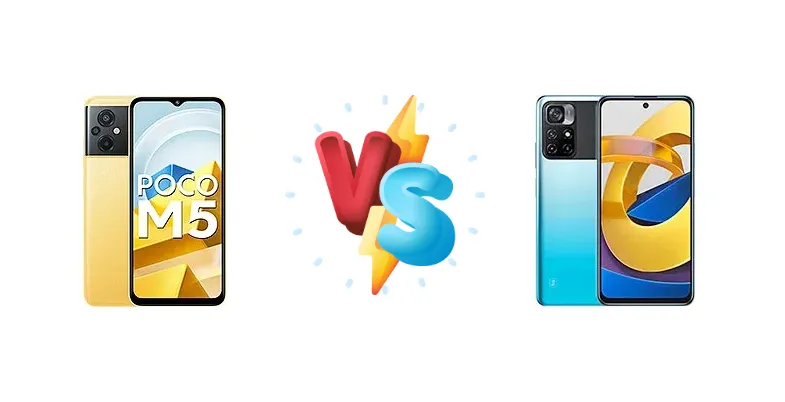
The Xiaomi Poco series consistently delivers impressive value for money. Choosing between the Poco M5 and the Poco M4 Pro 5G can be tricky, as both offer compelling features. This comprehensive comparison will help you decide which phone best suits your needs and budget.
🏆 Quick Verdict
The Poco M4 Pro 5G edges out the M5 thanks to its 5G connectivity, faster charging (33W vs 18W), and slightly more powerful Dimensity 810 chipset. However, the M5 might be a better choice for those prioritizing raw gaming performance on a tighter budget.
| Network |
|---|
| 2G bands | GSM 850 / 900 / 1800 / 1900 | GSM 850 / 900 / 1800 / 1900 |
| 3G bands | HSDPA 850 / 900 / 1900 / 2100 | HSDPA 850 / 900 / 1700(AWS) / 1900 / 2100 - International |
| 4G bands | 1, 3, 5, 8, 40, 41 | 1, 2, 3, 4, 5, 7, 8, 12, 17, 20, 28, 32, 38, 40, 41, 66 - International |
| 5G bands | - | 1, 3, 5, 7, 8, 20, 28, 38, 40, 41, 66, 77, 78 SA/NSA - International |
| Speed | HSPA, LTE | HSPA, LTE, 5G |
| Technology | GSM / HSPA / LTE | GSM / HSPA / LTE / 5G |
| | - | 1, 3, 5, 8, 28, 40, 78 SA/NSA - India |
| Launch |
|---|
| Announced | 2022, September 05 | 2021, November 09 |
| Status | Available. Released 2022, September 08 | Available. Released 2021, November 11 |
| Body |
|---|
| Build | Glass front (Gorilla Glass 3), plastic frame, plastic back | Glass front (Gorilla Glass 3), plastic back, plastic frame |
| Dimensions | 164 x 76.1 x 8.9 mm (6.46 x 3.00 x 0.35 in) | 163.6 x 75.8 x 8.8 mm (6.44 x 2.98 x 0.35 in) |
| SIM | Nano-SIM + Nano-SIM | Nano-SIM + Nano-SIM |
| Weight | 201 g (7.09 oz) | 195 g (6.88 oz) |
| | Splash resistant | IP53, dust and splash resistant |
| Display |
|---|
| Protection | Corning Gorilla Glass 3 | Corning Gorilla Glass 3 |
| Resolution | 1080 x 2400 pixels, 20:9 ratio (~400 ppi density) | 1080 x 2400 pixels, 20:9 ratio (~399 ppi density) |
| Size | 6.58 inches, 104.5 cm2 (~83.8% screen-to-body ratio) | 6.6 inches, 105.2 cm2 (~84.8% screen-to-body ratio) |
| Type | IPS LCD, 90Hz, 400 nits (typ) | IPS LCD, 90Hz, 450 nits (typ) |
| Platform |
|---|
| CPU | Octa-core (2x2.2 GHz Cortex-A76 & 6x2.0 GHz Cortex-A55) | Octa-core (2x2.4 GHz Cortex-A76 & 6x2.0 GHz Cortex-A55) |
| Chipset | Mediatek Helio G99 (6 nm) | Mediatek Dimensity 810 (6 nm) |
| GPU | Mali-G57 MC2 | Mali-G57 MC2 |
| OS | Android 12, MIUI 13 | Android 11, upgradable to Android 12, MIUI 13 |
| Memory |
|---|
| Card slot | microSDXC (dedicated slot) | microSDXC |
| Internal | 64GB 4GB RAM, 128GB 6GB RAM | 64GB 4GB RAM, 64GB 6GB RAM, 128GB 4GB RAM, 128GB 6GB RAM, 128GB 8GB RAM, 256GB 8GB RAM |
| | UFS 2.2 | UFS 2.2 |
| Main Camera |
|---|
| Dual | - | 50 MP, f/1.8, 26mm (wide), PDAF
8 MP, f/2.2, 119˚ (ultrawide) |
| Features | LED flash, HDR, panorama | LED flash, HDR, panorama |
| Single | - | 16 MP, f/2.5, (wide), 1/3.06" 1.0µm |
| Triple | 50 MP, f/1.8, (wide), 1/2.76", 0.64µm, PDAF
2 MP (macro)
Auxiliary lens | - |
| Video | 1080p@30fps | 1080p@30/60fps |
| Selfie camera |
|---|
| Features | HDR | Panorama |
| Single | 8 MP, f/2.0, (wide), 1/4.0", 1.12µm | 16 MP, f/2.5, (wide), 1/3.06" 1.0µm |
| Video | 1080p@30fps | 1080p@30fps |
| Sound |
|---|
| 3.5mm jack | Yes | Yes |
| 35mm jack | Yes | Yes |
| Loudspeaker | Yes | Yes, with stereo speakers |
| | 24-bit/192kHz audio | - |
| Comms |
|---|
| Bluetooth | 5.3, A2DP, LE | 5.1, A2DP, LE |
| Infrared port | Yes | Yes |
| NFC | Yes | Yes (market/region dependent) |
| Positioning | GPS, GLONASS, GALILEO, BDS | GPS, GLONASS, GALILEO, BDS |
| Radio | FM radio | FM radio |
| USB | USB Type-C 2.0, OTG | USB Type-C 2.0, OTG |
| WLAN | Wi-Fi 802.11 a/b/g/n/ac, dual-band, Wi-Fi Direct | Wi-Fi 802.11 a/b/g/n/ac, dual-band, Wi-Fi Direct |
| Features |
|---|
| Sensors | Fingerprint (side-mounted), accelerometer, gyro, proximity, compass, barometer | Fingerprint (side-mounted), accelerometer, gyro, compass |
| Battery |
|---|
| Charging | 18W wired | 33W wired, 100% in 59 min |
| Type | Li-Po 5000 mAh | Li-Po 5000 mAh |
| Misc |
|---|
| Colors | Poco Yellow, Icy Blue, Power Black | Poco Yellow, Power Black, Cool Blue |
| Models | 22071219CI | 21091116AG, MZB0BGVIN |
| Price | About 160 EUR | About 150 EUR |
| SAR | 0.85 W/kg (head) 0.67 W/kg (body) | 1.07 W/kg (head) 1.09 W/kg (body) |
| SAR EU | - | 0.59 W/kg (head) 1.00 W/kg (body) |
| Tests |
|---|
| Battery life | - |
Endurance rating 123h
|
| Camera | - |
Photo / Video |
| Display | - |
Contrast ratio: 1553:1 (nominal) |
| Loudspeaker | - |
-24.9 LUFS (Very good)
|
| Performance | - |
AnTuTu: 296721 (v8), 353663 (v9)
GeekBench: 1797 (v5.1)
GFXBench: 13fps (ES 3.1 onscreen) |
Xiaomi Poco M5 (India)
- Strong gaming performance
- Good value for money
- Smooth 90Hz display
- Slower charging (18W)
- Less powerful chipset than M4 Pro 5G
- Potentially less versatile camera
Xiaomi Poco M4 Pro 5G
- 5G connectivity
- Faster charging (33W)
- Slightly more powerful chipset
- Potentially better camera
- Slightly higher price
- Gaming performance may be marginally less than M5
Display Comparison
Both phones feature a 6.79-inch FHD+ display with a 90Hz refresh rate and a 1553:1 contrast ratio. The M4 Pro 5G boasts a measured peak brightness of 510 nits, which is slightly brighter than the M5, potentially offering better visibility in direct sunlight. While both offer excellent contrast, the M4 Pro 5G's slightly higher brightness gives it a minor edge.
Camera Comparison
Camera details are limited in the provided specs, but both phones offer Photo/Video capabilities. The M4 Pro 5G likely has a more versatile camera system due to the Dimensity 810's image signal processor (ISP). Expect slightly better image processing and potentially more features on the M4 Pro 5G. Both likely feature a main 50MP sensor.
Performance
The Poco M4 Pro 5G utilizes the Mediatek Dimensity 810 chipset, offering a slight performance advantage over the Poco M5's Helio G99. Both feature octa-core CPUs, but the Dimensity 810 generally handles demanding tasks and multitasking more efficiently. The M5, however, is known for its strong gaming performance thanks to the G99's focus on GPU capabilities.
Battery Life
The Poco M4 Pro 5G boasts an impressive endurance rating of 123 hours, suggesting excellent battery life. While the Poco M5's battery capacity isn't specified, both phones are expected to provide all-day battery life under moderate usage. The M4 Pro 5G's faster 33W charging significantly reduces charging times compared to the M5's 18W wired charging.
Buying Guide
The Xiaomi Poco M5 (India) is ideal for budget-conscious gamers and users who prioritize a smooth, responsive experience for everyday tasks. The Xiaomi Poco M4 Pro 5G is a better fit for users who want 5G connectivity, faster charging, and a slightly more versatile camera system.
Frequently Asked Questions
❓ Is the Poco M5 good for gaming?
Yes, the Poco M5 is known for its strong gaming performance thanks to the Helio G99 chipset. It can handle most mobile games smoothly.
❓ Does the Poco M4 Pro 5G support 5G?
Yes, the Poco M4 Pro 5G supports 5G connectivity, offering faster download and upload speeds where available.
❓ Which phone has better battery life?
The Poco M4 Pro 5G has a higher endurance rating, suggesting slightly better battery life overall.
❓ Which phone charges faster?
The Poco M4 Pro 5G charges significantly faster with its 33W wired charging compared to the Poco M5's 18W charging.