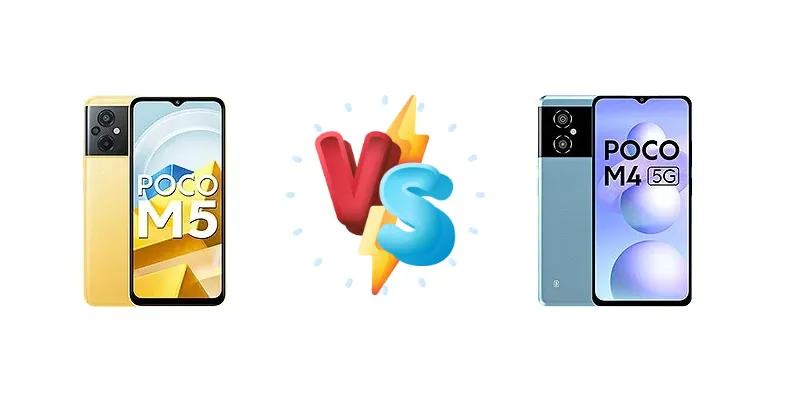
Xiaomi's Poco series consistently delivers impressive value in the budget smartphone market. The Poco M5 and Poco M4 5G are two contenders vying for your attention. But which one offers the best bang for your buck? Let's dive into a comprehensive comparison.
🏆 Quick Verdict
The Poco M5 edges out the M4 5G thanks to its slightly superior chipset and potentially better camera performance. However, the M4 5G's 5G connectivity is a significant advantage for those needing faster data speeds. It's a close call, depending on your priorities.
| Network |
|---|
| 2G bands | GSM 850 / 900 / 1800 / 1900 | GSM 850 / 900 / 1800 / 1900 |
| 3G bands | HSDPA 850 / 900 / 1900 / 2100 | HSDPA 850 / 900 / 1900 / 2100 |
| 4G bands | 1, 3, 5, 8, 40, 41 | 1, 3, 5, 8, 40, 41 |
| 5G bands | - | 1, 3, 5, 8, 28, 40, 78 SA/NSA |
| Speed | HSPA, LTE | HSPA, LTE, 5G |
| Technology | GSM / HSPA / LTE | GSM / HSPA / LTE / 5G |
| Launch |
|---|
| Announced | 2022, September 05 | 2022, April 29 |
| Status | Available. Released 2022, September 08 | Available. Released 2022, May 05 |
| Body |
|---|
| Build | Glass front (Gorilla Glass 3), plastic frame, plastic back | Glass front (Gorilla Glass 3), plastic frame, plastic back |
| Dimensions | 164 x 76.1 x 8.9 mm (6.46 x 3.00 x 0.35 in) | 164 x 76.1 x 8.9 mm (6.46 x 3.00 x 0.35 in) |
| SIM | Nano-SIM + Nano-SIM | Nano-SIM + Nano-SIM |
| Weight | 201 g (7.09 oz) | 200 g (7.05 oz) |
| | Splash resistant | Splash resistant |
| Display |
|---|
| Protection | Corning Gorilla Glass 3 | Corning Gorilla Glass 3 |
| Resolution | 1080 x 2400 pixels, 20:9 ratio (~400 ppi density) | 1080 x 2400 pixels, 20:9 ratio (~401 ppi density) |
| Size | 6.58 inches, 104.5 cm2 (~83.8% screen-to-body ratio) | 6.58 inches, 104.0 cm2 (~83.3% screen-to-body ratio) |
| Type | IPS LCD, 90Hz, 400 nits (typ) | IPS LCD, 90Hz |
| Platform |
|---|
| CPU | Octa-core (2x2.2 GHz Cortex-A76 & 6x2.0 GHz Cortex-A55) | Octa-core (2x2.2 GHz Cortex-A76 & 6x2.0 GHz Cortex-A55) |
| Chipset | Mediatek Helio G99 (6 nm) | Mediatek Dimensity 700 (7 nm) |
| GPU | Mali-G57 MC2 | Mali-G57 MC2 |
| OS | Android 12, MIUI 13 | Android 12, MIUI 13 |
| Memory |
|---|
| Card slot | microSDXC (dedicated slot) | microSDXC (dedicated slot) |
| Internal | 64GB 4GB RAM, 128GB 6GB RAM | 64GB 4GB RAM, 128GB 6GB RAM |
| | UFS 2.2 | UFS 2.2 |
| Main Camera |
|---|
| Dual | - | 50 MP, f/1.8, (wide), 0.7µm, PDAF
Auxiliary lens |
| Features | LED flash, HDR, panorama | LED flash, HDR, panorama |
| Single | - | 8 MP, f/2.4, (wide), 1.0µm |
| Triple | 50 MP, f/1.8, (wide), 1/2.76", 0.64µm, PDAF
2 MP (macro)
Auxiliary lens | - |
| Video | 1080p@30fps | 1080p@30fps |
| Selfie camera |
|---|
| Features | HDR | HDR |
| Single | 8 MP, f/2.0, (wide), 1/4.0", 1.12µm | 8 MP, f/2.4, (wide), 1.0µm |
| Video | 1080p@30fps | 1080p@30fps |
| Sound |
|---|
| 3.5mm jack | Yes | Yes |
| 35mm jack | Yes | Yes |
| Loudspeaker | Yes | Yes |
| | 24-bit/192kHz audio | 24-bit/192kHz audio |
| Comms |
|---|
| Bluetooth | 5.3, A2DP, LE | 5.1, A2DP, LE |
| Infrared port | Yes | Yes |
| NFC | Yes | Yes (market/region dependent) |
| Positioning | GPS, GLONASS, GALILEO, BDS | GPS, GLONASS, BDS |
| Radio | FM radio | FM radio |
| USB | USB Type-C 2.0, OTG | USB Type-C 2.0, OTG |
| WLAN | Wi-Fi 802.11 a/b/g/n/ac, dual-band, Wi-Fi Direct | Wi-Fi 802.11 a/b/g/n/ac, dual-band, Wi-Fi Direct |
| Features |
|---|
| Sensors | Fingerprint (side-mounted), accelerometer, gyro, proximity, compass, barometer | Fingerprint (side-mounted), accelerometer, proximity, gyro, compass |
| Battery |
|---|
| Charging | 18W wired | 18W wired |
| Type | Li-Po 5000 mAh | Li-Po 5000 mAh |
| Misc |
|---|
| Colors | Poco Yellow, Icy Blue, Power Black | Gray, Silver, Blue |
| Models | 22071219CI | MZB0BRZIN, 22041219PI |
| Price | About 160 EUR | About 190 EUR |
| SAR | 0.85 W/kg (head) 0.67 W/kg (body) | 0.85 W/kg (head) 0.85 W/kg (body) |
| Tests |
|---|
| Loudspeaker | - |
-28.8 LUFS (Average)
|
Xiaomi Poco M5 (India)
- Slightly better performance (Helio G99)
- Potentially better camera image quality
- Good value for money
- Slow 18W charging
- Display brightness could be better
- No 5G connectivity
Xiaomi Poco M4 5G (India)
- 5G connectivity
- Slightly brighter display
- Good battery life
- Slightly less powerful chipset
- Potentially slightly worse camera performance
- Slow 18W charging
Display Comparison
The Poco M4 5G boasts a slightly brighter display at 410 nits (measured) compared to the Poco M5, though both offer similar resolution and panel technology (likely IPS LCD). The M4 5G's 1630:1 contrast ratio suggests slightly better blacks and image depth. Both displays are adequate for everyday use but don't expect flagship-level visuals.
Camera Comparison
Camera specs are generally similar, with both phones likely featuring a 50MP main sensor. However, the G99 chipset in the Poco M5 often has better image signal processing (ISP), potentially leading to slightly better image quality, especially in low light. Both phones likely include ultrawide and macro lenses.
Performance
The Poco M5 holds a slight advantage here. While both phones share the same CPU core configuration, the Mediatek Helio G99 (6nm) in the M5 is generally considered to offer better overall performance than the Dimensity 700 (7nm) in the M4 5G, particularly in gaming. Expect smoother gameplay and faster app loading times on the M5.
Battery Life
Both devices feature 5000mAh batteries and 18W wired charging. Expect similar battery life from both phones, easily lasting a full day with moderate usage. Charging speeds are relatively slow compared to modern standards.
Buying Guide
The Poco M5 is ideal for users prioritizing raw performance and a potentially better camera experience within a tight budget. The Poco M4 5G is the better choice for those who need 5G connectivity and appreciate a slightly brighter display, even if it means a small compromise in processing power.
Frequently Asked Questions
❓ Is the Poco M5 worth buying over the M4 5G?
It depends. If 5G isn't a priority, the M5's better performance makes it a stronger choice. If you need 5G, the M4 5G is the way to go.
❓ What is the difference in performance between the Helio G99 and Dimensity 700?
The Helio G99 generally offers better CPU and GPU performance, making it more suitable for gaming and demanding tasks. The Dimensity 700 excels in 5G connectivity.