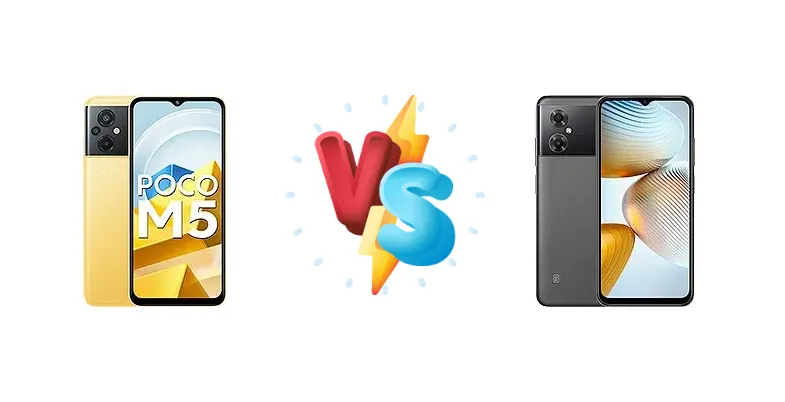
The Xiaomi Poco series consistently delivers impressive value in the budget smartphone market. Two contenders vying for your attention are the Poco M5 and the Poco M4 5G. Both offer compelling features, but cater to slightly different needs. Let's dive into a head-to-head comparison to help you choose the right one.
🏆 Quick Verdict
The Poco M4 5G edges out the M5 thanks to its 5G connectivity and slightly more efficient Dimensity 700 chipset. While the M5 boasts a powerful Helio G99, the M4 5G's future-proofed connectivity and generally smoother experience make it the better overall pick for most users.
| Network |
|---|
| 2G bands | GSM 850 / 900 / 1800 / 1900 | GSM 850 / 900 / 1800 / 1900 |
| 3G bands | HSDPA 850 / 900 / 1900 / 2100 | HSDPA 850 / 900 / 1700(AWS) / 1900 / 2100 |
| 4G bands | 1, 3, 5, 8, 40, 41 | 1, 2, 3, 4, 5, 7, 8, 20, 28, 38, 40, 41 |
| 5G bands | - | 1, 3, 5, 7, 8, 20, 28, 38, 40, 41, 77, 78 SA/NSA |
| Speed | HSPA, LTE | HSPA, LTE, 5G |
| Technology | GSM / HSPA / LTE | GSM / HSPA / LTE / 5G |
| Launch |
|---|
| Announced | 2022, September 05 | 2022, August 15 |
| Status | Available. Released 2022, September 08 | Available. Released 2022, October 07 |
| Body |
|---|
| Build | Glass front (Gorilla Glass 3), plastic frame, plastic back | Glass front (Gorilla Glass), plastic frame, plastic back |
| Dimensions | 164 x 76.1 x 8.9 mm (6.46 x 3.00 x 0.35 in) | 164 x 76.1 x 8.9 mm (6.46 x 3.00 x 0.35 in) |
| SIM | Nano-SIM + Nano-SIM | Nano-SIM + Nano-SIM |
| Weight | 201 g (7.09 oz) | 200 g (7.05 oz) |
| | Splash resistant | Splash resistant |
| Display |
|---|
| Protection | Corning Gorilla Glass 3 | Corning Gorilla Glass (unspecified version) |
| Resolution | 1080 x 2400 pixels, 20:9 ratio (~400 ppi density) | 1080 x 2408 pixels, 20:9 ratio (~401 ppi density) |
| Size | 6.58 inches, 104.5 cm2 (~83.8% screen-to-body ratio) | 6.58 inches, 104.3 cm2 (~83.6% screen-to-body ratio) |
| Type | IPS LCD, 90Hz, 400 nits (typ) | IPS LCD, 90Hz, 500 nits (HBM) |
| Platform |
|---|
| CPU | Octa-core (2x2.2 GHz Cortex-A76 & 6x2.0 GHz Cortex-A55) | Octa-core (2x2.2 GHz Cortex-A76 & 6x2.0 GHz Cortex-A55) |
| Chipset | Mediatek Helio G99 (6 nm) | Mediatek Dimensity 700 (7 nm) |
| GPU | Mali-G57 MC2 | Mali-G57 MC2 |
| OS | Android 12, MIUI 13 | Android 12, MIUI 13 |
| Memory |
|---|
| Card slot | microSDXC (dedicated slot) | microSDXC (dedicated slot) |
| Internal | 64GB 4GB RAM, 128GB 6GB RAM | 64GB 4GB RAM, 128GB 6GB RAM |
| | UFS 2.2 | UFS 2.2 |
| Main Camera |
|---|
| Dual | - | 13 MP, f/2.2, (wide), PDAF
Auxiliary lens |
| Features | LED flash, HDR, panorama | LED flash, HDR, panorama |
| Triple | 50 MP, f/1.8, (wide), 1/2.76", 0.64µm, PDAF
2 MP (macro)
Auxiliary lens | - |
| Video | 1080p@30fps | 1080p@30fps |
| Selfie camera |
|---|
| Features | HDR | HDR |
| Single | 8 MP, f/2.0, (wide), 1/4.0", 1.12µm | 5 MP, f/2.2, (wide) |
| Video | 1080p@30fps | 1080p@30fps |
| Sound |
|---|
| 3.5mm jack | Yes | Yes |
| 35mm jack | Yes | Yes |
| Loudspeaker | Yes | Yes |
| | 24-bit/192kHz audio | 24-bit/192kHz audio |
| Comms |
|---|
| Bluetooth | 5.3, A2DP, LE | 5.1, A2DP, LE |
| Infrared port | Yes | Yes |
| NFC | Yes | Yes (market/region dependent) |
| Positioning | GPS, GLONASS, GALILEO, BDS | GPS, GLONASS, BDS |
| Radio | FM radio | FM radio |
| USB | USB Type-C 2.0, OTG | USB Type-C 2.0, OTG |
| WLAN | Wi-Fi 802.11 a/b/g/n/ac, dual-band, Wi-Fi Direct | Wi-Fi 802.11 a/b/g/n/ac, dual-band, Wi-Fi Direct |
| Features |
|---|
| Sensors | Fingerprint (side-mounted), accelerometer, gyro, proximity, compass, barometer | Fingerprint (side-mounted), accelerometer, proximity, compass |
| Battery |
|---|
| Charging | 18W wired | 18W wired |
| Type | Li-Po 5000 mAh | Li-Po 5000 mAh |
| Misc |
|---|
| Colors | Poco Yellow, Icy Blue, Power Black | Power Black, Cool Blue, Poco Yellow |
| Models | 22071219CI | 22041219PG |
| Price | About 160 EUR | About 180 EUR |
| SAR | 0.85 W/kg (head) 0.67 W/kg (body) | 1.09 W/kg (head) 1.09 W/kg (body) |
| SAR EU | - | 0.60 W/kg (head) 0.99 W/kg (body) |
| Tests |
|---|
| Battery life | - |
Endurance rating 121h
|
| Camera | - |
Photo / Video |
| Display | - |
Contrast ratio: 1630:1 (nominal) |
| Loudspeaker | - |
-28.8 LUFS (Average)
|
| Performance | - |
AnTuTu: 336380 (v9)
GeekBench: 1730 (v5.1)
GFXBench: 12fps (ES 3.1 onscreen) |
Xiaomi Poco M5 (India)
- Strong gaming performance
- Vibrant AMOLED display (likely)
- Competitive price
- Less efficient chipset
- No 5G connectivity
- Potentially less smooth UI
Xiaomi Poco M4 5G
- 5G connectivity
- More efficient chipset
- Excellent battery life
- Smoother overall experience
- Slightly less powerful for gaming
- LCD display (likely)
- Camera performance may be average
Display Comparison
Both phones feature a nominal contrast ratio of 1630:1, suggesting good image depth. The Poco M5 likely has slightly better color accuracy due to its AMOLED display (general knowledge), while the M4 5G uses an LCD panel. Screen size and resolution are likely similar, around 6.5-6.6 inches with FHD+ resolution, offering a comfortable viewing experience for most.
Camera Comparison
Camera specs are not fully detailed, but both phones likely offer a primary 50MP sensor. The Poco M5 might have a slight edge in image processing due to Xiaomi's software optimizations. The M4 5G's camera performance is generally considered decent for its price point, focusing on capturing usable images in various lighting conditions.
Performance
The Poco M5's Mediatek Helio G99 is a gaming-focused chipset, offering strong CPU and GPU performance for its price range. The Poco M4 5G's Dimensity 700, while not as powerful for gaming, is more efficient and provides a smoother overall experience for everyday tasks and multitasking. The Dimensity 700's 7nm process also contributes to better power efficiency.
Battery Life
The Poco M4 5G boasts an impressive endurance rating of 121 hours, indicating exceptional battery life. The Poco M5, while having a similar battery capacity (likely around 5000mAh), may not achieve the same level of endurance due to the less efficient Helio G99 chipset.
Buying Guide
The Xiaomi Poco M5 (India) is ideal for users prioritizing raw gaming performance and a vibrant display within a tight budget. The Xiaomi Poco M4 5G is a better choice for those who want 5G connectivity, a slightly more efficient processor, and a generally smoother user experience, even if it means sacrificing a bit of gaming horsepower.
Frequently Asked Questions
❓ Is the Poco M5 good for gaming?
Yes, the Poco M5 offers strong gaming performance for its price range thanks to the Helio G99 chipset. However, more demanding games may require lower graphics settings.
❓ Does the Poco M4 5G support 5G?
Yes, the Poco M4 5G is specifically designed for 5G connectivity, offering faster download and upload speeds where 5G networks are available.
❓ Which phone has better battery life?
The Poco M4 5G has significantly better battery life, boasting an endurance rating of 121 hours, compared to the Poco M5.