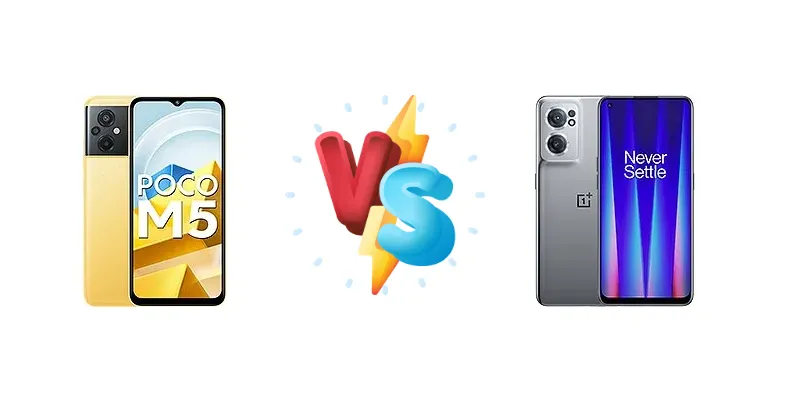
The sub-$200 (USD equivalent) 5G smartphone market is fiercely competitive. The Xiaomi Poco M5 (India variant) and OnePlus Nord CE 2 5G represent compelling options, but cater to slightly different priorities. The Poco M5 emphasizes efficiency with its Helio G99, while the Nord CE 2 5G prioritizes raw processing power with the Dimensity 900 and a significantly faster charging solution. This comparison dissects these trade-offs to determine the best fit for your needs.
🏆 Quick Verdict
For the average user prioritizing rapid charging and a slight performance edge in demanding tasks, the OnePlus Nord CE 2 5G is the better choice. Its 65W charging dramatically reduces downtime. However, the Poco M5’s Helio G99 offers excellent efficiency, potentially leading to longer battery life for everyday use, making it a strong contender for budget-conscious users.
| Network |
|---|
| 2G bands | GSM 850 / 900 / 1800 / 1900 | GSM 850 / 900 / 1800 / 1900 |
| 3G bands | HSDPA 850 / 900 / 1900 / 2100 | HSDPA 850 / 900 / 1700(AWS) / 1900 / 2100 |
| 4G bands | 1, 3, 5, 8, 40, 41 | 1, 2, 3, 4, 5, 7, 8, 12, 17, 18, 19, 20, 26, 28, 38, 39, 40, 41, 66 - Europe |
| 5G bands | - | 1, 3, 5, 7, 8, 20, 28, 38, 40, 41, 66, 77, 78 SA/NSA - Europe |
| Speed | HSPA, LTE | HSPA 42.2/5.76 Mbps, LTE Cat18 1200/150 Mbps, 5G |
| Technology | GSM / HSPA / LTE | GSM / HSPA / LTE / 5G |
| | - | 1, 3, 5, 8, 40, 41, 77, 78 SA/NSA - India |
| Launch |
|---|
| Announced | 2022, September 05 | 2022, February 17 |
| Status | Available. Released 2022, September 08 | Available. Released 2022, February 22 |
| Body |
|---|
| Build | Glass front (Gorilla Glass 3), plastic frame, plastic back | - |
| Dimensions | 164 x 76.1 x 8.9 mm (6.46 x 3.00 x 0.35 in) | 160.6 x 73.2 x 7.8 mm (6.32 x 2.88 x 0.31 in) |
| SIM | Nano-SIM + Nano-SIM | Nano-SIM + Nano-SIM |
| Weight | 201 g (7.09 oz) | 173 g (6.10 oz) |
| | Splash resistant | - |
| Display |
|---|
| Protection | Corning Gorilla Glass 3 | Corning Gorilla Glass 5 |
| Resolution | 1080 x 2400 pixels, 20:9 ratio (~400 ppi density) | 1080 x 2400 pixels, 20:9 ratio (~409 ppi density) |
| Size | 6.58 inches, 104.5 cm2 (~83.8% screen-to-body ratio) | 6.43 inches, 99.8 cm2 (~84.9% screen-to-body ratio) |
| Type | IPS LCD, 90Hz, 400 nits (typ) | AMOLED, 90Hz, HDR10+ |
| Platform |
|---|
| CPU | Octa-core (2x2.2 GHz Cortex-A76 & 6x2.0 GHz Cortex-A55) | Octa-core (2x2.4 GHz Cortex-A78 & 6x2.0 GHz Cortex-A55) |
| Chipset | Mediatek Helio G99 (6 nm) | Mediatek Dimensity 900 (6 nm) |
| GPU | Mali-G57 MC2 | Mali-G68 MC4 |
| OS | Android 12, MIUI 13 | Android 11, upgradable to Android 13, OxygenOS 13 |
| Memory |
|---|
| Card slot | microSDXC (dedicated slot) | microSDXC (dedicated slot) |
| Internal | 64GB 4GB RAM, 128GB 6GB RAM | 128GB 6GB RAM, 128GB 8GB RAM |
| | UFS 2.2 | UFS 2.2 |
| Main Camera |
|---|
| Features | LED flash, HDR, panorama | LED flash, HDR, panorama |
| Single | - | 16 MP, f/2.4, 27mm (wide), 1.0µm |
| Triple | 50 MP, f/1.8, (wide), 1/2.76", 0.64µm, PDAF
2 MP (macro)
Auxiliary lens | 64 MP, f/1.8, 26mm (wide), 1/1.97", 0.7µm, PDAF
8 MP, f/2.2, 119˚ (ultrawide)
2 MP (macro) |
| Video | 1080p@30fps | 4K@30fps, 1080p@30/60/120fps, gyro-EIS |
| Selfie camera |
|---|
| Features | HDR | HDR |
| Single | 8 MP, f/2.0, (wide), 1/4.0", 1.12µm | 16 MP, f/2.4, 27mm (wide), 1.0µm |
| Video | 1080p@30fps | 1080p@30/60fps, gyro-EIS |
| Sound |
|---|
| 3.5mm jack | Yes | Yes |
| 35mm jack | Yes | Yes |
| Loudspeaker | Yes | Yes |
| | 24-bit/192kHz audio | - |
| Comms |
|---|
| Bluetooth | 5.3, A2DP, LE | 5.2, A2DP, LE, aptX HD |
| Infrared port | Yes | - |
| NFC | Yes | Yes |
| Positioning | GPS, GLONASS, GALILEO, BDS | GPS, GLONASS, GALILEO, BDS, QZSS |
| Radio | FM radio | Unspecified |
| USB | USB Type-C 2.0, OTG | USB Type-C 2.0, OTG |
| WLAN | Wi-Fi 802.11 a/b/g/n/ac, dual-band, Wi-Fi Direct | Wi-Fi 802.11 a/b/g/n/ac/6, dual-band, Wi-Fi Direct |
| Features |
|---|
| Sensors | Fingerprint (side-mounted), accelerometer, gyro, proximity, compass, barometer | Fingerprint (under display, optical), accelerometer, gyro, proximity, compass |
| Battery |
|---|
| Charging | 18W wired | 65W wired |
| Type | Li-Po 5000 mAh | Li-Po 4500 mAh |
| Misc |
|---|
| Colors | Poco Yellow, Icy Blue, Power Black | Gray Mirror, Bahama Blue |
| Models | 22071219CI | IV2201 |
| Price | About 160 EUR | £ 99.00 / € 182.18 |
| SAR | 0.85 W/kg (head) 0.67 W/kg (body) | - |
Xiaomi Poco M5 (India)
- Excellent power efficiency with the Helio G99.
- Potentially longer battery life for everyday use.
- More affordable price point.
- Slower charging speed (18W).
- Less powerful CPU for demanding tasks.
OnePlus Nord CE 2 5G
- Faster CPU performance with the Dimensity 900.
- Ultra-fast 65W charging.
- Potentially better image processing.
- Less power-efficient chipset.
- Higher price compared to the Poco M5.
Display Comparison
Neither device boasts a standout display. Both utilize 6nm chipsets, suggesting similar power draw and therefore similar display capabilities. While specific display specs (resolution, panel type) are missing, the focus here is on performance. The absence of high refresh rates on either device suggests a cost-saving measure, prioritizing battery life over visual fluidity. Bezels are likely comparable given the price bracket, and color accuracy will likely be tuned for vibrant, rather than color-accurate, visuals.
Camera Comparison
Without detailed camera specs, analysis is limited. Both phones likely feature a primary camera and multiple supporting lenses (often including a 2MP macro). The image processing style will differ – Xiaomi typically leans towards vibrant, saturated colors, while OnePlus aims for a more natural look. The Dimensity 900’s ISP (Image Signal Processor) is generally more capable than the Helio G99’s, potentially leading to better dynamic range and noise reduction in challenging lighting conditions. The absence of OIS (Optical Image Stabilization) on either device suggests reliance on software stabilization, which can introduce artifacts. The main sensor size will be the key differentiator, but without that data, it's difficult to declare a clear winner.
Performance
The core difference lies in the chipsets. The OnePlus Nord CE 2 5G’s Mediatek Dimensity 900, with its 2x2.4 GHz Cortex-A78 cores, offers a clear advantage in peak CPU performance compared to the Poco M5’s Helio G99 (2x2.2 GHz Cortex-A76). The A78 cores are architecturally superior, delivering more instructions per clock cycle. However, the G99’s 6nm process and efficient Cortex-A55 cores could translate to better sustained performance under load, minimizing thermal throttling. The G99 is designed for gaming, but the Dimensity 900’s overall processing power will likely result in smoother multitasking and faster app loading times. RAM configurations are crucial here; equal RAM would minimize the performance gap, but any difference would favor the Nord CE 2 5G.
Battery Life
The Poco M5’s Helio G99 chipset is inherently more power-efficient than the Dimensity 900. This efficiency, combined with potentially optimized software, could result in longer battery life during typical usage. However, the Nord CE 2 5G’s 65W charging is a game-changer. A full charge from 0-100% will take significantly less time (likely under 40 minutes) compared to the Poco M5’s 18W charging (potentially over 2 hours). This difference in charging speed dramatically impacts usability, especially for users who frequently need to top up their battery.
Buying Guide
Buy the Xiaomi Poco M5 (India) if you need a phone that maximizes battery life for all-day use and prioritize value for money. It’s ideal for users who primarily browse, use social media, and engage in casual gaming. Buy the OnePlus Nord CE 2 5G if you prefer faster charging, a more powerful processor for smoother multitasking and gaming, and are willing to trade some potential battery longevity for those benefits. It’s geared towards users who demand responsiveness and quick power-ups.
Frequently Asked Questions
❓ Will the Helio G99 in the Poco M5 struggle with graphically intensive games like Genshin Impact?
While the Helio G99 is a capable gaming chip, Genshin Impact is a demanding title. Expect to play at medium settings with moderate frame rates. The Dimensity 900 in the Nord CE 2 5G will provide a smoother experience at higher settings, but both phones will likely experience some frame drops during intense combat.
❓ How much faster is the 65W charging on the Nord CE 2 5G compared to the 18W charging on the Poco M5 in real-world use?
The difference is substantial. The Nord CE 2 5G can go from 0-100% in approximately 35-40 minutes. The Poco M5, with its 18W charging, will likely take over 2 hours to achieve a full charge. This means you can quickly top up the Nord CE 2 5G during a short break, while the Poco M5 requires a longer charging period.
❓ Does the Dimensity 900 in the Nord CE 2 5G tend to overheat during prolonged gaming sessions?
The Dimensity 900 is known to generate some heat under sustained load. However, OnePlus typically implements thermal management solutions to mitigate throttling. While some performance reduction is possible during extended gaming, it shouldn't be severe enough to render the phone unusable. The Poco M5's G99, being more efficient, will likely run cooler.