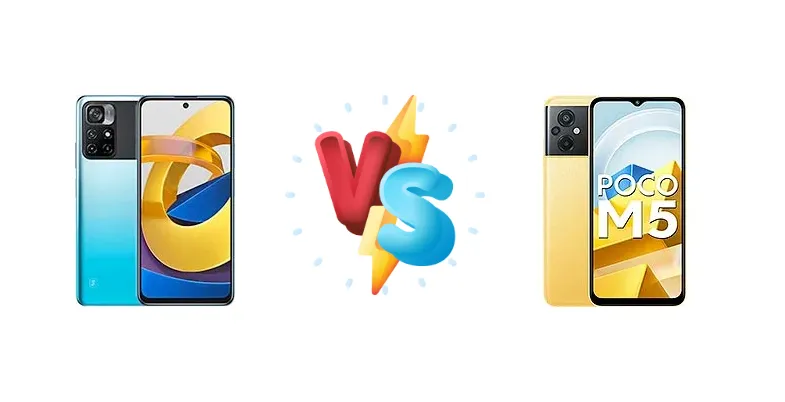
Xiaomi's Poco series consistently delivers impressive value, and the M4 Pro 5G and M5 are no exception. Both offer compelling features at affordable prices, but cater to slightly different needs. This comprehensive comparison will break down their strengths and weaknesses to help you choose the right one for you.
🏆 Quick Verdict
The Poco M4 Pro 5G takes the lead thanks to its faster charging, brighter display, and 5G connectivity. However, the Poco M5 offers a slightly more refined design and potentially better gaming performance due to the Helio G99. Ultimately, the M4 Pro 5G provides a more well-rounded experience.
| Network |
|---|
| 2G bands | GSM 850 / 900 / 1800 / 1900 | GSM 850 / 900 / 1800 / 1900 |
| 3G bands | HSDPA 850 / 900 / 1700(AWS) / 1900 / 2100 - International | HSDPA 850 / 900 / 1700(AWS) / 1900 / 2100 |
| 4G bands | 1, 2, 3, 4, 5, 7, 8, 12, 17, 20, 28, 32, 38, 40, 41, 66 - International | 1, 2, 3, 4, 5, 7, 8, 20, 28, 38, 40, 41 |
| 5G bands | 1, 3, 5, 7, 8, 20, 28, 38, 40, 41, 66, 77, 78 SA/NSA - International | - |
| Speed | HSPA, LTE, 5G | HSPA, LTE |
| Technology | GSM / HSPA / LTE / 5G | GSM / HSPA / LTE |
| | 1, 3, 5, 8, 28, 40, 78 SA/NSA - India | - |
| Launch |
|---|
| Announced | 2021, November 09 | 2022, September 05 |
| Status | Available. Released 2021, November 11 | Available. Released 2022, September 13 |
| Body |
|---|
| Build | Glass front (Gorilla Glass 3), plastic back, plastic frame | Glass front (Gorilla Glass 3), plastic frame, plastic back |
| Dimensions | 163.6 x 75.8 x 8.8 mm (6.44 x 2.98 x 0.35 in) | 164 x 76.1 x 8.9 mm (6.46 x 3.00 x 0.35 in) |
| SIM | Nano-SIM + Nano-SIM | Nano-SIM + Nano-SIM |
| Weight | 195 g (6.88 oz) | 201 g (7.09 oz) |
| | IP53, dust and splash resistant | - |
| Display |
|---|
| Protection | Corning Gorilla Glass 3 | Corning Gorilla Glass 3 |
| Resolution | 1080 x 2400 pixels, 20:9 ratio (~399 ppi density) | 1080 x 2408 pixels, 20:9 ratio (~401 ppi density) |
| Size | 6.6 inches, 105.2 cm2 (~84.8% screen-to-body ratio) | 6.58 inches, 104.3 cm2 (~83.6% screen-to-body ratio) |
| Type | IPS LCD, 90Hz, 450 nits (typ) | IPS LCD, 90Hz, 500 nits (HBM) |
| Platform |
|---|
| CPU | Octa-core (2x2.4 GHz Cortex-A76 & 6x2.0 GHz Cortex-A55) | Octa-core (2x2.2 GHz Cortex-A76 & 6x2.0 GHz Cortex-A55) |
| Chipset | Mediatek Dimensity 810 (6 nm) | Mediatek Helio G99 (6 nm) |
| GPU | Mali-G57 MC2 | Mali-G57 MC2 |
| OS | Android 11, upgradable to Android 12, MIUI 13 | Android 12, upgradable to Android 14, HyperOS |
| Memory |
|---|
| Card slot | microSDXC | microSDXC (dedicated slot) |
| Internal | 64GB 4GB RAM, 64GB 6GB RAM, 128GB 4GB RAM, 128GB 6GB RAM, 128GB 8GB RAM, 256GB 8GB RAM | 64GB 4GB RAM, 128GB 4GB RAM, 128GB 6GB RAM |
| | UFS 2.2 | UFS 2.2 |
| Main Camera |
|---|
| Dual | 50 MP, f/1.8, 26mm (wide), PDAF
8 MP, f/2.2, 119˚ (ultrawide) | - |
| Features | LED flash, HDR, panorama | LED flash, HDR, panorama |
| Single | 16 MP, f/2.5, (wide), 1/3.06" 1.0µm | - |
| Triple | - | 50 MP, f/1.8, (wide), PDAF
2 MP (macro)
Auxiliary lens |
| Video | 1080p@30/60fps | 1080p@30fps |
| Selfie camera |
|---|
| Features | Panorama | - |
| Single | 16 MP, f/2.5, (wide), 1/3.06" 1.0µm | 5 MP, f/2.2, (wide), 1/5.0", 1.12µm |
| Video | 1080p@30fps | 1080p@30fps |
| Sound |
|---|
| 3.5mm jack | Yes | Yes |
| 35mm jack | Yes | Yes |
| Loudspeaker | Yes, with stereo speakers | Yes |
| Comms |
|---|
| Bluetooth | 5.1, A2DP, LE | 5.3, A2DP, LE |
| Infrared port | Yes | Yes |
| NFC | Yes (market/region dependent) | Yes |
| Positioning | GPS, GLONASS, GALILEO, BDS | GPS, GLONASS, GALILEO, BDS |
| Radio | FM radio | FM radio |
| USB | USB Type-C 2.0, OTG | USB Type-C 2.0, OTG |
| WLAN | Wi-Fi 802.11 a/b/g/n/ac, dual-band, Wi-Fi Direct | Wi-Fi 802.11 a/b/g/n/ac, dual-band, Wi-Fi Direct |
| Features |
|---|
| Sensors | Fingerprint (side-mounted), accelerometer, gyro, compass | Fingerprint (side-mounted), accelerometer, proximity, compass |
| Battery |
|---|
| Charging | 33W wired, 100% in 59 min | 18W wired |
| Type | Li-Po 5000 mAh | Li-Po 5000 mAh |
| Misc |
|---|
| Colors | Poco Yellow, Power Black, Cool Blue | Black, Green, Yellow |
| Models | 21091116AG, MZB0BGVIN | 22071219CG |
| Price | About 150 EUR | About 100 EUR |
| SAR | 1.07 W/kg (head) 1.09 W/kg (body) | 1.04 W/kg (head) 0.83 W/kg (body) |
| SAR EU | 0.59 W/kg (head) 1.00 W/kg (body) | 0.52 W/kg (head) 0.83 W/kg (body) |
| Tests |
|---|
| Battery life |
Endurance rating 123h
|
Endurance rating 121h
|
| Camera |
Photo / Video |
Photo / Video |
| Display |
Contrast ratio: 1553:1 (nominal) |
Contrast ratio: 1363:1 |
| Loudspeaker |
-24.9 LUFS (Very good)
|
-27.6 LUFS (Good)
|
| Performance |
AnTuTu: 296721 (v8), 353663 (v9)
GeekBench: 1797 (v5.1)
GFXBench: 13fps (ES 3.1 onscreen) |
AnTuTu: 386311 (v9)
GeekBench: 1896 (v5.1)
GFXBench: 12fps (ES 3.1 onscreen) |
Xiaomi Poco M4 Pro 5G
- Faster 33W Charging
- Brighter Display (510 nits)
- 5G Connectivity
- Good Overall Performance
- Potentially less optimized gaming performance than M5
- Design may feel less premium
Xiaomi Poco M5
- Potentially better gaming performance (Helio G99)
- Slightly more refined design
- Competitive price
- Slower 18W Charging
- Lower peak brightness (448 nits)
- No 5G
Display Comparison
The Poco M4 Pro 5G boasts a higher peak brightness of 510 nits compared to the Poco M5's 448 nits, resulting in better visibility outdoors. Both offer excellent contrast ratios (1553:1 and 1363:1 respectively), delivering vibrant colors. The M4 Pro 5G's display is generally considered superior due to the higher brightness.
Camera Comparison
Both phones feature similar camera setups, but image processing and software optimization can vary. The Poco M4 Pro 5G likely offers slightly better video recording capabilities due to the Dimensity 810's ISP. Real-world camera performance will depend on individual preferences and shooting conditions. Detailed camera reviews are recommended for a deeper dive.
Performance
The Poco M4 Pro 5G utilizes the Mediatek Dimensity 810, known for its good overall performance and 5G capabilities. The Poco M5 features the Mediatek Helio G99, which is often praised for its gaming performance. While both have octa-core CPUs, the Helio G99's GPU gives it a slight edge in graphically intensive tasks. However, the Dimensity 810's 5G modem is a significant advantage.
Battery Life
Both phones offer excellent battery life with endurance ratings of 123h. However, the Poco M4 Pro 5G's 33W charging is significantly faster than the Poco M5's 18W charging, allowing for quicker top-ups.
Buying Guide
The Xiaomi Poco M4 Pro 5G is ideal for users who prioritize fast charging, a brighter screen, and 5G connectivity. The Poco M5 is a great choice for those seeking a slightly more premium feel and potentially better gaming performance without needing 5G.
Frequently Asked Questions
❓ Is the Poco M4 Pro 5G worth the extra money?
If 5G connectivity and faster charging are important to you, then yes. The brighter display is also a plus. However, if you primarily game and don't need 5G, the Poco M5 offers excellent value.
❓ Which chipset is better, Dimensity 810 or Helio G99?
The Dimensity 810 offers better overall performance and 5G capabilities. The Helio G99 is often favored for its gaming performance due to its GPU.