
Xiaomi Poco M4 Pro 5G vs Poco M4 Pro: The Ultimate Showdown
| Phones Images | |||||
|---|---|---|---|---|---|
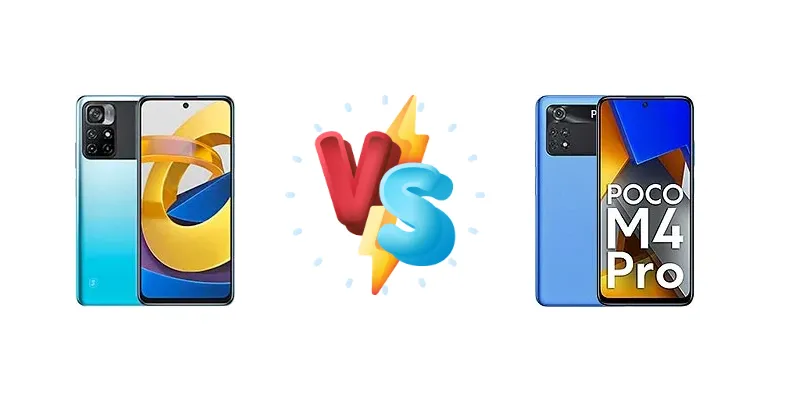
|
🏆 Quick Verdict
The Poco M4 Pro 5G offers 5G connectivity and a slightly more modern chipset, while the Poco M4 Pro boasts a brighter display and marginally better battery endurance. For those needing 5G, the M4 Pro 5G is the clear winner; otherwise, the M4 Pro provides a slightly more polished experience.
| PHONES | ||
|---|---|---|
| Phone Names | Xiaomi Poco M4 Pro 5G | Xiaomi Poco M4 Pro |
| Network | ||
|---|---|---|
| 2G bands | GSM 850 / 900 / 1800 / 1900 | GSM 850 / 900 / 1800 / 1900 |
| 3G bands | HSDPA 850 / 900 / 1700(AWS) / 1900 / 2100 - International | HSDPA 850 / 900 / 1700(AWS) / 1900 / 2100 - International |
| 4G bands | 1, 2, 3, 4, 5, 7, 8, 12, 17, 20, 28, 32, 38, 40, 41, 66 - International | 1, 2, 3, 4, 5, 7, 8, 20, 28, 38, 40, 41 - International |
| 5G bands | 1, 3, 5, 7, 8, 20, 28, 38, 40, 41, 66, 77, 78 SA/NSA - International | - |
| Speed | HSPA, LTE, 5G | HSPA, LTE |
| Technology | GSM / HSPA / LTE / 5G | GSM / HSPA / LTE |
| 1, 3, 5, 8, 28, 40, 78 SA/NSA - India | 1, 3, 5, 8, 40, 41 - India | |
| Launch | ||
|---|---|---|
| Announced | 2021, November 09 | 2022, February 28 |
| Status | Available. Released 2021, November 11 | Available. Released 2022, March 16 |
| Body | ||
|---|---|---|
| Build | Glass front (Gorilla Glass 3), plastic back, plastic frame | Glass front (Gorilla Glass 3), plastic frame, plastic back |
| Dimensions | 163.6 x 75.8 x 8.8 mm (6.44 x 2.98 x 0.35 in) | 159.9 x 73.9 x 8.1 mm (6.30 x 2.91 x 0.32 in) |
| SIM | Nano-SIM + Nano-SIM | Nano-SIM + Nano-SIM |
| Weight | 195 g (6.88 oz) | 179.5 g (6.31 oz) |
| IP53, dust and splash resistant | IP53, dust and splash resistant | |
| Display | ||
|---|---|---|
| Protection | Corning Gorilla Glass 3 | Corning Gorilla Glass 3 |
| Resolution | 1080 x 2400 pixels, 20:9 ratio (~399 ppi density) | 1080 x 2400 pixels, 20:9 ratio (~409 ppi density) |
| Size | 6.6 inches, 105.2 cm2 (~84.8% screen-to-body ratio) | 6.43 inches, 99.8 cm2 (~84.5% screen-to-body ratio) |
| Type | IPS LCD, 90Hz, 450 nits (typ) | AMOLED, 90Hz, 700 nits, 1000 nits (peak) |
| Platform | ||
|---|---|---|
| CPU | Octa-core (2x2.4 GHz Cortex-A76 & 6x2.0 GHz Cortex-A55) | Octa-core (2x2.05 GHz Cortex-A76 & 6x2.0 GHz Cortex-A55) |
| Chipset | Mediatek Dimensity 810 (6 nm) | Mediatek MT6781 Helio G96 (12 nm) |
| GPU | Mali-G57 MC2 | Mali-G57 MC2 |
| OS | Android 11, upgradable to Android 12, MIUI 13 | Android 11, MIUI 13 for POCO |
| Memory | ||
|---|---|---|
| Card slot | microSDXC | microSDXC (dedicated slot) |
| Internal | 64GB 4GB RAM, 64GB 6GB RAM, 128GB 4GB RAM, 128GB 6GB RAM, 128GB 8GB RAM, 256GB 8GB RAM | 64GB 6GB RAM, 128GB 6GB RAM, 128GB 8GB RAM, 256GB 8GB RAM |
| UFS 2.2 | UFS 2.2 | |
| Main Camera | ||
|---|---|---|
| Dual | 50 MP, f/1.8, 26mm (wide), PDAF 8 MP, f/2.2, 119˚ (ultrawide) | - |
| Features | LED flash, HDR, panorama | LED flash, HDR, panorama |
| Single | 16 MP, f/2.5, (wide), 1/3.06" 1.0µm | 16 MP, f/2.5, (wide), 1/3.06" 1.0µm |
| Triple | - | 64 MP, f/1.8, 26mm (wide), 0.7µm, PDAF 8 MP, f/2.2, 118˚ (ultrawide), 1/4.0", 1.12µm 2 MP (macro) |
| Video | 1080p@30/60fps | 1080p@30fps |
| Selfie camera | ||
|---|---|---|
| Features | Panorama | HDR |
| Single | 16 MP, f/2.5, (wide), 1/3.06" 1.0µm | 16 MP, f/2.5, (wide), 1/3.06" 1.0µm |
| Video | 1080p@30fps | 1080p@30fps |
| Sound | ||
|---|---|---|
| 3.5mm jack | Yes | Yes |
| 35mm jack | Yes | Yes |
| Loudspeaker | Yes, with stereo speakers | Yes, with stereo speakers |
| - | 24-bit/192kHz audio | |
| Comms | ||
|---|---|---|
| Bluetooth | 5.1, A2DP, LE | 5.0, A2DP, LE |
| Infrared port | Yes | Yes |
| NFC | Yes (market/region dependent) | Yes |
| Positioning | GPS, GLONASS, GALILEO, BDS | GPS, GLONASS, BDS, GALILEO |
| Radio | FM radio | FM radio, recording |
| USB | USB Type-C 2.0, OTG | USB Type-C 2.0, OTG |
| WLAN | Wi-Fi 802.11 a/b/g/n/ac, dual-band, Wi-Fi Direct | Wi-Fi 802.11 a/b/g/n/ac, dual-band, Wi-Fi Direct |
| Features | ||
|---|---|---|
| Sensors | Fingerprint (side-mounted), accelerometer, gyro, compass | Fingerprint (side-mounted), accelerometer, gyro, compass |
| - | Virtual proximity sensing | |
| Battery | ||
|---|---|---|
| Charging | 33W wired, 100% in 59 min | 33W wired, PD3.0, QC3, 100% in 58 min |
| Type | Li-Po 5000 mAh | Li-Po 5000 mAh |
| Misc | ||
|---|---|---|
| Colors | Poco Yellow, Power Black, Cool Blue | Power Black, Cool Blue, Poco Yellow |
| Models | 21091116AG, MZB0BGVIN | MZB0B5VIN, 2201117PI, 2201117PG |
| Price | About 150 EUR | € 100.18 |
| SAR | 1.07 W/kg (head) 1.09 W/kg (body) | 0.85 W/kg (head) 0.85 W/kg (body) |
| SAR EU | 0.59 W/kg (head) 1.00 W/kg (body) | 0.59 W/kg (head) 0.84 W/kg (body) |
| Tests | ||
|---|---|---|
| Battery life | Endurance rating 123h | Endurance rating 126h |
| Camera | Photo / Video | Photo / Video |
| Display | Contrast ratio: 1553:1 (nominal) | Contrast ratio: Infinite (nominal) |
| Loudspeaker | -24.9 LUFS (Very good) | -25.2 LUFS (Very good) |
| Performance | AnTuTu: 296721 (v8), 353663 (v9) GeekBench: 1797 (v5.1) GFXBench: 13fps (ES 3.1 onscreen) | AnTuTu: 318444 (v9) GeekBench: 1836 (v5.1) GFXBench: 12fps (ES 3.1 onscreen) |
Xiaomi Poco M4 Pro 5G
- 5G Connectivity
- More Modern Chipset (Dimensity 810)
- Slightly better efficiency
- Fast Charging (33W)
- Lower Display Brightness (510 nits)
- Slightly lower battery endurance
- Potentially less refined display
Xiaomi Poco M4 Pro
- Brighter Display (737 nits)
- Slightly better battery endurance (126h)
- Potentially better image processing
- Fast Charging (33W)
- No 5G Connectivity
- Older Chipset (Helio G96)
- Less future-proof
Display Comparison
The Poco M4 Pro takes a clear lead in the display department. While both offer excellent contrast ratios (1553:1 for the 5G and 'Infinite' for the standard), the M4 Pro's measured peak brightness of 737 nits significantly outshines the M4 Pro 5G's 510 nits. This translates to better visibility in direct sunlight. The M4 Pro's display feels more premium.
Camera Comparison
Both phones feature similar camera setups, but image processing can differ. Expect comparable photo and video quality in good lighting conditions. Low-light performance is likely to be similar, though the M4 Pro's slightly better overall processing might give it a marginal advantage. Detailed camera reviews would be needed for a definitive verdict.
Performance
The Poco M4 Pro 5G utilizes the Mediatek Dimensity 810, a 6nm chip, offering a slight edge in efficiency and potentially future-proofing. The Poco M4 Pro uses the Helio G96 (12nm). While both feature octa-core CPUs with Cortex-A76 cores, the Dimensity 810 generally provides a smoother experience for demanding tasks and gaming, though both are capable for everyday use. 5G connectivity is, of course, exclusive to the M4 Pro 5G.
Battery Life
Battery life is remarkably similar, with both phones achieving impressive endurance ratings. The Poco M4 Pro edges out the M4 Pro 5G by a small margin (126h vs 123h). Both offer 33W fast charging, completing a full charge in roughly 58-59 minutes.
Buying Guide
The Xiaomi Poco M4 Pro 5G is ideal for users who prioritize 5G connectivity and a more future-proof chipset. The Xiaomi Poco M4 Pro is a great choice for those seeking a brighter screen, slightly longer battery life, and a more refined overall experience, especially if 5G isn't a necessity.