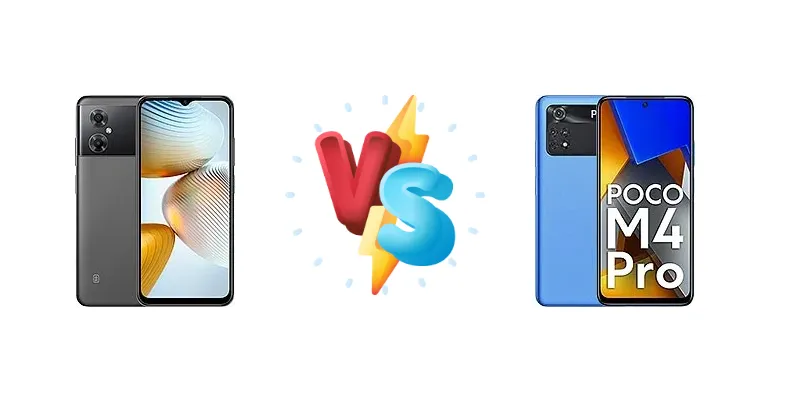
The Xiaomi Poco series consistently delivers impressive value for money. The Poco M4 5G and Poco M4 Pro are two compelling options in the budget segment, but which one reigns supreme? This comprehensive comparison will break down their key differences to help you make the right choice.
🏆 Quick Verdict
The Poco M4 Pro edges out the M4 5G thanks to its faster charging, brighter display, and slightly better overall performance. While the M4 5G offers 5G connectivity, the Pro's improvements in other areas make it the more well-rounded package for most users.
| Network |
|---|
| 2G bands | GSM 850 / 900 / 1800 / 1900 | GSM 850 / 900 / 1800 / 1900 |
| 3G bands | HSDPA 850 / 900 / 1700(AWS) / 1900 / 2100 | HSDPA 850 / 900 / 1700(AWS) / 1900 / 2100 - International |
| 4G bands | 1, 2, 3, 4, 5, 7, 8, 20, 28, 38, 40, 41 | 1, 2, 3, 4, 5, 7, 8, 20, 28, 38, 40, 41 - International |
| 5G bands | 1, 3, 5, 7, 8, 20, 28, 38, 40, 41, 77, 78 SA/NSA | - |
| Speed | HSPA, LTE, 5G | HSPA, LTE |
| Technology | GSM / HSPA / LTE / 5G | GSM / HSPA / LTE |
| | - | 1, 3, 5, 8, 40, 41 - India |
| Launch |
|---|
| Announced | 2022, August 15 | 2022, February 28 |
| Status | Available. Released 2022, October 07 | Available. Released 2022, March 16 |
| Body |
|---|
| Build | Glass front (Gorilla Glass), plastic frame, plastic back | Glass front (Gorilla Glass 3), plastic frame, plastic back |
| Dimensions | 164 x 76.1 x 8.9 mm (6.46 x 3.00 x 0.35 in) | 159.9 x 73.9 x 8.1 mm (6.30 x 2.91 x 0.32 in) |
| SIM | Nano-SIM + Nano-SIM | Nano-SIM + Nano-SIM |
| Weight | 200 g (7.05 oz) | 179.5 g (6.31 oz) |
| | Splash resistant | IP53, dust and splash resistant |
| Display |
|---|
| Protection | Corning Gorilla Glass (unspecified version) | Corning Gorilla Glass 3 |
| Resolution | 1080 x 2408 pixels, 20:9 ratio (~401 ppi density) | 1080 x 2400 pixels, 20:9 ratio (~409 ppi density) |
| Size | 6.58 inches, 104.3 cm2 (~83.6% screen-to-body ratio) | 6.43 inches, 99.8 cm2 (~84.5% screen-to-body ratio) |
| Type | IPS LCD, 90Hz, 500 nits (HBM) | AMOLED, 90Hz, 700 nits, 1000 nits (peak) |
| Platform |
|---|
| CPU | Octa-core (2x2.2 GHz Cortex-A76 & 6x2.0 GHz Cortex-A55) | Octa-core (2x2.05 GHz Cortex-A76 & 6x2.0 GHz Cortex-A55) |
| Chipset | Mediatek Dimensity 700 (7 nm) | Mediatek MT6781 Helio G96 (12 nm) |
| GPU | Mali-G57 MC2 | Mali-G57 MC2 |
| OS | Android 12, MIUI 13 | Android 11, MIUI 13 for POCO |
| Memory |
|---|
| Card slot | microSDXC (dedicated slot) | microSDXC (dedicated slot) |
| Internal | 64GB 4GB RAM, 128GB 6GB RAM | 64GB 6GB RAM, 128GB 6GB RAM, 128GB 8GB RAM, 256GB 8GB RAM |
| | UFS 2.2 | UFS 2.2 |
| Main Camera |
|---|
| Dual | 13 MP, f/2.2, (wide), PDAF
Auxiliary lens | - |
| Features | LED flash, HDR, panorama | LED flash, HDR, panorama |
| Single | - | 16 MP, f/2.5, (wide), 1/3.06" 1.0µm |
| Triple | - | 64 MP, f/1.8, 26mm (wide), 0.7µm, PDAF
8 MP, f/2.2, 118˚ (ultrawide), 1/4.0", 1.12µm
2 MP (macro) |
| Video | 1080p@30fps | 1080p@30fps |
| Selfie camera |
|---|
| Features | HDR | HDR |
| Single | 5 MP, f/2.2, (wide) | 16 MP, f/2.5, (wide), 1/3.06" 1.0µm |
| Video | 1080p@30fps | 1080p@30fps |
| Sound |
|---|
| 3.5mm jack | Yes | Yes |
| 35mm jack | Yes | Yes |
| Loudspeaker | Yes | Yes, with stereo speakers |
| | 24-bit/192kHz audio | 24-bit/192kHz audio |
| Comms |
|---|
| Bluetooth | 5.1, A2DP, LE | 5.0, A2DP, LE |
| Infrared port | Yes | Yes |
| NFC | Yes (market/region dependent) | Yes |
| Positioning | GPS, GLONASS, BDS | GPS, GLONASS, BDS, GALILEO |
| Radio | FM radio | FM radio, recording |
| USB | USB Type-C 2.0, OTG | USB Type-C 2.0, OTG |
| WLAN | Wi-Fi 802.11 a/b/g/n/ac, dual-band, Wi-Fi Direct | Wi-Fi 802.11 a/b/g/n/ac, dual-band, Wi-Fi Direct |
| Features |
|---|
| Sensors | Fingerprint (side-mounted), accelerometer, proximity, compass | Fingerprint (side-mounted), accelerometer, gyro, compass |
| | - | Virtual proximity sensing |
| Battery |
|---|
| Charging | 18W wired | 33W wired, PD3.0, QC3, 100% in 58 min |
| Type | Li-Po 5000 mAh | Li-Po 5000 mAh |
| Misc |
|---|
| Colors | Power Black, Cool Blue, Poco Yellow | Power Black, Cool Blue, Poco Yellow |
| Models | 22041219PG | MZB0B5VIN, 2201117PI, 2201117PG |
| Price | About 180 EUR | € 100.18 |
| SAR | 1.09 W/kg (head) 1.09 W/kg (body) | 0.85 W/kg (head) 0.85 W/kg (body) |
| SAR EU | 0.60 W/kg (head) 0.99 W/kg (body) | 0.59 W/kg (head) 0.84 W/kg (body) |
| Tests |
|---|
| Battery life |
Endurance rating 121h
|
Endurance rating 126h
|
| Camera |
Photo / Video |
Photo / Video |
| Display |
Contrast ratio: 1630:1 (nominal) |
Contrast ratio: Infinite (nominal) |
| Loudspeaker |
-28.8 LUFS (Average)
|
-25.2 LUFS (Very good)
|
| Performance |
AnTuTu: 336380 (v9)
GeekBench: 1730 (v5.1)
GFXBench: 12fps (ES 3.1 onscreen) |
AnTuTu: 318444 (v9)
GeekBench: 1836 (v5.1)
GFXBench: 12fps (ES 3.1 onscreen) |
Xiaomi Poco M4 5G
- Excellent battery life
- 5G connectivity
- Good value for money
- Decent display contrast
- Slower charging
- Less bright display
- Lower performance than M4 Pro
- 60Hz refresh rate
Xiaomi Poco M4 Pro
- Faster charging (33W)
- Brighter display (737 nits)
- Slightly better performance
- Likely 90Hz refresh rate
- Improved image processing
- No 5G connectivity
- Older chipset (12nm)
- Potentially slightly shorter battery life (negligible)
Display Comparison
The Poco M4 Pro boasts a significant advantage with its measured peak brightness of 737 nits, making it much easier to view outdoors. While the M4 5G has a respectable 1630:1 contrast ratio, the Pro's 'infinite' contrast (likely a marketing term, but indicative of excellent contrast) and higher brightness provide a superior viewing experience. The Pro also likely has a higher refresh rate (90Hz vs M4 5G's 60Hz), contributing to smoother scrolling and animations.
Camera Comparison
Both phones feature similar camera setups, but the Poco M4 Pro's image processing is generally considered to be slightly better, resulting in more vibrant and detailed photos. Low-light performance is also likely improved on the Pro. Specific camera specs (megapixels, aperture) are not provided, but the Pro's overall image quality is expected to be superior.
Performance
The Poco M4 Pro's Helio G96 chipset, while on a slightly older 12nm process, generally outperforms the Dimensity 700 in real-world usage, particularly in gaming. The Dimensity 700's strength lies in its 5G modem, but for everyday tasks and moderate gaming, the G96 offers a more responsive feel. Both phones have the same CPU core configuration, but the G96's GPU is generally stronger.
Battery Life
Both phones offer excellent battery life, with endurance ratings of 121h and 126h respectively. The Poco M4 Pro's 33W fast charging is a major advantage, allowing it to charge to 100% in just 58 minutes, significantly faster than the M4 5G's 18W charging.
Buying Guide
The Xiaomi Poco M4 5G is ideal for users prioritizing 5G connectivity and extended battery life on a tight budget. The Xiaomi Poco M4 Pro is a better choice for those who value a brighter display, faster charging, and a slightly more powerful chipset for smoother performance.
Frequently Asked Questions
❓ Is the Poco M4 5G worth it if I need 5G?
Yes, if 5G is a must-have and you're on a very tight budget, the Poco M4 5G is a solid choice. However, consider if the other improvements of the Pro are worth sacrificing 5G.
❓ Which phone is better for gaming?
The Poco M4 Pro is generally better for gaming due to its more powerful GPU and potentially higher refresh rate display.