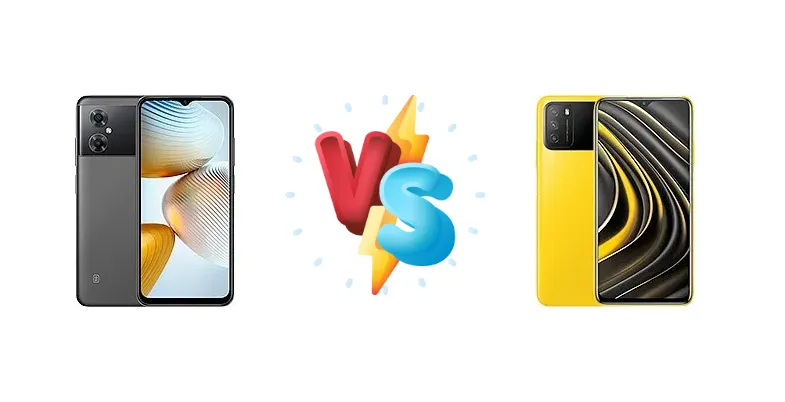
Xiaomi's Poco series consistently delivers impressive value for money. The Poco M4 5G and Poco M3 are two popular contenders in the budget smartphone arena. But which one reigns supreme? This comprehensive comparison will break down their key features to help you make the right choice.
🏆 Quick Verdict
The Poco M4 5G offers 5G connectivity and a slightly more modern chipset, but the Poco M3 boasts a brighter display and reverse charging. Ultimately, the M4 5G is a better choice for those prioritizing future-proofing and 5G, while the M3 remains a strong contender for its display and features.
| Network |
|---|
| 2G bands | GSM 850 / 900 / 1800 / 1900 | GSM 850 / 900 / 1800 / 1900 |
| 3G bands | HSDPA 850 / 900 / 1700(AWS) / 1900 / 2100 | HSDPA 850 / 900 / 1700(AWS) / 1900 / 2100 |
| 4G bands | 1, 2, 3, 4, 5, 7, 8, 20, 28, 38, 40, 41 | 1, 2, 3, 4, 5, 7, 8, 20, 28, 38, 40, 41 |
| 5G bands | 1, 3, 5, 7, 8, 20, 28, 38, 40, 41, 77, 78 SA/NSA | - |
| Speed | HSPA, LTE, 5G | HSPA, LTE |
| Technology | GSM / HSPA / LTE / 5G | GSM / HSPA / LTE |
| Launch |
|---|
| Announced | 2022, August 15 | 2020, November 24 |
| Status | Available. Released 2022, October 07 | Available. Released 2020, November 27 |
| Body |
|---|
| Build | Glass front (Gorilla Glass), plastic frame, plastic back | Glass front (Gorilla Glass 3), plastic back, plastic frame |
| Dimensions | 164 x 76.1 x 8.9 mm (6.46 x 3.00 x 0.35 in) | 162.3 x 77.3 x 9.6 mm (6.39 x 3.04 x 0.38 in) |
| SIM | Nano-SIM + Nano-SIM | Nano-SIM + Nano-SIM |
| Weight | 200 g (7.05 oz) | 198 g (6.98 oz) |
| | Splash resistant | - |
| Display |
|---|
| Protection | Corning Gorilla Glass (unspecified version) | Corning Gorilla Glass 3 |
| Resolution | 1080 x 2408 pixels, 20:9 ratio (~401 ppi density) | 1080 x 2340 pixels, 19.5:9 ratio (~395 ppi density) |
| Size | 6.58 inches, 104.3 cm2 (~83.6% screen-to-body ratio) | 6.53 inches, 104.7 cm2 (~83.4% screen-to-body ratio) |
| Type | IPS LCD, 90Hz, 500 nits (HBM) | IPS LCD, 400 nits (typ) |
| Platform |
|---|
| CPU | Octa-core (2x2.2 GHz Cortex-A76 & 6x2.0 GHz Cortex-A55) | Octa-core (4x2.0 GHz Kryo 260 Gold & 4x1.8 GHz Kryo 260 Silver) |
| Chipset | Mediatek Dimensity 700 (7 nm) | Qualcomm SM6115 Snapdragon 662 (11 nm) |
| GPU | Mali-G57 MC2 | Adreno 610 |
| OS | Android 12, MIUI 13 | Android 10, MIUI 12 |
| Memory |
|---|
| Card slot | microSDXC (dedicated slot) | microSDXC (dedicated slot) |
| Internal | 64GB 4GB RAM, 128GB 6GB RAM | 64GB 4GB RAM, 64GB 6GB RAM, 128GB 4GB RAM, 128GB 6GB RAM |
| | UFS 2.2 | UFS 2.1 - 64GB
UFS 2.2 - 128GB |
| Main Camera |
|---|
| Dual | 13 MP, f/2.2, (wide), PDAF
Auxiliary lens | - |
| Features | LED flash, HDR, panorama | LED flash, HDR, panorama |
| Triple | - | 48 MP, f/1.8, (wide), 1/2.0", 0.8µm, PDAF
2 MP (macro)
Auxiliary lens |
| Video | 1080p@30fps | 1080p@30fps |
| Selfie camera |
|---|
| Features | HDR | Panorama |
| Single | 5 MP, f/2.2, (wide) | 8 MP, f/2.1, (wide), 1/4.0", 1.12µm |
| Video | 1080p@30fps | 1080p@30fps |
| Sound |
|---|
| 3.5mm jack | Yes | Yes |
| 35mm jack | Yes | Yes |
| Loudspeaker | Yes | Yes, with dual speakers |
| | 24-bit/192kHz audio | 24-bit/192kHz audio |
| Comms |
|---|
| Bluetooth | 5.1, A2DP, LE | 5.0, A2DP, LE |
| Infrared port | Yes | Yes |
| NFC | Yes (market/region dependent) | No |
| Positioning | GPS, GLONASS, BDS | GPS, GLONASS, BDS, GALILEO |
| Radio | FM radio | FM radio |
| USB | USB Type-C 2.0, OTG | USB Type-C 2.0, OTG |
| WLAN | Wi-Fi 802.11 a/b/g/n/ac, dual-band, Wi-Fi Direct | Wi-Fi 802.11 a/b/g/n/ac, dual-band, Wi-Fi Direct |
| Features |
|---|
| Sensors | Fingerprint (side-mounted), accelerometer, proximity, compass | Fingerprint (side-mounted), accelerometer, proximity, compass |
| Battery |
|---|
| Charging | 18W wired | 18W wired
2.5W reverse wired |
| Type | Li-Po 5000 mAh | Li-Po 6000 mAh |
| Misc |
|---|
| Colors | Power Black, Cool Blue, Poco Yellow | Cool Blue, Poco Yellow, Power Black |
| Models | 22041219PG | M2010J19CG, M2010J19CI |
| Price | About 180 EUR | $ 130.00 / ₹ 11,590 |
| SAR | 1.09 W/kg (head) 1.09 W/kg (body) | 1.09 W/kg (head) 1.00 W/kg (body) |
| SAR EU | 0.60 W/kg (head) 0.99 W/kg (body) | 0.60 W/kg (head) 0.81 W/kg (body) |
| Tests |
|---|
| Battery life |
Endurance rating 121h
| Endurance rating 154h |
| Camera |
Photo / Video |
Photo / Video |
| Display |
Contrast ratio: 1630:1 (nominal) |
Contrast ratio: 1567:1 (nominal) |
| Loudspeaker |
-28.8 LUFS (Average)
|
-26.5 LUFS (Good) |
| Performance |
AnTuTu: 336380 (v9)
GeekBench: 1730 (v5.1)
GFXBench: 12fps (ES 3.1 onscreen) |
AnTuTu: 177904 (v8)
GeekBench: 1398 (v5.1)
GFXBench: 5.9fps (ES 3.1 onscreen) |
Xiaomi Poco M4 5G
- 5G Connectivity
- More Powerful Chipset (Dimensity 700)
- Modern Design
- Slightly better video recording
- Less Bright Display
- Shorter Battery Life
- No Reverse Charging
Xiaomi Poco M3
- Brighter Display (439 nits)
- Reverse Wired Charging
- Slightly Longer Battery Life
- Competitive Price
- Older Chipset (Snapdragon 662)
- No 5G Connectivity
- Less Modern Design
Display Comparison
The Poco M3 takes a slight edge in the display department. While both offer excellent contrast ratios (1630:1 for the M4 5G and 1567:1 for the M3), the M3's measured peak brightness of 439 nits provides a noticeably better viewing experience, especially outdoors. The M4 5G's display is perfectly adequate, but lacks the M3's punch.
Camera Comparison
Camera performance is comparable between the two devices. Both feature a multi-lens setup (typically a main sensor, ultrawide, and macro). Image quality is decent in good lighting conditions, but struggles in low light. The M4 5G might offer slightly better video recording capabilities due to its newer chipset.
Performance
The Poco M4 5G's Mediatek Dimensity 700 chipset generally outperforms the Poco M3's Snapdragon 662. The Dimensity 700's newer architecture and 7nm process offer improved efficiency and performance, particularly in gaming and demanding applications. However, for everyday tasks, both phones are capable.
Battery Life
The Poco M3 holds a slight advantage in battery endurance, boasting an endurance rating of 154h compared to the M4 5G's 121h. While both offer large battery capacities, the M3's slightly more efficient chipset contributes to its longer battery life. The M4 5G also lacks reverse charging, a feature present on the M3.
Buying Guide
Who should buy the Xiaomi Poco M4 5G? Users seeking 5G connectivity, a slightly more powerful processor for smoother multitasking, and a more modern design. Who should buy the Xiaomi Poco M3? Those prioritizing a brighter display for better outdoor visibility, reverse wired charging for topping up accessories, and a slightly longer battery life in real-world usage.
Frequently Asked Questions
❓ Is the Poco M4 5G worth the extra money over the Poco M3?
If 5G connectivity is important to you and you want a slightly more powerful processor, then the Poco M4 5G is worth the upgrade. Otherwise, the Poco M3 offers excellent value with its brighter display and reverse charging.
❓ Which phone has better gaming performance?
The Poco M4 5G generally offers better gaming performance due to its more modern and powerful Dimensity 700 chipset.