
Xiaomi Poco M4 5G vs Samsung Galaxy F14: The Ultimate Budget Showdown
| Phones Images | |||||
|---|---|---|---|---|---|
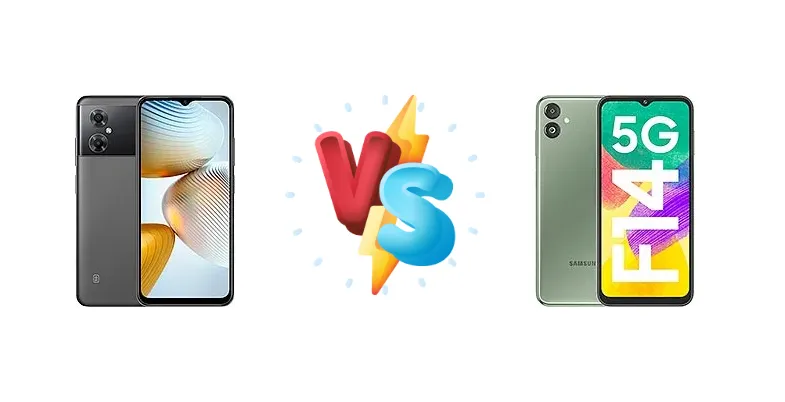
|
🏆 Quick Verdict
The Samsung Galaxy F14 edges out the Poco M4 5G thanks to its more modern chipset (Exynos 1330), faster charging, and generally smoother performance. While the Poco boasts incredible battery life, the F14's overall package is more appealing for most users.
| PHONES | ||
|---|---|---|
| Phone Names | Xiaomi Poco M4 5G | Samsung Galaxy F14 |
| Network | ||
|---|---|---|
| 2G bands | GSM 850 / 900 / 1800 / 1900 | GSM 850 / 900 / 1800 / 1900 |
| 3G bands | HSDPA 850 / 900 / 1700(AWS) / 1900 / 2100 | HSDPA 850 / 900 / 1700(AWS) / 1900 / 2100 |
| 4G bands | 1, 2, 3, 4, 5, 7, 8, 20, 28, 38, 40, 41 | 1, 2, 3, 4, 5, 7, 8, 12, 17, 20, 26, 28, 38, 40, 41, 66 |
| 5G bands | 1, 3, 5, 7, 8, 20, 28, 38, 40, 41, 77, 78 SA/NSA | 1, 3, 5, 7, 8, 20, 28, 38, 40, 41, 66, 77, 78 SA/NSA/Sub6 |
| Speed | HSPA, LTE, 5G | HSPA, LTE-А, 5G |
| Technology | GSM / HSPA / LTE / 5G | GSM / HSPA / LTE / 5G |
| Launch | ||
|---|---|---|
| Announced | 2022, August 15 | 2023, March 24 |
| Status | Available. Released 2022, October 07 | Available. Released 2023, March 30 |
| Body | ||
|---|---|---|
| Build | Glass front (Gorilla Glass), plastic frame, plastic back | Glass front (Gorilla Glass 5), plastic back, plastic frame |
| Dimensions | 164 x 76.1 x 8.9 mm (6.46 x 3.00 x 0.35 in) | 166.8 x 77.2 x 9.4 mm (6.57 x 3.04 x 0.37 in) |
| SIM | Nano-SIM + Nano-SIM | Nano-SIM + Nano-SIM |
| Weight | 200 g (7.05 oz) | 206 g (7.27 oz) |
| Splash resistant | - | |
| Display | ||
|---|---|---|
| Protection | Corning Gorilla Glass (unspecified version) | Corning Gorilla Glass 5 |
| Resolution | 1080 x 2408 pixels, 20:9 ratio (~401 ppi density) | 1080 x 2408 pixels, 20:9 ratio (~400 ppi density) |
| Size | 6.58 inches, 104.3 cm2 (~83.6% screen-to-body ratio) | 6.6 inches, 104.9 cm2 (~81.5% screen-to-body ratio) |
| Type | IPS LCD, 90Hz, 500 nits (HBM) | PLS LCD, 90Hz |
| Platform | ||
|---|---|---|
| CPU | Octa-core (2x2.2 GHz Cortex-A76 & 6x2.0 GHz Cortex-A55) | Octa-core (2x2.4 GHz Cortex-A78 & 6x2.0 GHz Cortex-A55) |
| Chipset | Mediatek Dimensity 700 (7 nm) | Exynos 1330 (5 nm) |
| GPU | Mali-G57 MC2 | Mali-G68 MP2 |
| OS | Android 12, MIUI 13 | Android 13, One UI Core 5.1 |
| Memory | ||
|---|---|---|
| Card slot | microSDXC (dedicated slot) | microSDXC (dedicated slot) |
| Internal | 64GB 4GB RAM, 128GB 6GB RAM | 64GB 4GB RAM, 128GB 4GB RAM, 128GB 6GB RAM |
| UFS 2.2 | - | |
| Main Camera | ||
|---|---|---|
| Dual | 13 MP, f/2.2, (wide), PDAF Auxiliary lens | 50 MP, f/1.8, (wide), PDAF 2 MP (macro) |
| Features | LED flash, HDR, panorama | LED flash, panorama, HDR |
| Video | 1080p@30fps | 1080p@30fps |
| Selfie camera | ||
|---|---|---|
| Features | HDR | - |
| Single | 5 MP, f/2.2, (wide) | 13 MP, f/2.0, (wide) |
| Video | 1080p@30fps | 1080p@30fps |
| Sound | ||
|---|---|---|
| 3.5mm jack | Yes | Yes |
| 35mm jack | Yes | Yes |
| Loudspeaker | Yes | Yes |
| 24-bit/192kHz audio | - | |
| Comms | ||
|---|---|---|
| Bluetooth | 5.1, A2DP, LE | 5.2, A2DP, LE |
| Infrared port | Yes | - |
| NFC | Yes (market/region dependent) | No |
| Positioning | GPS, GLONASS, BDS | GPS, GLONASS, GALILEO, BDS, QZSS, NavIC |
| Radio | FM radio | FM radio, recording |
| USB | USB Type-C 2.0, OTG | USB Type-C 2.0 |
| WLAN | Wi-Fi 802.11 a/b/g/n/ac, dual-band, Wi-Fi Direct | Wi-Fi 802.11 a/b/g/n/ac, dual-band, Wi-Fi Direct |
| Features | ||
|---|---|---|
| Sensors | Fingerprint (side-mounted), accelerometer, proximity, compass | Fingerprint (side-mounted), accelerometer, gyro, proximity, compass |
| Battery | ||
|---|---|---|
| Charging | 18W wired | 25W wired |
| Type | Li-Po 5000 mAh | Li-Po 6000 mAh |
| Misc | ||
|---|---|---|
| Colors | Power Black, Cool Blue, Poco Yellow | Black, Green, Purple |
| Models | 22041219PG | SM-E146B, SM-E146B/DS |
| Price | About 180 EUR | About 150 EUR |
| SAR | 1.09 W/kg (head) 1.09 W/kg (body) | 0.69 W/kg (head) |
| SAR EU | 0.60 W/kg (head) 0.99 W/kg (body) | - |
| Tests | ||
|---|---|---|
| Battery life | Endurance rating 121h | - |
| Camera | Photo / Video | - |
| Display | Contrast ratio: 1630:1 (nominal) | - |
| Loudspeaker | -28.8 LUFS (Average) | - |
| Performance | AnTuTu: 336380 (v9) GeekBench: 1730 (v5.1) GFXBench: 12fps (ES 3.1 onscreen) | - |
Xiaomi Poco M4 5G
- Exceptional battery life
- Good contrast ratio display
- Affordable price
- Older chipset
- Slower charging
- Potentially less refined camera
Samsung Galaxy F14
- Modern chipset (Exynos 1330)
- Faster charging (25W)
- Generally smoother performance
- Samsung's display expertise
- Battery life not as exceptional as Poco M4 5G
- Price slightly higher than Poco M4 5G
Display Comparison
Both phones feature a 6.6-inch FHD+ display, offering a decent viewing experience. The Poco M4 5G's contrast ratio of 1630:1 is impressive, suggesting good blacks and vibrant colors. However, the Galaxy F14 likely benefits from Samsung's display expertise, potentially offering slightly better color accuracy and brightness. Screen refresh rate is likely 90Hz on the F14 and 90Hz on the Poco M4 5G.
Camera Comparison
Camera specs are not fully provided. Assuming similar megapixel counts, the Galaxy F14's superior image processing capabilities, thanks to the Exynos 1330, should result in better image quality, especially in low light. The Poco M4 5G's camera is likely adequate but won't match the F14's performance. Video recording capabilities are likely similar, both offering 1080p recording.
Performance
This is where the Galaxy F14 takes a significant lead. The Exynos 1330 (5nm) is a more modern and powerful chipset than the Mediatek Dimensity 700 (7nm). Expect smoother multitasking, faster app loading times, and better gaming performance on the F14. The Dimensity 700 is still capable for everyday tasks, but it will show its age more quickly.
Battery Life
The Poco M4 5G shines in this category. Its endurance rating of 121h is exceptional, suggesting it can easily last for multiple days on a single charge. The Galaxy F14, while offering good battery life, won't reach the same level of longevity. However, the F14's 25W charging is faster than the Poco's 18W, partially offsetting the battery life difference.
Buying Guide
The Xiaomi Poco M4 5G is ideal for users prioritizing exceptional battery life above all else and who are comfortable with a slightly older chipset. The Samsung Galaxy F14 is a better choice for those seeking a more modern processor, faster charging, and a generally more polished user experience.