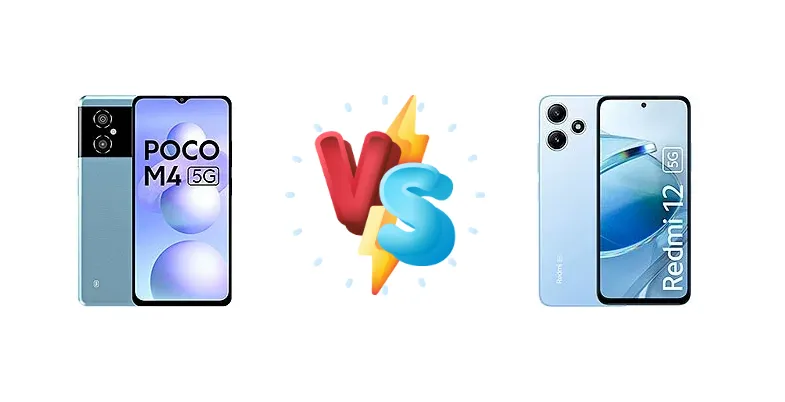
Xiaomi's budget 5G offerings, the Poco M4 5G (India) and the Redmi 12 5G, represent compelling options for users entering the 5G space. While both aim for affordability, they diverge in their core hardware, specifically the chipset. This comparison dissects these differences to determine which phone delivers the best value and performance for your needs.
🏆 Quick Verdict
For most users, the Xiaomi Redmi 12 5G emerges as the better choice. Its Snapdragon 4 Gen 2, built on a more efficient 4nm process, offers a noticeable performance advantage and improved thermal management over the Poco M4 5G's Dimensity 700, despite similar CPU clock speeds. The inclusion of PD charging is a welcome bonus.
| Network |
|---|
| 2G bands | GSM 850 / 900 / 1800 / 1900 | GSM 850 / 900 / 1800 / 1900 |
| 3G bands | HSDPA 850 / 900 / 1900 / 2100 | HSDPA 850 / 900 / 2100 |
| 4G bands | 1, 3, 5, 8, 40, 41 | 1, 3, 5, 8, 40, 41 |
| 5G bands | 1, 3, 5, 8, 28, 40, 78 SA/NSA | 1, 3, 5, 8, 28, 40, 78 SA/NSA |
| Speed | HSPA, LTE, 5G | HSPA, LTE, 5G |
| Technology | GSM / HSPA / LTE / 5G | GSM / HSPA / LTE / 5G |
| Launch |
|---|
| Announced | 2022, April 29 | 2023, August 01 |
| Status | Available. Released 2022, May 05 | Available. Released 2023, August 04 |
| Body |
|---|
| Build | Glass front (Gorilla Glass 3), plastic frame, plastic back | Glass front (Gorilla Glass), plastic frame, glass back (Gorilla Glass) |
| Dimensions | 164 x 76.1 x 8.9 mm (6.46 x 3.00 x 0.35 in) | 168.6 x 76.3 x 8.2 mm (6.64 x 3.00 x 0.32 in) |
| SIM | Nano-SIM + Nano-SIM | Nano-SIM + Nano-SIM |
| Weight | 200 g (7.05 oz) | 199 g (7.02 oz) |
| | Splash resistant | - |
| Display |
|---|
| Protection | Corning Gorilla Glass 3 | Corning Gorilla Glass |
| Resolution | 1080 x 2400 pixels, 20:9 ratio (~401 ppi density) | 1080 x 2460 pixels (~396 ppi density) |
| Size | 6.58 inches, 104.0 cm2 (~83.3% screen-to-body ratio) | 6.79 inches, 109.5 cm2 (~85.1% screen-to-body ratio) |
| Type | IPS LCD, 90Hz | IPS LCD, 90Hz, 550 nits |
| Platform |
|---|
| CPU | Octa-core (2x2.2 GHz Cortex-A76 & 6x2.0 GHz Cortex-A55) | Octa-core (2x2.2 GHz Cortex-A78 & 6x1.95 GHz Cortex-A55) |
| Chipset | Mediatek Dimensity 700 (7 nm) | Qualcomm SM4450 Snapdragon 4 Gen 2 (4 nm) |
| GPU | Mali-G57 MC2 | Adreno 613 |
| OS | Android 12, MIUI 13 | Android 13, upgradable to Android 15, HyperOS 2 |
| Memory |
|---|
| Card slot | microSDXC (dedicated slot) | microSDXC (uses shared SIM slot) |
| Internal | 64GB 4GB RAM, 128GB 6GB RAM | 128GB 4GB RAM, 128GB 6GB RAM, 128GB 8GB RAM, 256GB 8GB RAM |
| | UFS 2.2 | - |
| Main Camera |
|---|
| Dual | 50 MP, f/1.8, (wide), 0.7µm, PDAF
Auxiliary lens | 50 MP, f/1.8, (wide), PDAF
Auxiliary lens |
| Features | LED flash, HDR, panorama | LED flash, HDR |
| Single | 8 MP, f/2.4, (wide), 1.0µm | - |
| Video | 1080p@30fps | 1080p@30fps |
| Selfie camera |
|---|
| Features | HDR | HDR |
| Single | 8 MP, f/2.4, (wide), 1.0µm | 8 MP, f/2.0, (wide), 1.12µm |
| Video | 1080p@30fps | 1080p@30fps |
| Sound |
|---|
| 3.5mm jack | Yes | - |
| 35mm jack | Yes | Yes |
| Loudspeaker | Yes | Yes |
| | 24-bit/192kHz audio | - |
| Comms |
|---|
| Bluetooth | 5.1, A2DP, LE | 5.3, A2DP, LE |
| Infrared port | Yes | Yes |
| NFC | Yes (market/region dependent) | Unspecified |
| Positioning | GPS, GLONASS, BDS | GPS, GLONASS, GALILEO, BDS |
| Radio | FM radio | No |
| USB | USB Type-C 2.0, OTG | USB Type-C |
| WLAN | Wi-Fi 802.11 a/b/g/n/ac, dual-band, Wi-Fi Direct | Wi-Fi 802.11 a/b/g/n/ac, dual-band |
| Features |
|---|
| Sensors | Fingerprint (side-mounted), accelerometer, proximity, gyro, compass | Fingerprint (side-mounted), accelerometer, compass |
| Battery |
|---|
| Charging | 18W wired | 18W wired, PD |
| Type | Li-Po 5000 mAh | Li-Po 5000 mAh |
| Misc |
|---|
| Colors | Gray, Silver, Blue | Jade Black, Pastel Blue, Moonstone Silver |
| Models | MZB0BRZIN, 22041219PI | 23076RN4BI, 23076RN8DY, 2AFZZRN8DY |
| Price | About 190 EUR | € 104.09 / ₹ 15,999 |
| SAR | 0.85 W/kg (head) 0.85 W/kg (body) | 1.09 W/kg (head) 0.88 W/kg (body) |
| SAR EU | - | 0.98 W/kg (head) 1.00 W/kg (body) |
| Tests |
|---|
| Loudspeaker |
-28.8 LUFS (Average)
| - |
Xiaomi Poco M4 5G (India)
- Potentially lower price point
- Slightly higher contrast ratio (1630:1)
- Established Xiaomi ecosystem integration
- Less efficient Dimensity 700 chipset
- No Power Delivery charging support
- Potential for thermal throttling under sustained load
Xiaomi Redmi 12 5G
- More efficient Snapdragon 4 Gen 2 chipset (4nm)
- Power Delivery (PD) charging support
- Potentially better sustained performance
- May be slightly more expensive
- Display brightness likely similar to Poco M4 5G
- Camera performance likely comparable
Display Comparison
Both phones feature displays geared towards affordability. The Poco M4 5G boasts a measured peak brightness of 410 nits and a 1630:1 contrast ratio. While adequate for indoor use, the Redmi 12 5G’s display specifications are not provided, suggesting a similar, if not slightly lower, brightness level. The absence of high refresh rate panels on either device indicates a focus on power efficiency rather than visual fluidity. The Poco's contrast ratio is a slight advantage, but real-world differences will be minimal for average users.
Camera Comparison
Detailed camera specifications are lacking for both devices. Given their price points, we can expect similar camera performance, likely centered around a primary sensor with modest resolution. The presence of a 2MP macro camera on both is largely a marketing tactic, offering limited practical benefit. Image processing will likely lean towards Xiaomi’s signature vibrant style. Without further details on sensor size and aperture, it’s difficult to definitively declare a winner.
Performance
The core difference lies in the chipsets. The Poco M4 5G utilizes the Mediatek Dimensity 700 (7nm), featuring an octa-core CPU with 2x2.2 GHz Cortex-A76 and 6x2.0 GHz Cortex-A55 cores. The Redmi 12 5G, however, is powered by the Qualcomm SM4450 Snapdragon 4 Gen 2 (4nm), with an octa-core CPU of 2x2.2 GHz Cortex-A78 and 6x1.95 GHz Cortex-A55 cores. The Snapdragon 4 Gen 2’s 4nm fabrication process is a significant advantage, offering improved power efficiency and potentially better sustained performance under load. While both CPUs have similar peak clock speeds, the Cortex-A78 cores in the Snapdragon 4 Gen 2 generally outperform the Cortex-A76 cores in the Dimensity 700. This translates to snappier app launches and smoother multitasking on the Redmi 12 5G.
Battery Life
Both phones feature 18W wired charging. However, the Redmi 12 5G adds Power Delivery (PD) support, offering wider compatibility with chargers and potentially faster charging speeds with compatible adapters. While the battery capacity isn't specified, the Snapdragon 4 Gen 2’s superior efficiency should translate to longer battery life on the Redmi 12 5G, even with a similar capacity. The PD support on the Redmi 12 5G provides a convenience factor that the Poco M4 5G lacks.
Buying Guide
Buy the Xiaomi Poco M4 5G (India) if you prioritize a slightly higher contrast ratio and are already deeply embedded in the Xiaomi ecosystem and find a significantly lower price. Buy the Xiaomi Redmi 12 5G if you prefer a more modern and efficient chipset, faster charging with Power Delivery support, and a potentially smoother long-term user experience due to better thermal efficiency.
Frequently Asked Questions
❓ Will the Snapdragon 4 Gen 2 in the Redmi 12 5G handle demanding games like PUBG Mobile smoothly?
The Snapdragon 4 Gen 2 is capable of running PUBG Mobile, but expect to play at medium settings for a consistently smooth experience. While not a gaming powerhouse, its improved efficiency over the Dimensity 700 will result in less frame rate drops during extended gaming sessions.
❓ Does the Redmi 12 5G support faster charging than 18W, even with Power Delivery?
While the Redmi 12 5G supports Power Delivery, the maximum charging speed is still capped at 18W. However, PD allows for compatibility with a wider range of chargers, and some PD chargers may optimize the charging process for slightly faster overall times compared to a standard 18W charger.
❓ Is the difference in CPU architecture (Cortex-A78 vs A76) noticeable in everyday tasks?
Yes, the Cortex-A78 cores in the Snapdragon 4 Gen 2 offer a performance uplift over the Cortex-A76 cores in the Dimensity 700. This translates to snappier app launches, smoother scrolling, and a more responsive overall user experience, particularly when multitasking.