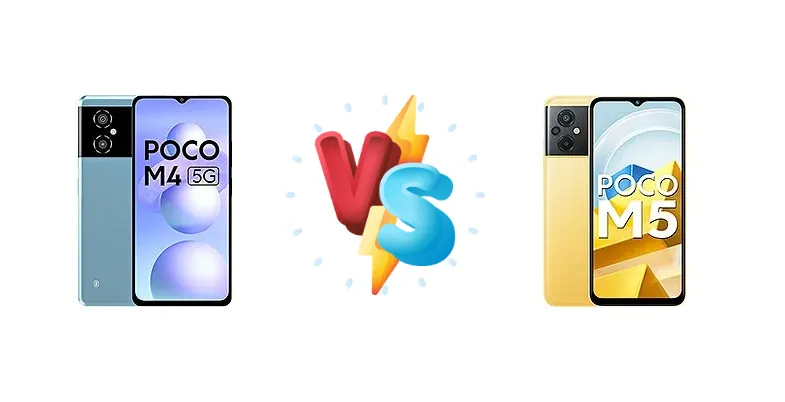
Xiaomi's Poco sub-brand consistently delivers impressive value, but navigating their lineup can be tricky. The Poco M4 5G (specifically the India variant) and the Poco M5 represent two compelling options in the sub-$200 price bracket. This comparison dissects their key differences, focusing on performance, display quality, and battery endurance to determine which device best suits your needs.
🏆 Quick Verdict
For most users, the Poco M5 emerges as the better choice. While the M4 5G offers 5G connectivity, the Poco M5’s more efficient Helio G99 chipset and slightly brighter display provide a smoother overall experience, especially for everyday tasks and light gaming, despite both phones sharing the same 18W charging.
| Network |
|---|
| 2G bands | GSM 850 / 900 / 1800 / 1900 | GSM 850 / 900 / 1800 / 1900 |
| 3G bands | HSDPA 850 / 900 / 1900 / 2100 | HSDPA 850 / 900 / 1700(AWS) / 1900 / 2100 |
| 4G bands | 1, 3, 5, 8, 40, 41 | 1, 2, 3, 4, 5, 7, 8, 20, 28, 38, 40, 41 |
| 5G bands | 1, 3, 5, 8, 28, 40, 78 SA/NSA | - |
| Speed | HSPA, LTE, 5G | HSPA, LTE |
| Technology | GSM / HSPA / LTE / 5G | GSM / HSPA / LTE |
| Launch |
|---|
| Announced | 2022, April 29 | 2022, September 05 |
| Status | Available. Released 2022, May 05 | Available. Released 2022, September 13 |
| Body |
|---|
| Build | Glass front (Gorilla Glass 3), plastic frame, plastic back | Glass front (Gorilla Glass 3), plastic frame, plastic back |
| Dimensions | 164 x 76.1 x 8.9 mm (6.46 x 3.00 x 0.35 in) | 164 x 76.1 x 8.9 mm (6.46 x 3.00 x 0.35 in) |
| SIM | Nano-SIM + Nano-SIM | Nano-SIM + Nano-SIM |
| Weight | 200 g (7.05 oz) | 201 g (7.09 oz) |
| | Splash resistant | - |
| Display |
|---|
| Protection | Corning Gorilla Glass 3 | Corning Gorilla Glass 3 |
| Resolution | 1080 x 2400 pixels, 20:9 ratio (~401 ppi density) | 1080 x 2408 pixels, 20:9 ratio (~401 ppi density) |
| Size | 6.58 inches, 104.0 cm2 (~83.3% screen-to-body ratio) | 6.58 inches, 104.3 cm2 (~83.6% screen-to-body ratio) |
| Type | IPS LCD, 90Hz | IPS LCD, 90Hz, 500 nits (HBM) |
| Platform |
|---|
| CPU | Octa-core (2x2.2 GHz Cortex-A76 & 6x2.0 GHz Cortex-A55) | Octa-core (2x2.2 GHz Cortex-A76 & 6x2.0 GHz Cortex-A55) |
| Chipset | Mediatek Dimensity 700 (7 nm) | Mediatek Helio G99 (6 nm) |
| GPU | Mali-G57 MC2 | Mali-G57 MC2 |
| OS | Android 12, MIUI 13 | Android 12, upgradable to Android 14, HyperOS |
| Memory |
|---|
| Card slot | microSDXC (dedicated slot) | microSDXC (dedicated slot) |
| Internal | 64GB 4GB RAM, 128GB 6GB RAM | 64GB 4GB RAM, 128GB 4GB RAM, 128GB 6GB RAM |
| | UFS 2.2 | UFS 2.2 |
| Main Camera |
|---|
| Dual | 50 MP, f/1.8, (wide), 0.7µm, PDAF
Auxiliary lens | - |
| Features | LED flash, HDR, panorama | LED flash, HDR, panorama |
| Single | 8 MP, f/2.4, (wide), 1.0µm | - |
| Triple | - | 50 MP, f/1.8, (wide), PDAF
2 MP (macro)
Auxiliary lens |
| Video | 1080p@30fps | 1080p@30fps |
| Selfie camera |
|---|
| Features | HDR | - |
| Single | 8 MP, f/2.4, (wide), 1.0µm | 5 MP, f/2.2, (wide), 1/5.0", 1.12µm |
| Video | 1080p@30fps | 1080p@30fps |
| Sound |
|---|
| 3.5mm jack | Yes | Yes |
| 35mm jack | Yes | Yes |
| Loudspeaker | Yes | Yes |
| | 24-bit/192kHz audio | - |
| Comms |
|---|
| Bluetooth | 5.1, A2DP, LE | 5.3, A2DP, LE |
| Infrared port | Yes | Yes |
| NFC | Yes (market/region dependent) | Yes |
| Positioning | GPS, GLONASS, BDS | GPS, GLONASS, GALILEO, BDS |
| Radio | FM radio | FM radio |
| USB | USB Type-C 2.0, OTG | USB Type-C 2.0, OTG |
| WLAN | Wi-Fi 802.11 a/b/g/n/ac, dual-band, Wi-Fi Direct | Wi-Fi 802.11 a/b/g/n/ac, dual-band, Wi-Fi Direct |
| Features |
|---|
| Sensors | Fingerprint (side-mounted), accelerometer, proximity, gyro, compass | Fingerprint (side-mounted), accelerometer, proximity, compass |
| Battery |
|---|
| Charging | 18W wired | 18W wired |
| Type | Li-Po 5000 mAh | Li-Po 5000 mAh |
| Misc |
|---|
| Colors | Gray, Silver, Blue | Black, Green, Yellow |
| Models | MZB0BRZIN, 22041219PI | 22071219CG |
| Price | About 190 EUR | About 100 EUR |
| SAR | 0.85 W/kg (head) 0.85 W/kg (body) | 1.04 W/kg (head) 0.83 W/kg (body) |
| SAR EU | - | 0.52 W/kg (head) 0.83 W/kg (body) |
| Tests |
|---|
| Battery life | - |
Endurance rating 121h
|
| Camera | - |
Photo / Video |
| Display | - |
Contrast ratio: 1363:1 |
| Loudspeaker |
-28.8 LUFS (Average)
|
-27.6 LUFS (Good)
|
| Performance | - |
AnTuTu: 386311 (v9)
GeekBench: 1896 (v5.1)
GFXBench: 12fps (ES 3.1 onscreen) |
Xiaomi Poco M4 5G (India)
- 5G Connectivity: Offers future-proofed network access.
- Slightly Higher Contrast Ratio: May result in marginally deeper blacks.
- Competitive Price: Often available at a similar or lower price point.
- Less Efficient Chipset: Dimensity 700 consumes more power.
- Potential for Throttling: May experience performance drops during extended use.
Xiaomi Poco M5
- More Efficient Chipset: Helio G99 provides better power management.
- Brighter Display: Improved visibility in sunlight.
- Sustained Performance: Less prone to throttling during gaming.
- Lacks 5G Connectivity: Limited to 4G networks.
- Similar Camera Performance: Image quality is likely comparable to the M4 5G.
Display Comparison
Both the Poco M4 5G and M5 feature displays capable of 400+ nits of brightness, but the Poco M5 edges ahead with a measured peak brightness of 448 nits compared to the M4 5G’s 410 nits. This translates to slightly better visibility in direct sunlight. Contrast ratios are similar, at 1363:1 for the M5 and 1630:1 for the M4 5G, meaning black levels are comparable. Neither display boasts a high refresh rate, focusing instead on efficiency. The difference in contrast is unlikely to be noticeable in real-world use.
Camera Comparison
Both phones are equipped with cameras for photo and video capture, but detailed sensor information is lacking. Given the price point, expectations should be tempered. The focus should be on the image processing capabilities of each chipset. The Helio G99 in the M5 generally offers better image signal processing (ISP) capabilities than the Dimensity 700, potentially leading to slightly improved image quality, particularly in challenging lighting conditions. The presence of a 2MP macro camera on both devices is largely a marketing feature and unlikely to deliver significant photographic value.
Performance
The core difference lies in the chipsets. The Poco M4 5G utilizes the Mediatek Dimensity 700 (7nm), while the Poco M5 features the Helio G99 (6nm). While both CPUs share the same core configuration (2x2.2 GHz Cortex-A76 & 6x2.0 GHz Cortex-A55), the 6nm process of the Helio G99 offers improved power efficiency and thermal performance. This means the M5 is likely to sustain peak performance for longer periods without significant throttling, benefiting gamers and heavy multitaskers. The M4 5G’s 5G modem adds connectivity, but at the expense of efficiency.
Battery Life
Both devices achieve an impressive endurance rating of 121 hours, suggesting similar real-world battery life. However, the more efficient Helio G99 in the Poco M5, coupled with the 6nm process, likely contributes to slightly longer screen-on time. Both phones support 18W wired charging, meaning 0-100% charge times will be comparable, around 2-3 hours. The efficiency gains of the G99 translate to less energy wasted during typical usage.
Buying Guide
Buy the Xiaomi Poco M4 5G (India) if 5G connectivity is a non-negotiable requirement and you prioritize future-proofing, even at the cost of slightly reduced performance. Buy the Xiaomi Poco M5 if you prioritize a more responsive user experience, a marginally better display, and longer sustained performance during gaming and multimedia consumption, and don't need immediate 5G access.
Frequently Asked Questions
❓ Does the Poco M4 5G's 5G connectivity significantly impact battery life?
Yes, actively using 5G on the Poco M4 5G will noticeably reduce battery life compared to 4G on the Poco M5. The 5G modem consumes more power, and the network itself can be less efficient in areas with limited 5G coverage, forcing the phone to work harder to maintain a connection.
❓ Is the Helio G99 in the Poco M5 powerful enough for demanding games like PUBG Mobile?
The Helio G99 is capable of running PUBG Mobile at medium settings with stable frame rates. While it won't deliver the highest graphical fidelity, the improved thermal efficiency of the G99 allows for longer gaming sessions without significant performance throttling, providing a smoother experience than the Poco M4 5G.
❓ Are the camera differences between the Poco M4 5G and Poco M5 noticeable in everyday photos?
The differences are likely subtle. Both phones will produce acceptable photos in good lighting conditions. The Poco M5 may exhibit slightly better dynamic range and noise reduction in low-light scenarios due to the Helio G99's improved ISP, but the overall image quality will be similar.
❓ Which phone is better for watching videos and streaming content?
The Poco M5 is slightly better for video consumption due to its brighter display. The increased brightness makes videos more visible in well-lit environments, and the more efficient chipset contributes to longer battery life during extended viewing sessions.