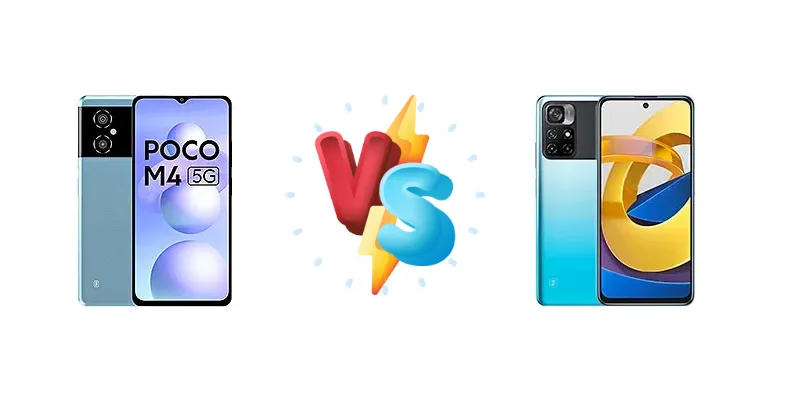
Xiaomi's Poco series consistently delivers impressive value in the budget smartphone market. The Poco M4 5G and M4 Pro 5G are two compelling options, both offering 5G connectivity. But which one reigns supreme? This comprehensive comparison will break down the key differences to help you make the right choice.
🏆 Quick Verdict
The Poco M4 Pro 5G edges out the M4 5G thanks to its faster Dimensity 810 chipset, brighter display, quicker charging, and potentially better camera capabilities. However, the M4 5G remains a solid choice for those prioritizing a slightly more budget-friendly price point.
| Network |
|---|
| 2G bands | GSM 850 / 900 / 1800 / 1900 | GSM 850 / 900 / 1800 / 1900 |
| 3G bands | HSDPA 850 / 900 / 1900 / 2100 | HSDPA 850 / 900 / 1700(AWS) / 1900 / 2100 - International |
| 4G bands | 1, 3, 5, 8, 40, 41 | 1, 2, 3, 4, 5, 7, 8, 12, 17, 20, 28, 32, 38, 40, 41, 66 - International |
| 5G bands | 1, 3, 5, 8, 28, 40, 78 SA/NSA | 1, 3, 5, 7, 8, 20, 28, 38, 40, 41, 66, 77, 78 SA/NSA - International |
| Speed | HSPA, LTE, 5G | HSPA, LTE, 5G |
| Technology | GSM / HSPA / LTE / 5G | GSM / HSPA / LTE / 5G |
| | - | 1, 3, 5, 8, 28, 40, 78 SA/NSA - India |
| Launch |
|---|
| Announced | 2022, April 29 | 2021, November 09 |
| Status | Available. Released 2022, May 05 | Available. Released 2021, November 11 |
| Body |
|---|
| Build | Glass front (Gorilla Glass 3), plastic frame, plastic back | Glass front (Gorilla Glass 3), plastic back, plastic frame |
| Dimensions | 164 x 76.1 x 8.9 mm (6.46 x 3.00 x 0.35 in) | 163.6 x 75.8 x 8.8 mm (6.44 x 2.98 x 0.35 in) |
| SIM | Nano-SIM + Nano-SIM | Nano-SIM + Nano-SIM |
| Weight | 200 g (7.05 oz) | 195 g (6.88 oz) |
| | Splash resistant | IP53, dust and splash resistant |
| Display |
|---|
| Protection | Corning Gorilla Glass 3 | Corning Gorilla Glass 3 |
| Resolution | 1080 x 2400 pixels, 20:9 ratio (~401 ppi density) | 1080 x 2400 pixels, 20:9 ratio (~399 ppi density) |
| Size | 6.58 inches, 104.0 cm2 (~83.3% screen-to-body ratio) | 6.6 inches, 105.2 cm2 (~84.8% screen-to-body ratio) |
| Type | IPS LCD, 90Hz | IPS LCD, 90Hz, 450 nits (typ) |
| Platform |
|---|
| CPU | Octa-core (2x2.2 GHz Cortex-A76 & 6x2.0 GHz Cortex-A55) | Octa-core (2x2.4 GHz Cortex-A76 & 6x2.0 GHz Cortex-A55) |
| Chipset | Mediatek Dimensity 700 (7 nm) | Mediatek Dimensity 810 (6 nm) |
| GPU | Mali-G57 MC2 | Mali-G57 MC2 |
| OS | Android 12, MIUI 13 | Android 11, upgradable to Android 12, MIUI 13 |
| Memory |
|---|
| Card slot | microSDXC (dedicated slot) | microSDXC |
| Internal | 64GB 4GB RAM, 128GB 6GB RAM | 64GB 4GB RAM, 64GB 6GB RAM, 128GB 4GB RAM, 128GB 6GB RAM, 128GB 8GB RAM, 256GB 8GB RAM |
| | UFS 2.2 | UFS 2.2 |
| Main Camera |
|---|
| Dual | 50 MP, f/1.8, (wide), 0.7µm, PDAF
Auxiliary lens | 50 MP, f/1.8, 26mm (wide), PDAF
8 MP, f/2.2, 119˚ (ultrawide) |
| Features | LED flash, HDR, panorama | LED flash, HDR, panorama |
| Single | 8 MP, f/2.4, (wide), 1.0µm | 16 MP, f/2.5, (wide), 1/3.06" 1.0µm |
| Video | 1080p@30fps | 1080p@30/60fps |
| Selfie camera |
|---|
| Features | HDR | Panorama |
| Single | 8 MP, f/2.4, (wide), 1.0µm | 16 MP, f/2.5, (wide), 1/3.06" 1.0µm |
| Video | 1080p@30fps | 1080p@30fps |
| Sound |
|---|
| 3.5mm jack | Yes | Yes |
| 35mm jack | Yes | Yes |
| Loudspeaker | Yes | Yes, with stereo speakers |
| | 24-bit/192kHz audio | - |
| Comms |
|---|
| Bluetooth | 5.1, A2DP, LE | 5.1, A2DP, LE |
| Infrared port | Yes | Yes |
| NFC | Yes (market/region dependent) | Yes (market/region dependent) |
| Positioning | GPS, GLONASS, BDS | GPS, GLONASS, GALILEO, BDS |
| Radio | FM radio | FM radio |
| USB | USB Type-C 2.0, OTG | USB Type-C 2.0, OTG |
| WLAN | Wi-Fi 802.11 a/b/g/n/ac, dual-band, Wi-Fi Direct | Wi-Fi 802.11 a/b/g/n/ac, dual-band, Wi-Fi Direct |
| Features |
|---|
| Sensors | Fingerprint (side-mounted), accelerometer, proximity, gyro, compass | Fingerprint (side-mounted), accelerometer, gyro, compass |
| Battery |
|---|
| Charging | 18W wired | 33W wired, 100% in 59 min |
| Type | Li-Po 5000 mAh | Li-Po 5000 mAh |
| Misc |
|---|
| Colors | Gray, Silver, Blue | Poco Yellow, Power Black, Cool Blue |
| Models | MZB0BRZIN, 22041219PI | 21091116AG, MZB0BGVIN |
| Price | About 190 EUR | About 150 EUR |
| SAR | 0.85 W/kg (head) 0.85 W/kg (body) | 1.07 W/kg (head) 1.09 W/kg (body) |
| SAR EU | - | 0.59 W/kg (head) 1.00 W/kg (body) |
| Tests |
|---|
| Battery life | - |
Endurance rating 123h
|
| Camera | - |
Photo / Video |
| Display | - |
Contrast ratio: 1553:1 (nominal) |
| Loudspeaker |
-28.8 LUFS (Average)
|
-24.9 LUFS (Very good)
|
| Performance | - |
AnTuTu: 296721 (v8), 353663 (v9)
GeekBench: 1797 (v5.1)
GFXBench: 13fps (ES 3.1 onscreen) |
Xiaomi Poco M4 5G (India)
- More affordable
- Decent 5G connectivity
- Good battery life
- Lightweight design
- Slower chipset
- Lower brightness display
- Slower charging
- Less capable camera
Xiaomi Poco M4 Pro 5G
- Faster chipset (Dimensity 810)
- Brighter display
- Faster charging (33W)
- Potentially better camera
- Stylish design
- Slightly more expensive
- May have slightly less storage options
Display Comparison
The Poco M4 Pro 5G boasts a slightly brighter display at 510 nits compared to the M4 5G's 410 nits. While both offer a respectable 1553:1 and 1630:1 contrast ratio respectively, the Pro's extra brightness will be noticeable in outdoor conditions. Both likely use an AMOLED panel, offering vibrant colors and deep blacks.
Camera Comparison
While both are listed as having 'Photo / Video' capabilities, the Poco M4 Pro 5G is generally expected to have a more capable camera system. It likely features a higher resolution main sensor and potentially additional features like optical image stabilization (OIS). The M4 5G's camera is adequate for basic photography.
Performance
The Dimensity 810 in the Poco M4 Pro 5G provides a noticeable performance boost over the Dimensity 700 in the M4 5G. Expect smoother multitasking, faster app loading times, and better gaming performance on the Pro. Both phones have 8GB of RAM, which helps with multitasking.
Battery Life
Both phones offer excellent battery life, with the Poco M4 Pro 5G achieving an impressive endurance rating of 123h. The M4 5G's battery life is also very good, though slightly less than the Pro. The Pro's 33W charging is significantly faster than the M4 5G's 18W, allowing for quicker top-ups.
Buying Guide
Who should buy the Xiaomi Poco M4 5G (India)? This phone is ideal for users on a tight budget who need basic 5G connectivity and reliable performance for everyday tasks. Who should buy the Xiaomi Poco M4 Pro 5G? It's the better pick for those who value a smoother experience, faster charging, a brighter screen, and potentially improved camera quality, even if it means spending a bit more.
Frequently Asked Questions
❓ Is the Poco M4 Pro 5G worth the extra money?
If you prioritize performance, a brighter display, and faster charging, then the Poco M4 Pro 5G is definitely worth the extra investment. However, if you're on a strict budget, the M4 5G still offers a solid 5G experience.
❓ What is the difference between the Dimensity 700 and Dimensity 810 chipsets?
The Dimensity 810 offers a significant performance improvement over the Dimensity 700, resulting in smoother multitasking, faster app loading, and better gaming performance. It also benefits from a more efficient 6nm manufacturing process.