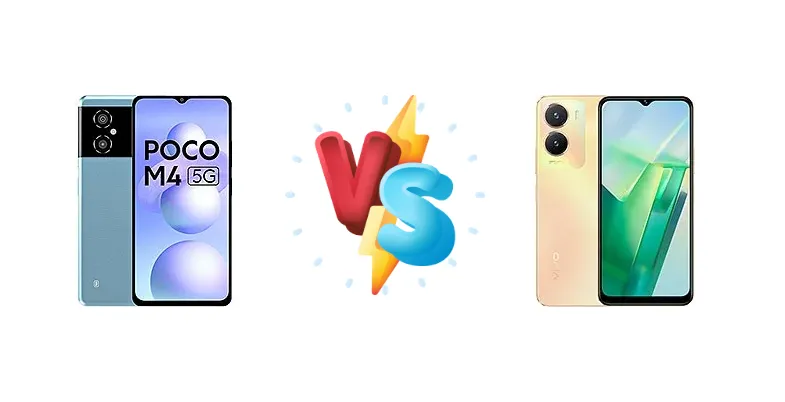
The budget 5G smartphone market is heating up, and the Xiaomi Poco M4 5G and vivo T2x are two contenders vying for your attention. Both offer 5G connectivity at an attractive price point, but which one delivers the better overall experience? Let's dive into a comprehensive comparison.
🏆 Quick Verdict
The Poco M4 5G edges out the vivo T2x thanks to its slightly more powerful chipset and potentially better software support. While both offer similar charging speeds and design aesthetics, the Dimensity 700 provides a noticeable performance advantage for gaming and demanding tasks. Ultimately, it's a close call, but the Poco takes the crown.
| Network |
|---|
| 2G bands | GSM 850 / 900 / 1800 / 1900 | GSM 850 / 900 / 1800 / 1900 |
| 3G bands | HSDPA 850 / 900 / 1900 / 2100 | HSDPA 850 / 900 / 2100 |
| 4G bands | 1, 3, 5, 8, 40, 41 | 1, 3, 5, 8, 38, 40, 41 |
| 5G bands | 1, 3, 5, 8, 28, 40, 78 SA/NSA | 1, 3, 8, 28, 77, 78 SA/NSA |
| Speed | HSPA, LTE, 5G | HSPA, LTE, 5G |
| Technology | GSM / HSPA / LTE / 5G | GSM / HSPA / LTE / 5G |
| Launch |
|---|
| Announced | 2022, April 29 | 2023, April 11 |
| Status | Available. Released 2022, May 05 | Available. Released 2023, April 21 |
| Body |
|---|
| Build | Glass front (Gorilla Glass 3), plastic frame, plastic back | Glass front, plastic frame, plastic back |
| Dimensions | 164 x 76.1 x 8.9 mm (6.46 x 3.00 x 0.35 in) | 164.1 x 75.6 x 8.2 mm (6.46 x 2.98 x 0.32 in) |
| SIM | Nano-SIM + Nano-SIM | Nano-SIM + Nano-SIM |
| Weight | 200 g (7.05 oz) | 184 g (6.49 oz) |
| | Splash resistant | - |
| Display |
|---|
| Protection | Corning Gorilla Glass 3 | - |
| Resolution | 1080 x 2400 pixels, 20:9 ratio (~401 ppi density) | 1080 x 2408 pixels, 20:9 ratio (~401 ppi density) |
| Size | 6.58 inches, 104.0 cm2 (~83.3% screen-to-body ratio) | 6.58 inches, 104.3 cm2 (~84.1% screen-to-body ratio) |
| Type | IPS LCD, 90Hz | IPS LCD |
| Platform |
|---|
| CPU | Octa-core (2x2.2 GHz Cortex-A76 & 6x2.0 GHz Cortex-A55) | Octa-core (2x2.2 GHz Cortex-A76 & 6x2.0 GHz Cortex-A55) |
| Chipset | Mediatek Dimensity 700 (7 nm) | Mediatek Dimensity 6020 (7 nm) |
| GPU | Mali-G57 MC2 | Mali-G57 MC2 |
| OS | Android 12, MIUI 13 | Android 13, Funtouch 13 |
| Memory |
|---|
| Card slot | microSDXC (dedicated slot) | microSDXC (uses shared SIM slot) |
| Internal | 64GB 4GB RAM, 128GB 6GB RAM | 128GB 4GB RAM, 128GB 6GB RAM, 128GB 8GB RAM |
| | UFS 2.2 | - |
| Main Camera |
|---|
| Dual | 50 MP, f/1.8, (wide), 0.7µm, PDAF
Auxiliary lens | 50 MP, f/1.8, 0.64µm, (wide), PDAF
2 MP (macro) |
| Features | LED flash, HDR, panorama | LED flash, HDR, panorama |
| Single | 8 MP, f/2.4, (wide), 1.0µm | - |
| Video | 1080p@30fps | 1080p@30fps |
| Selfie camera |
|---|
| Features | HDR | - |
| Single | 8 MP, f/2.4, (wide), 1.0µm | 8 MP, f/2.0, (wide) |
| Video | 1080p@30fps | Yes |
| Sound |
|---|
| 3.5mm jack | Yes | Yes |
| 35mm jack | Yes | Yes |
| Loudspeaker | Yes | Yes |
| | 24-bit/192kHz audio | - |
| Comms |
|---|
| Bluetooth | 5.1, A2DP, LE | 5.1, A2DP, LE |
| Infrared port | Yes | - |
| NFC | Yes (market/region dependent) | No |
| Positioning | GPS, GLONASS, BDS | GPS, GLONASS, GALILEO, BDS, QZSS |
| Radio | FM radio | FM radio |
| USB | USB Type-C 2.0, OTG | USB Type-C 2.0, OTG |
| WLAN | Wi-Fi 802.11 a/b/g/n/ac, dual-band, Wi-Fi Direct | Wi-Fi 802.11 a/b/g/n/ac, dual-band |
| Features |
|---|
| Sensors | Fingerprint (side-mounted), accelerometer, proximity, gyro, compass | Fingerprint (side-mounted), accelerometer, proximity, compass |
| Battery |
|---|
| Charging | 18W wired | 18W wired |
| Type | Li-Po 5000 mAh | 5000 mAh |
| Misc |
|---|
| Colors | Gray, Silver, Blue | Glimmer Black, Aurora Gold, Marine Blue |
| Models | MZB0BRZIN, 22041219PI | V2253 |
| Price | About 190 EUR | About 150 EUR |
| SAR | 0.85 W/kg (head) 0.85 W/kg (body) | - |
| Tests |
|---|
| Loudspeaker |
-28.8 LUFS (Average)
| - |
Xiaomi Poco M4 5G (India)
- Slightly more powerful chipset (Dimensity 700)
- Potentially better software support
- Good contrast ratio display
- Decent battery life
- 18W charging is slow
- Camera performance is average
- Design is somewhat generic
vivo T2x (India)
- Clean and user-friendly Funtouch OS
- Good value for money
- Decent battery life
- Reliable performance for everyday tasks
- Less powerful chipset (Dimensity 6020)
- Slower performance compared to Poco M4 5G
- 18W charging is slow
- Camera performance is average
Display Comparison
Both phones feature similar display technology, likely LCD panels. The Poco M4 5G boasts a 1630:1 contrast ratio, which suggests deeper blacks and better image quality compared to the T2x. However, both have a measured max brightness of around 410 nits, indicating they might struggle in direct sunlight. Resolution and refresh rate are likely to be similar, probably FHD+ and 60Hz.
Camera Comparison
Camera specs are likely comparable, with both phones probably featuring a primary 50MP sensor. Image quality will depend heavily on software processing. The Poco M4 5G might have a slight edge due to Xiaomi's generally good camera software. However, both are unlikely to excel in low-light conditions. Expect standard features like portrait mode and HDR.
Performance
Here's where the Poco M4 5G has a slight advantage. While both phones share the same CPU configuration (2x2.2 GHz Cortex-A76 & 6x2.0 GHz Cortex-A55), the Dimensity 700 chipset in the Poco M4 5G is generally considered more powerful than the Dimensity 6020 in the vivo T2x. This translates to smoother multitasking, faster app loading times, and potentially better gaming performance. Expect the Poco to handle more demanding games at higher settings.
Battery Life
Both phones offer 18W wired charging, which is relatively slow by today's standards. Battery capacity is likely to be around 5000mAh for both devices, suggesting all-day battery life for moderate users. Charging times will be similar, around 1.5-2 hours for a full charge.
Buying Guide
The Xiaomi Poco M4 5G is ideal for users who prioritize performance and future-proofing. It's a good choice for light to moderate gamers and those who want a reliable 5G experience. The vivo T2x is a solid option for budget-conscious users who primarily use their phones for everyday tasks like browsing, social media, and calls. It offers a clean user experience and decent battery life.
Frequently Asked Questions
❓ Which phone is better for gaming?
The Xiaomi Poco M4 5G is generally better for gaming due to its more powerful Dimensity 700 chipset.
❓ Do both phones support 5G?
Yes, both the Xiaomi Poco M4 5G and the vivo T2x support 5G connectivity.