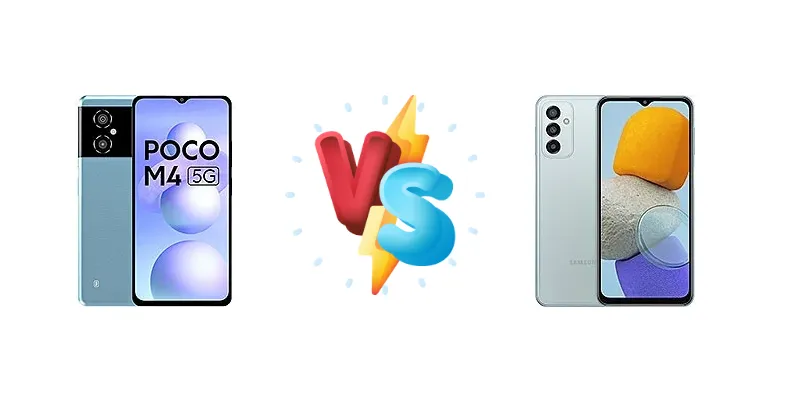
The budget 5G smartphone market is heating up, and two contenders are vying for your attention: the Xiaomi Poco M4 5G and the Samsung Galaxy F23. Both offer 5G connectivity at an attractive price point, but which one delivers the best overall experience? Let's dive into a detailed comparison.
🏆 Quick Verdict
The Samsung Galaxy F23 edges out the Poco M4 5G thanks to its slightly more powerful chipset, faster charging, and generally smoother software experience. While the Poco M4 5G offers good value, the F23 provides a more refined and future-proof package.
| Network |
|---|
| 2G bands | GSM 850 / 900 / 1800 / 1900 | GSM 850 / 900 / 1800 / 1900 |
| 3G bands | HSDPA 850 / 900 / 1900 / 2100 | HSDPA 850 / 900 / 1700(AWS) / 1900 / 2100 |
| 4G bands | 1, 3, 5, 8, 40, 41 | 1, 2, 3, 4, 5, 7, 8, 12, 17, 20, 26, 28, 38, 40, 41, 66 |
| 5G bands | 1, 3, 5, 8, 28, 40, 78 SA/NSA | 1, 3, 5, 7, 8, 20, 28, 38, 40, 41, 66, 78 SA/NSA/Sub6 |
| Speed | HSPA, LTE, 5G | HSPA, LTE, 5G |
| Technology | GSM / HSPA / LTE / 5G | GSM / HSPA / LTE / 5G |
| Launch |
|---|
| Announced | 2022, April 29 | 2022, March 08 |
| Status | Available. Released 2022, May 05 | Available. Released 2022, March 16 |
| Body |
|---|
| Build | Glass front (Gorilla Glass 3), plastic frame, plastic back | Glass front (Gorilla Glass 5), plastic frame, plastic back |
| Dimensions | 164 x 76.1 x 8.9 mm (6.46 x 3.00 x 0.35 in) | 165.5 x 77 x 8.4 mm (6.52 x 3.03 x 0.33 in) |
| SIM | Nano-SIM + Nano-SIM | Nano-SIM + Nano-SIM |
| Weight | 200 g (7.05 oz) | 198 g (6.98 oz) |
| | Splash resistant | - |
| Display |
|---|
| Protection | Corning Gorilla Glass 3 | Corning Gorilla Glass 5 |
| Resolution | 1080 x 2400 pixels, 20:9 ratio (~401 ppi density) | 1080 x 2408 pixels, 20:9 ratio (~400 ppi density) |
| Size | 6.58 inches, 104.0 cm2 (~83.3% screen-to-body ratio) | 6.6 inches, 104.9 cm2 (~82.3% screen-to-body ratio) |
| Type | IPS LCD, 90Hz | TFT LCD, 120Hz |
| Platform |
|---|
| CPU | Octa-core (2x2.2 GHz Cortex-A76 & 6x2.0 GHz Cortex-A55) | Octa-core (2x2.2 GHz Kryo 570 & 6x1.8 GHz Kryo 570) |
| Chipset | Mediatek Dimensity 700 (7 nm) | Qualcomm SM7225 Snapdragon 750G 5G (8 nm) |
| GPU | Mali-G57 MC2 | Adreno 619 |
| OS | Android 12, MIUI 13 | Android 12, upgradable to Android 14, One UI 6 |
| Memory |
|---|
| Card slot | microSDXC (dedicated slot) | microSDXC (dedicated slot) |
| Internal | 64GB 4GB RAM, 128GB 6GB RAM | 128GB 4GB RAM, 128GB 6GB RAM |
| | UFS 2.2 | - |
| Main Camera |
|---|
| Dual | 50 MP, f/1.8, (wide), 0.7µm, PDAF
Auxiliary lens | - |
| Features | LED flash, HDR, panorama | LED flash, panorama, HDR |
| Single | 8 MP, f/2.4, (wide), 1.0µm | 8 MP, f/2.2, (wide) |
| Triple | - | 50 MP, f/1.8, (wide), PDAF
8 MP, f/2.2, 123˚ (ultrawide), 1/4.0", 1.12µm
2 MP (macro) |
| Video | 1080p@30fps | 4K@30fps, 1080p@30fps, 720p@480fps |
| Selfie camera |
|---|
| Features | HDR | - |
| Single | 8 MP, f/2.4, (wide), 1.0µm | 8 MP, f/2.2, (wide) |
| Video | 1080p@30fps | 1080p@30fps |
| Sound |
|---|
| 3.5mm jack | Yes | Yes |
| 35mm jack | Yes | Yes |
| Loudspeaker | Yes | Yes |
| | 24-bit/192kHz audio | - |
| Comms |
|---|
| Bluetooth | 5.1, A2DP, LE | 5.0, A2DP, LE |
| Infrared port | Yes | - |
| NFC | Yes (market/region dependent) | Yes |
| Positioning | GPS, GLONASS, BDS | GPS, GLONASS, GALILEO, BDS, QZSS |
| Radio | FM radio | FM radio, recording |
| USB | USB Type-C 2.0, OTG | USB Type-C 2.0, OTG |
| WLAN | Wi-Fi 802.11 a/b/g/n/ac, dual-band, Wi-Fi Direct | Wi-Fi 802.11 a/b/g/n/ac, dual-band, Wi-Fi Direct |
| Features |
|---|
| Sensors | Fingerprint (side-mounted), accelerometer, proximity, gyro, compass | Fingerprint (side-mounted), accelerometer, gyro, compass |
| | - | Virtual Proximity Sensing |
| Battery |
|---|
| Charging | 18W wired | 25W wired |
| Type | Li-Po 5000 mAh | Li-Po 5000 mAh |
| Misc |
|---|
| Colors | Gray, Silver, Blue | Aqua Blue, Forest Green |
| Models | MZB0BRZIN, 22041219PI | SM-E236B, SM-E236B/DS |
| Price | About 190 EUR | About 190 EUR |
| SAR | 0.85 W/kg (head) 0.85 W/kg (body) | 1.24 W/kg (head) |
| Tests |
|---|
| Loudspeaker |
-28.8 LUFS (Average)
| - |
Xiaomi Poco M4 5G (India)
- Competitive price
- Decent performance for the price
- 5G connectivity
- Large display
- Slower charging
- Lower brightness display
- Less refined software
- Potentially less camera quality
Samsung Galaxy F23
- Faster charging (25W)
- Better performance (Snapdragon 750G)
- Smoother software experience (One UI)
- Likely better camera quality
- Reputable brand
- Slightly higher price
- Design may be less appealing to some
Display Comparison
Both phones feature FHD+ displays, but the Samsung Galaxy F23 likely has better color accuracy and viewing angles due to Samsung's display technology. The Poco M4 5G's 410 nits brightness is adequate but may struggle in direct sunlight. The F23's display is expected to be slightly brighter.
Camera Comparison
The Samsung Galaxy F23 is expected to have a more versatile camera system, potentially including a higher resolution main sensor and improved image processing. While both phones offer decent camera capabilities, the F23 is likely to produce better photos in various lighting conditions. The F23 also likely has better video recording capabilities.
Performance
The Samsung Galaxy F23's Snapdragon 750G (8nm) generally outperforms the Poco M4 5G's Dimensity 700 (7nm) in real-world usage. The Snapdragon offers better CPU and GPU performance, resulting in smoother multitasking and gaming. The F23's 8nm process also contributes to better power efficiency.
Battery Life
Both phones have similar battery capacities (around 5000mAh), but the Samsung Galaxy F23's 25W charging is significantly faster than the Poco M4 5G's 18W charging. This means the F23 will charge much quicker, a significant convenience.
Buying Guide
The Xiaomi Poco M4 5G is a good choice for users prioritizing raw performance on a tight budget and who don't mind a slightly less polished software experience. The Samsung Galaxy F23 is ideal for those seeking a more balanced experience with better charging speeds, a smoother UI, and a more reputable brand.
Frequently Asked Questions
❓ Which phone has better gaming performance?
The Samsung Galaxy F23, with its Snapdragon 750G chipset, generally offers better gaming performance than the Poco M4 5G.
❓ Is the Samsung Galaxy F23 worth the extra money?
If you value faster charging, smoother performance, and a potentially better camera, the Samsung Galaxy F23 is likely worth the extra investment.