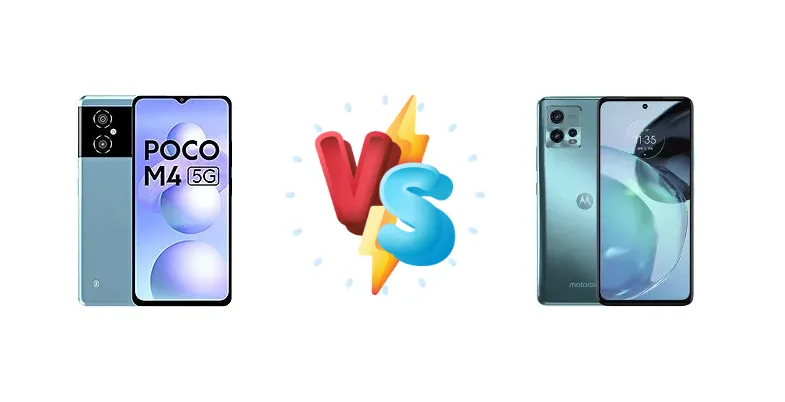
The Xiaomi Poco M4 5G (India) and Motorola Moto G72 represent compelling options in the competitive budget smartphone space. While both aim for affordability, they take different approaches – the Poco prioritizing 5G connectivity and a lower price point, while the Moto G72 focuses on a brighter display and faster charging. This comparison dissects their key differences to help you choose the right device.
🏆 Quick Verdict
For most users, the Motorola Moto G72 emerges as the better choice. Its significantly brighter 1015-nit display and 33W fast charging offer a superior user experience, outweighing the Poco M4 5G’s slightly lower cost. However, the Poco remains a viable option for those prioritizing 5G on a strict budget.
| Network |
|---|
| 2G bands | GSM 850 / 900 / 1800 / 1900 | GSM 850 / 900 / 1800 / 1900 |
| 3G bands | HSDPA 850 / 900 / 1900 / 2100 | HSDPA 850 / 900 / 1900 / 2100 |
| 4G bands | 1, 3, 5, 8, 40, 41 | 1, 2, 3, 5, 7, 8, 18, 19, 20, 26, 28, 38, 40, 41 |
| 5G bands | 1, 3, 5, 8, 28, 40, 78 SA/NSA | - |
| Speed | HSPA, LTE, 5G | HSPA 42.2/5.76 Mbps, LTE Cat4 150/50 Mbps |
| Technology | GSM / HSPA / LTE / 5G | GSM / HSPA / LTE |
| Launch |
|---|
| Announced | 2022, April 29 | 2022, September 29 |
| Status | Available. Released 2022, May 05 | Available. Released 2022, October 03 |
| Body |
|---|
| Build | Glass front (Gorilla Glass 3), plastic frame, plastic back | Glass front, plastic back, plastic frame |
| Dimensions | 164 x 76.1 x 8.9 mm (6.46 x 3.00 x 0.35 in) | 160.5 x 74.4 x 7.9 mm (6.32 x 2.93 x 0.31 in) |
| SIM | Nano-SIM + Nano-SIM | Nano-SIM + Nano-SIM |
| Weight | 200 g (7.05 oz) | 166 g (5.86 oz) |
| | Splash resistant | Water-repellent design |
| Display |
|---|
| Protection | Corning Gorilla Glass 3 | - |
| Resolution | 1080 x 2400 pixels, 20:9 ratio (~401 ppi density) | 1080 x 2400 pixels, 20:9 ratio (~402 ppi density) |
| Size | 6.58 inches, 104.0 cm2 (~83.3% screen-to-body ratio) | 6.6 inches, 103.6 cm2 (~86.8% screen-to-body ratio) |
| Type | IPS LCD, 90Hz | P-OLED, 1B colors, 120Hz |
| Platform |
|---|
| CPU | Octa-core (2x2.2 GHz Cortex-A76 & 6x2.0 GHz Cortex-A55) | Octa-core (2x2.2 GHz Cortex-A76 & 6x2.0 GHz Cortex-A55) |
| Chipset | Mediatek Dimensity 700 (7 nm) | Mediatek Helio G99 (6 nm) |
| GPU | Mali-G57 MC2 | Mali-G57 MC2 |
| OS | Android 12, MIUI 13 | Android 12, upgradable to Android 13 |
| Memory |
|---|
| Card slot | microSDXC (dedicated slot) | microSDXC (uses shared SIM slot) |
| Internal | 64GB 4GB RAM, 128GB 6GB RAM | 128GB 6GB RAM, 128GB 8GB RAM, 256GB 8GB RAM |
| | UFS 2.2 | - |
| Main Camera |
|---|
| Dual | 50 MP, f/1.8, (wide), 0.7µm, PDAF
Auxiliary lens | - |
| Features | LED flash, HDR, panorama | LED flash, HDR, panorama |
| Single | 8 MP, f/2.4, (wide), 1.0µm | - |
| Triple | - | 108 MP, f/1.7, 24mm (wide), 1/1.67", 0.64µm, PDAF
8 MP, f/2.2, 118˚ (ultrawide), 1/4.0", 1.12µm
2 MP (macro) |
| Video | 1080p@30fps | 1080p@30/60fps |
| Selfie camera |
|---|
| Features | HDR | - |
| Single | 8 MP, f/2.4, (wide), 1.0µm | 16 MP, f/2.5, (wide), 1/3.0", 1.0µm |
| Video | 1080p@30fps | 1080p@30fps |
| Sound |
|---|
| 3.5mm jack | Yes | Yes |
| 35mm jack | Yes | Yes |
| Loudspeaker | Yes | Yes, with stereo speakers |
| | 24-bit/192kHz audio | - |
| Comms |
|---|
| Bluetooth | 5.1, A2DP, LE | 5.1, A2DP, LE |
| Infrared port | Yes | - |
| NFC | Yes (market/region dependent) | Yes |
| Positioning | GPS, GLONASS, BDS | GPS, GLONASS, GALILEO |
| Radio | FM radio | FM radio |
| USB | USB Type-C 2.0, OTG | USB Type-C 2.0, OTG |
| WLAN | Wi-Fi 802.11 a/b/g/n/ac, dual-band, Wi-Fi Direct | Wi-Fi 802.11 a/b/g/n/ac, dual-band, Wi-Fi Direct |
| Features |
|---|
| Sensors | Fingerprint (side-mounted), accelerometer, proximity, gyro, compass | Fingerprint (under display, optical), accelerometer, proximity |
| Battery |
|---|
| Charging | 18W wired | 33W wired |
| Type | Li-Po 5000 mAh | Li-Po 5000 mAh |
| Misc |
|---|
| Colors | Gray, Silver, Blue | Meteorite Gray, Polar Blue, Mineral White |
| Models | MZB0BRZIN, 22041219PI | XT2255-1 |
| Price | About 190 EUR | About 150 EUR |
| SAR | 0.85 W/kg (head) 0.85 W/kg (body) | - |
| Tests |
|---|
| Battery life | - |
Endurance rating 121h
|
| Camera | - |
Photo / Video |
| Display | - |
Contrast ratio: Infinite (nominal) |
| Loudspeaker |
-28.8 LUFS (Average)
|
-26.5 LUFS (Good)
|
| Performance | - |
AnTuTu: 383317 (v9)
GeekBench: 1842 (v5.1)
GFXBench: 13fps (ES 3.1 onscreen) |
Xiaomi Poco M4 5G (India)
- Lower price point makes it accessible.
- 5G connectivity for faster data speeds.
- Decent performance for everyday tasks.
- Significantly dimmer display.
- Slower 18W charging.
- Less efficient chipset.
Motorola Moto G72
- Much brighter display for outdoor visibility.
- Faster 33W charging for convenience.
- More efficient chipset for sustained performance.
- Generally slightly more expensive.
- May not have 5G in all regions.
- Camera details are limited.
Display Comparison
The Motorola Moto G72 boasts a substantial advantage in display technology, achieving a measured peak brightness of 1015 nits compared to the Poco M4 5G’s 410 nits. This difference is immediately noticeable in outdoor visibility, making the Moto G72 far more usable in direct sunlight. While the Poco M4 5G lists a 1630:1 contrast ratio, the Moto G72’s ‘Infinite’ contrast ratio (typical of AMOLED panels, though not explicitly stated) suggests deeper blacks and more vivid colors. The lack of detailed panel information for the Poco (like refresh rate or PWM dimming) suggests a more basic display experience.
Camera Comparison
Both phones feature 'Photo / Video' capabilities, but detailed camera specifications are missing. Without sensor size, aperture, or image processing details, a direct comparison is difficult. However, the market positioning suggests the Moto G72 likely benefits from a more refined camera system, potentially with better low-light performance and image stabilization. The prevalence of 2MP macro lenses on both devices suggests they are largely marketing features and offer limited practical benefit.
Performance
Both devices utilize octa-core CPUs with the same core configuration – 2x2.2 GHz Cortex-A76 and 6x2.0 GHz Cortex-A55. However, the chipset differs: the Poco M4 5G uses the Mediatek Dimensity 700 (7nm), while the Moto G72 employs the Mediatek Helio G99 (6nm). The 6nm process of the Helio G99 generally translates to improved power efficiency and potentially slightly better sustained performance under load, reducing thermal throttling. While both chips are capable for everyday tasks, the G99 offers a marginal edge for gaming and demanding applications. The absence of LPDDR5x RAM specification for either device suggests they likely use LPDDR4x, limiting memory bandwidth.
Battery Life
Both the Poco M4 5G and Moto G72 achieve an endurance rating of 121 hours, indicating similar overall battery life. However, the charging speeds differ significantly. The Moto G72 supports 33W wired charging, allowing for a much faster 0-100% charge compared to the Poco M4 5G’s 18W charging. This faster charging is a significant convenience factor, especially for users who frequently need to top up their battery quickly. The similar endurance ratings suggest the more efficient Helio G99 in the Moto G72 offsets any potential battery capacity differences.
Buying Guide
Buy the Xiaomi Poco M4 5G (India) if you absolutely need 5G connectivity and are operating on a very tight budget, willing to compromise on display quality and charging speed. Buy the Motorola Moto G72 if you prioritize a vibrant, easily viewable display, faster charging, and a generally more polished user experience, even if it means sacrificing the absolute lowest price.
Frequently Asked Questions
❓ Does the Mediatek Helio G99 in the Moto G72 get noticeably warmer than the Dimensity 700 during extended gaming sessions?
While both chips can heat up during prolonged gaming, the Helio G99’s 6nm process generally offers better thermal efficiency than the Dimensity 700’s 7nm process. This means the Moto G72 is likely to experience less thermal throttling and maintain higher frame rates for longer periods, though both phones are unlikely to deliver flagship-level gaming performance.
❓ Is the difference in display brightness between the Poco M4 5G and Moto G72 significant enough to impact daily use?
Yes, the 600+ nit difference in peak brightness is substantial. The Moto G72’s 1015 nits makes it easily viewable outdoors in direct sunlight, while the Poco M4 5G’s 410 nits will struggle in similar conditions, requiring users to seek shade or increase brightness, impacting battery life.
❓ Given the similar endurance ratings, does the faster charging of the Moto G72 negate the need for a larger battery?
Precisely. The 121-hour endurance rating suggests comparable battery life. The Moto G72’s 33W charging allows you to quickly replenish the battery when needed, making a larger battery capacity less critical. This is a trade-off many users will find worthwhile for the convenience of faster charging.