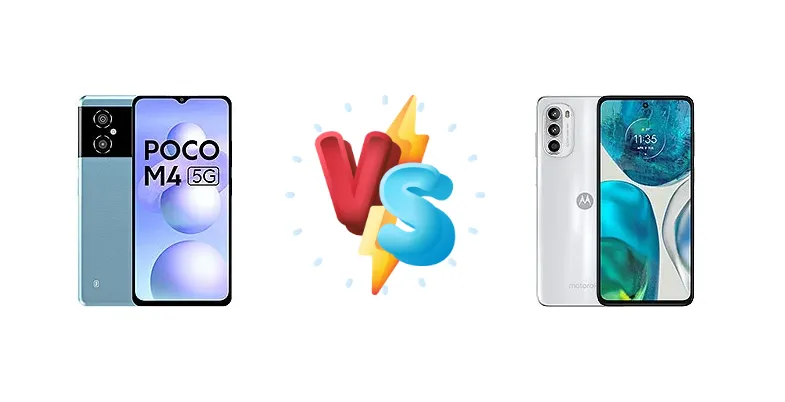
The Xiaomi Poco M4 5G (India) and Motorola Moto G52 represent compelling options in the sub-$200 smartphone market. The Poco prioritizes 5G connectivity and raw processing power, while the Moto G52 focuses on a more efficient chipset and faster charging. This comparison dissects their key differences to determine which device delivers the best value.
🏆 Quick Verdict
For users prioritizing 5G access and occasional gaming, the Xiaomi Poco M4 5G is the better choice. However, the Motorola Moto G52 excels in battery management and charging speed, making it ideal for users who value longevity and convenience over peak performance.
| Network |
|---|
| 2G bands | GSM 850 / 900 / 1800 / 1900 | GSM 850 / 900 / 1800 / 1900 |
| 3G bands | HSDPA 850 / 900 / 1900 / 2100 | HSDPA 850 / 900 / 1700(AWS) / 1900 / 2100 |
| 4G bands | 1, 3, 5, 8, 40, 41 | LTE |
| 5G bands | 1, 3, 5, 8, 28, 40, 78 SA/NSA | - |
| Speed | HSPA, LTE, 5G | HSPA, LTE |
| Technology | GSM / HSPA / LTE / 5G | GSM / HSPA / LTE |
| Launch |
|---|
| Announced | 2022, April 29 | 2022, April 12 |
| Status | Available. Released 2022, May 05 | Available. Released 2022, April 20 |
| Body |
|---|
| Build | Glass front (Gorilla Glass 3), plastic frame, plastic back | - |
| Dimensions | 164 x 76.1 x 8.9 mm (6.46 x 3.00 x 0.35 in) | 160.1 x 74.5 x 8 mm (6.30 x 2.93 x 0.31 in) |
| SIM | Nano-SIM + Nano-SIM | Nano-SIM + Nano-SIM |
| Weight | 200 g (7.05 oz) | 169 g (5.96 oz) |
| | Splash resistant | Water-repellent design |
| Display |
|---|
| Protection | Corning Gorilla Glass 3 | - |
| Resolution | 1080 x 2400 pixels, 20:9 ratio (~401 ppi density) | 1080 x 2400 pixels, 20:9 ratio (~402 ppi density) |
| Size | 6.58 inches, 104.0 cm2 (~83.3% screen-to-body ratio) | 6.6 inches, 103.6 cm2 (~86.9% screen-to-body ratio) |
| Type | IPS LCD, 90Hz | AMOLED, 90Hz |
| Platform |
|---|
| CPU | Octa-core (2x2.2 GHz Cortex-A76 & 6x2.0 GHz Cortex-A55) | Octa-core (4x2.4 GHz Kryo 265 Gold & 4x1.9 GHz Kryo 265 Silver) |
| Chipset | Mediatek Dimensity 700 (7 nm) | Qualcomm SM6225 Snapdragon 680 4G (6 nm) |
| GPU | Mali-G57 MC2 | Adreno 610 |
| OS | Android 12, MIUI 13 | Android 12, planned upgrade to Android 13 |
| Memory |
|---|
| Card slot | microSDXC (dedicated slot) | microSDXC (uses shared SIM slot) |
| Internal | 64GB 4GB RAM, 128GB 6GB RAM | 64GB 4GB RAM, 128GB 4GB RAM, 128GB 6GB RAM, 256GB 6GB RAM |
| | UFS 2.2 | - |
| Main Camera |
|---|
| Dual | 50 MP, f/1.8, (wide), 0.7µm, PDAF
Auxiliary lens | - |
| Features | LED flash, HDR, panorama | LED flash, HDR, panorama |
| Single | 8 MP, f/2.4, (wide), 1.0µm | - |
| Triple | - | 50 MP, f/1.8 (wide), 1/2.76", 0.64µm, PDAF
8 MP, f/2.2, 118˚ (ultrawide), 1/4.0", 1.12µm
2 MP (macro) |
| Video | 1080p@30fps | 1080p@30fps |
| Selfie camera |
|---|
| Features | HDR | - |
| Single | 8 MP, f/2.4, (wide), 1.0µm | 16 MP, f/2.5, (wide), 1.0µm |
| Video | 1080p@30fps | 1080p@30fps |
| Sound |
|---|
| 3.5mm jack | Yes | Yes |
| 35mm jack | Yes | Yes |
| Loudspeaker | Yes | Yes, with stereo speakers |
| | 24-bit/192kHz audio | - |
| Comms |
|---|
| Bluetooth | 5.1, A2DP, LE | 5.0, A2DP, LE |
| Infrared port | Yes | - |
| NFC | Yes (market/region dependent) | Yes (market/region dependent) |
| Positioning | GPS, GLONASS, BDS | GPS, GLONASS, GALILEO |
| Radio | FM radio | Unspecified |
| USB | USB Type-C 2.0, OTG | USB Type-C 2.0 |
| WLAN | Wi-Fi 802.11 a/b/g/n/ac, dual-band, Wi-Fi Direct | Wi-Fi 802.11 a/b/g/n/ac, dual-band, Wi-Fi Direct |
| Features |
|---|
| Sensors | Fingerprint (side-mounted), accelerometer, proximity, gyro, compass | Fingerprint (side-mounted), accelerometer, gyro, proximity, compass |
| Battery |
|---|
| Charging | 18W wired | 30W wired |
| Type | Li-Po 5000 mAh | Li-Po 5000 mAh |
| Misc |
|---|
| Colors | Gray, Silver, Blue | Charcoal Gray, Porcelain White |
| Models | MZB0BRZIN, 22041219PI | XT2221-1, XT2221-2 |
| Price | About 190 EUR | About 470 EUR |
| SAR | 0.85 W/kg (head) 0.85 W/kg (body) | - |
| Tests |
|---|
| Loudspeaker |
-28.8 LUFS (Average)
| - |
Xiaomi Poco M4 5G (India)
- Faster 5G connectivity with Dimensity 700
- Potentially better CPU performance for demanding apps
- More powerful chipset for gaming
- Slower 18W charging
- Likely shorter battery life due to less efficient chipset
- Lower peak brightness on display
Motorola Moto G52
- Faster 30W charging for quick top-ups
- More power-efficient Snapdragon 680 chipset
- Potentially better low-light camera performance
- Lacks 5G connectivity
- Less powerful CPU for demanding tasks
- May struggle with graphically intensive games
Display Comparison
Both phones lack detailed display specifications beyond the basics. The Poco M4 5G’s display is measured at 410 nits of peak brightness and a 1630:1 contrast ratio. While adequate for indoor use, this brightness level may struggle in direct sunlight. The Moto G52’s display specs are not provided, but Motorola typically focuses on color accuracy in this segment. The absence of high refresh rate panels on either device suggests a focus on power efficiency rather than fluid visuals. The Poco's contrast ratio suggests a standard IPS panel, while the Moto G52 may employ a different panel technology to enhance color reproduction.
Camera Comparison
Detailed camera specifications are absent for both devices. However, given their price point, it’s safe to assume both rely on primary sensors around the 50MP mark. The Snapdragon 680’s ISP (Image Signal Processor) is known for its efficient image processing, potentially leading to better low-light performance on the Moto G52. The Poco M4 5G’s Dimensity 700 also has a capable ISP, but the Snapdragon’s optimization for image quality is a potential edge. Without further details, it’s difficult to definitively declare a winner; image processing algorithms will play a crucial role.
Performance
The core difference lies in the chipsets. The Poco M4 5G utilizes the Mediatek Dimensity 700 (7nm), featuring a dual-core Cortex-A76 setup for performance and a hexa-core Cortex-A55 cluster for efficiency. This translates to a theoretical performance advantage in CPU-intensive tasks. Conversely, the Moto G52 employs the Qualcomm Snapdragon 680 (6nm). While the Snapdragon 680 has a higher clock speed on its performance cores (2.4 GHz vs 2.2 GHz), the Dimensity 700’s architecture and 7nm process node offer a more balanced approach. The 6nm process of the Snapdragon 680 should provide better power efficiency, but the Dimensity 700’s integrated 5G modem is a significant advantage for users in 5G-covered areas.
Battery Life
The Motorola Moto G52 boasts a significant advantage with its 30W wired charging, allowing for a much faster 0-100% charge compared to the Poco M4 5G’s 18W charging. While battery capacity isn’t specified, the Snapdragon 680’s 6nm efficiency should translate to longer battery life on the Moto G52, even with a potentially smaller battery. The Poco M4 5G’s Dimensity 700, while powerful, is less efficient, meaning users may need to charge it more frequently.
Buying Guide
Buy the Xiaomi Poco M4 5G (India) if you need 5G connectivity for faster data speeds and are willing to trade some battery life for a more powerful processor. Buy the Motorola Moto G52 if you prioritize all-day battery life, faster charging, and a more efficient processor for everyday tasks, and don't require 5G.
Frequently Asked Questions
❓ Will the Poco M4 5G’s Dimensity 700 handle demanding games like PUBG or Call of Duty?
The Dimensity 700 is capable of running PUBG and Call of Duty, but you’ll likely need to lower graphics settings for a smooth experience. The chipset isn’t designed for sustained high-performance gaming, so expect some throttling after extended play sessions. The Moto G52 would likely struggle even more with these titles.
❓ How long will it take to fully charge each phone from 0%?
The Motorola Moto G52’s 30W charging will likely take around 60-75 minutes to fully charge. The Poco M4 5G’s 18W charging will take considerably longer, potentially exceeding 2 hours. This is a significant difference for users who prioritize quick charging.
❓ Is the lack of 5G on the Moto G52 a dealbreaker in 2024?
It depends on your location and data needs. If you live in an area with widespread 5G coverage and frequently download large files or stream high-resolution video, the lack of 5G on the Moto G52 will be noticeable. However, if 5G isn’t available or you primarily use Wi-Fi, it’s less of a concern.