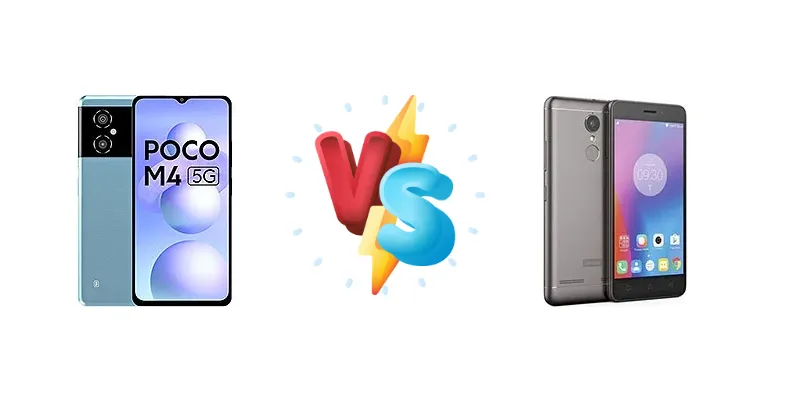
The budget smartphone market is fiercely competitive, offering incredible value for money. Today, we're pitting two contenders against each other: the Xiaomi Poco M4 5G and the Lenovo K6 Power. Both aim to deliver a solid experience without breaking the bank, but which one comes out on top?
🏆 Quick Verdict
The Poco M4 5G is the clear winner, boasting a significantly faster chipset, 5G connectivity, and a brighter display. While the K6 Power remains a decent option for basic tasks, the Poco M4 5G offers a more modern and capable experience for the price.
| Network |
|---|
| 2G bands | GSM 850 / 900 / 1800 / 1900 | GSM 850 / 900 / 1800 / 1900 - SIM 1 & SIM 2 (dual-SIM model only) |
| 3G bands | HSDPA 850 / 900 / 1900 / 2100 | HSDPA 850 / 900 / 1900 / 2100 |
| 4G bands | 1, 3, 5, 8, 40, 41 | 1, 3, 5, 7, 8, 20, 38, 40, 41 |
| 5G bands | 1, 3, 5, 8, 28, 40, 78 SA/NSA | - |
| Speed | HSPA, LTE, 5G | HSPA 42.2/5.76 Mbps, LTE Cat4 150/50 Mbps |
| Technology | GSM / HSPA / LTE / 5G | GSM / HSPA / LTE |
| Launch |
|---|
| Announced | 2022, April 29 | 2016, September. Released 2016, November |
| Status | Available. Released 2022, May 05 | Discontinued |
| Body |
|---|
| Build | Glass front (Gorilla Glass 3), plastic frame, plastic back | Glass front, aluminum back, aluminum frame |
| Dimensions | 164 x 76.1 x 8.9 mm (6.46 x 3.00 x 0.35 in) | 141.9 x 70.3 x 9.3 mm (5.59 x 2.77 x 0.37 in) |
| SIM | Nano-SIM + Nano-SIM | · Nano-SIM· Nano-SIM + Nano-SIM |
| Weight | 200 g (7.05 oz) | 145 g (5.11 oz) |
| | Splash resistant | - |
| Display |
|---|
| Protection | Corning Gorilla Glass 3 | - |
| Resolution | 1080 x 2400 pixels, 20:9 ratio (~401 ppi density) | 1080 x 1920 pixels, 16:9 ratio (~441 ppi density) |
| Size | 6.58 inches, 104.0 cm2 (~83.3% screen-to-body ratio) | 5.0 inches, 68.9 cm2 (~69.1% screen-to-body ratio) |
| Type | IPS LCD, 90Hz | IPS LCD |
| Platform |
|---|
| CPU | Octa-core (2x2.2 GHz Cortex-A76 & 6x2.0 GHz Cortex-A55) | Octa-core 1.4 GHz Cortex-A53 |
| Chipset | Mediatek Dimensity 700 (7 nm) | Qualcomm MSM8937 Snapdragon 430 (28 nm) |
| GPU | Mali-G57 MC2 | Adreno 505 |
| OS | Android 12, MIUI 13 | Android 6.0 (Marshmallow), upgradable to 7.0 (Nougat) |
| Memory |
|---|
| Card slot | microSDXC (dedicated slot) | microSDXC (uses shared SIM slot) |
| Internal | 64GB 4GB RAM, 128GB 6GB RAM | 16GB 2GB RAM, 32GB 3GB RAM |
| | UFS 2.2 | eMMC 5.1 |
| Main Camera |
|---|
| Dual | 50 MP, f/1.8, (wide), 0.7µm, PDAF
Auxiliary lens | - |
| Features | LED flash, HDR, panorama | LED flash, HDR, panorama |
| Single | 8 MP, f/2.4, (wide), 1.0µm | 13 MP, PDAF |
| Video | 1080p@30fps | 1080p@30fps |
| Selfie camera |
|---|
| Features | HDR | - |
| Single | 8 MP, f/2.4, (wide), 1.0µm | 8 MP |
| Video | 1080p@30fps | 1080p@30fps |
| Sound |
|---|
| 3.5mm jack | Yes | Yes |
| 35mm jack | Yes | Yes |
| Loudspeaker | Yes | Yes, with stereo speakers |
| | 24-bit/192kHz audio | - |
| Comms |
|---|
| Bluetooth | 5.1, A2DP, LE | 4.2, A2DP, LE |
| Infrared port | Yes | - |
| NFC | Yes (market/region dependent) | No |
| Positioning | GPS, GLONASS, BDS | GPS |
| Radio | FM radio | FM radio |
| USB | USB Type-C 2.0, OTG | microUSB 2.0 |
| WLAN | Wi-Fi 802.11 a/b/g/n/ac, dual-band, Wi-Fi Direct | Wi-Fi 802.11 b/g/n |
| Features |
|---|
| Sensors | Fingerprint (side-mounted), accelerometer, proximity, gyro, compass | Fingerprint (rear-mounted), accelerometer, gyro, proximity, compass |
| Battery |
|---|
| Charging | 18W wired | - |
| Stand-by | - | Up to 649 h (3G) |
| Talk time | - | Up to 50 h (2G) / Up to 33 h (3G) |
| Type | Li-Po 5000 mAh | Li-Po 4000 mAh, non-removable |
| Misc |
|---|
| Colors | Gray, Silver, Blue | Silver, Gold, Dark Grey |
| Models | MZB0BRZIN, 22041219PI | K33a42 |
| Price | About 190 EUR | About 170 EUR |
| SAR | 0.85 W/kg (head) 0.85 W/kg (body) | - |
| Tests |
|---|
| Loudspeaker |
-28.8 LUFS (Average)
| - |
| Performance | - |
GFXBench: 2.4fps (ES 3.1 onscreen) |
Xiaomi Poco M4 5G (India)
- Faster Processor
- 5G Connectivity
- Brighter Display
- Modern Design
- Likely Better Camera
- 18W Charging could be faster
- Battery life might be slightly less than K6 Power
Lenovo K6 Power
- Excellent Battery Life (Historically)
- Very Affordable
- Compact Size (Likely)
- Outdated Processor
- No 5G
- Lower Display Quality
- Older Design
- Likely Inferior Camera
Display Comparison
The Poco M4 5G features a modern display with a 1630:1 contrast ratio and a measured 410 nits brightness, offering better visibility and color reproduction compared to the K6 Power's likely older and less vibrant panel. The K6 Power's display is adequate for its time but lacks the modern enhancements of the Poco M4 5G.
Camera Comparison
While specific camera specs are missing for the K6 Power, the Poco M4 5G likely offers a more capable camera system. Modern smartphone cameras generally benefit from advancements in image processing and sensor technology, giving the Poco M4 5G an edge in image quality, especially in low-light conditions. Expect better detail and dynamic range from the Poco M4 5G.
Performance
Here's where the Poco M4 5G truly shines. The Mediatek Dimensity 700 chipset, built on a 7nm process, is significantly more powerful than the Lenovo K6 Power's Qualcomm Snapdragon 430 (28nm). Expect smoother app loading, better multitasking, and improved gaming performance on the Poco M4 5G. The K6 Power is sufficient for basic tasks but will struggle with demanding applications.
Battery Life
The Lenovo K6 Power was known for its excellent battery life, often lasting a full day or more on a single charge. The Poco M4 5G, while likely having a decent battery, may not match the K6 Power's longevity due to its more power-hungry chipset and 5G capabilities. However, the Poco M4 5G's 18W charging is faster than what the K6 Power likely offered.
Buying Guide
The Xiaomi Poco M4 5G is ideal for users who want 5G connectivity, smoother performance for gaming and multitasking, and a more modern smartphone experience. The Lenovo K6 Power is a good choice for users on a very tight budget who primarily need a phone for basic calling, texting, and light web browsing.
Frequently Asked Questions
❓ Is the Poco M4 5G worth the extra cost compared to the K6 Power?
Yes, the Poco M4 5G offers significantly better performance, 5G connectivity, and a more modern display, making it a worthwhile upgrade if your budget allows.
❓ Can the Lenovo K6 Power still be used for everyday tasks?
Absolutely! The Lenovo K6 Power is still capable of handling basic tasks like calling, texting, and light web browsing, especially if you're on a very tight budget.