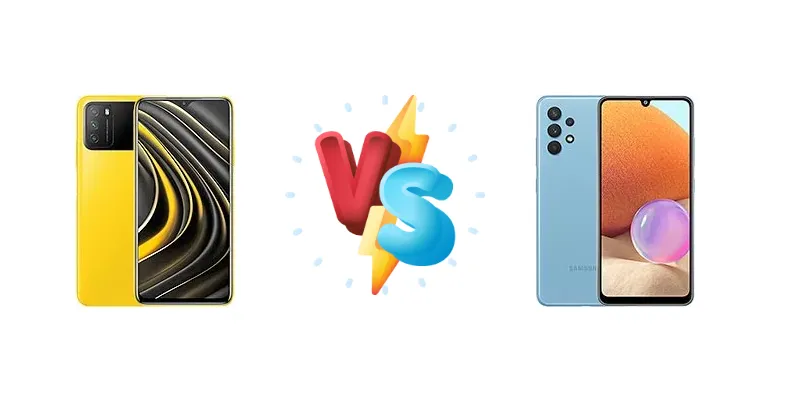
The Xiaomi Poco M3 and Samsung Galaxy A32 represent compelling options in the sub-$200 smartphone market. While both aim to deliver essential features at an accessible price, they take distinctly different approaches to achieving this goal. The Poco M3 prioritizes battery endurance and a surprisingly robust chipset for the price, while the Galaxy A32 focuses on a brighter display and Samsung’s established software ecosystem.
🏆 Quick Verdict
For the average user prioritizing longevity and consistent performance, the Xiaomi Poco M3 emerges as the stronger choice. Its significantly superior battery life (154h vs 119h) and efficient Snapdragon 662 chipset provide a smoother, longer-lasting experience, despite the Galaxy A32’s brighter screen.
| Network |
|---|
| 2G bands | GSM 850 / 900 / 1800 / 1900 | GSM 850 / 900 / 1800 / 1900 |
| 3G bands | HSDPA 850 / 900 / 1700(AWS) / 1900 / 2100 | HSDPA 850 / 900 / 1900 / 2100 |
| 4G bands | 1, 2, 3, 4, 5, 7, 8, 20, 28, 38, 40, 41 | 1, 2, 3, 5, 7, 8, 20, 28, 38, 40, 41 |
| Speed | HSPA, LTE | HSPA, LTE |
| Technology | GSM / HSPA / LTE | GSM / HSPA / LTE |
| Launch |
|---|
| Announced | 2020, November 24 | 2021, February 25 |
| Status | Available. Released 2020, November 27 | Available. Released 2021, February 25 |
| Body |
|---|
| Build | Glass front (Gorilla Glass 3), plastic back, plastic frame | Glass front (Gorilla Glass 5), plastic frame, plastic back |
| Dimensions | 162.3 x 77.3 x 9.6 mm (6.39 x 3.04 x 0.38 in) | 158.9 x 73.6 x 8.4 mm (6.26 x 2.90 x 0.33 in) |
| SIM | Nano-SIM + Nano-SIM | · Nano-SIM· Nano-SIM + Nano-SIM |
| Weight | 198 g (6.98 oz) | 184 g (6.49 oz) |
| Display |
|---|
| Protection | Corning Gorilla Glass 3 | Corning Gorilla Glass 5 |
| Resolution | 1080 x 2340 pixels, 19.5:9 ratio (~395 ppi density) | 1080 x 2400 pixels, 20:9 ratio (~411 ppi density) |
| Size | 6.53 inches, 104.7 cm2 (~83.4% screen-to-body ratio) | 6.4 inches, 98.9 cm2 (~84.6% screen-to-body ratio) |
| Type | IPS LCD, 400 nits (typ) | Super AMOLED, 90Hz, 800 nits (HBM) |
| Platform |
|---|
| CPU | Octa-core (4x2.0 GHz Kryo 260 Gold & 4x1.8 GHz Kryo 260 Silver) | Octa-core (2x2.0 GHz Cortex-A75 & 6x1.8 GHz Cortex-A55) |
| Chipset | Qualcomm SM6115 Snapdragon 662 (11 nm) | Mediatek MT6769V/CU Helio G80 (12 nm) |
| GPU | Adreno 610 | Mali-G52 MC2 |
| OS | Android 10, MIUI 12 | Android 11, upgradable to Android 13, One UI 5 |
| Memory |
|---|
| Card slot | microSDXC (dedicated slot) | microSDXC (dedicated slot) |
| Internal | 64GB 4GB RAM, 64GB 6GB RAM, 128GB 4GB RAM, 128GB 6GB RAM | 64GB 4GB RAM, 64GB 6GB RAM, 128GB 4GB RAM, 128GB 6GB RAM, 128GB 8GB RAM |
| | UFS 2.1 - 64GB
UFS 2.2 - 128GB | - |
| Main Camera |
|---|
| Features | LED flash, HDR, panorama | LED flash, panorama, HDR |
| Quad | - | 64 MP, f/1.8, 26mm (wide), PDAF
8 MP, f/2.2, 123˚, (ultrawide), 1/4.0", 1.12µm
5 MP (macro)
Auxiliary lens |
| Single | - | 20 MP, f/2.2, (wide) |
| Triple | 48 MP, f/1.8, (wide), 1/2.0", 0.8µm, PDAF
2 MP (macro)
Auxiliary lens | - |
| Video | 1080p@30fps | 1080p@30fps |
| Selfie camera |
|---|
| Features | Panorama | - |
| Single | 8 MP, f/2.1, (wide), 1/4.0", 1.12µm | 20 MP, f/2.2, (wide) |
| Video | 1080p@30fps | 1080p@30fps |
| Sound |
|---|
| 3.5mm jack | Yes | Yes |
| 35mm jack | Yes | Yes |
| Loudspeaker | Yes, with dual speakers | Yes |
| | 24-bit/192kHz audio | - |
| Comms |
|---|
| Bluetooth | 5.0, A2DP, LE | 5.0, A2DP, LE |
| Infrared port | Yes | - |
| NFC | No | Yes (market/region dependent) |
| Positioning | GPS, GLONASS, BDS, GALILEO | GPS, GLONASS, BDS, GALILEO |
| Radio | FM radio | FM radio, RDS, recording |
| USB | USB Type-C 2.0, OTG | USB Type-C 2.0, OTG |
| WLAN | Wi-Fi 802.11 a/b/g/n/ac, dual-band, Wi-Fi Direct | Wi-Fi 802.11 a/b/g/n/ac, dual-band, Wi-Fi Direct |
| Features |
|---|
| Sensors | Fingerprint (side-mounted), accelerometer, proximity, compass | Fingerprint (under display, optical), accelerometer, gyro, compass |
| | - | Virtual proximity sensing |
| Battery |
|---|
| Charging | 18W wired
2.5W reverse wired | 15W wired |
| Type | Li-Po 6000 mAh | Li-Ion 5000 mAh |
| Misc |
|---|
| Colors | Cool Blue, Poco Yellow, Power Black | Awesome Black, Awesome White, Awesome Blue, Awesome Violet |
| Models | M2010J19CG, M2010J19CI | SM-A325F, SM-A325F/DS, SM-A325M, SM-A325N |
| Price | $ 130.00 / ₹ 11,590 | € 124.99 / £ 89.38 |
| SAR | 1.09 W/kg (head) 1.00 W/kg (body) | - |
| SAR EU | 0.60 W/kg (head) 0.81 W/kg (body) | 0.45 W/kg (head) 1.30 W/kg (body) |
| Tests |
|---|
| Battery life | Endurance rating 154h |
Endurance rating 119h
|
| Camera |
Photo / Video |
Photo / Video |
| Display |
Contrast ratio: 1567:1 (nominal) |
Contrast ratio: Infinite (nominal) |
| Loudspeaker |
-26.5 LUFS (Good) |
-30.3 LUFS (Below average)
|
| Performance |
AnTuTu: 177904 (v8)
GeekBench: 1398 (v5.1)
GFXBench: 5.9fps (ES 3.1 onscreen) |
AnTuTu: 286666 (v8)
GeekBench: 1277 (v5.1)
GFXBench: 8.1fps (ES 3.1 onscreen) |
Xiaomi Poco M3
- Exceptional battery life (154h endurance)
- More efficient Snapdragon 662 chipset
- Reverse wired charging capability
- Lower peak display brightness
- Potentially less refined software experience
Samsung Galaxy A32
- Brighter display for outdoor visibility (814 nits)
- Samsung’s established software ecosystem
- Slightly faster charging (15W vs 18W)
- Significantly shorter battery life (119h endurance)
- Less efficient Helio G80 chipset
- No reverse charging
Display Comparison
The Samsung Galaxy A32 boasts a significantly brighter display, reaching 814 nits compared to the Poco M3’s 439 nits. This makes the A32 far more usable in direct sunlight. However, the Poco M3’s 1567:1 contrast ratio, while 'nominal' as specified, suggests good black levels. The A32’s ‘Infinite’ contrast ratio is a marketing term and doesn’t necessarily translate to superior real-world performance. The difference in brightness will be most noticeable when viewing HDR content or using the phone outdoors.
Camera Comparison
Both phones offer a 'Photo / Video' camera experience, but lack detailed specifications. Without sensor size or aperture information, a direct comparison is difficult. However, given the market positioning, it’s safe to assume both utilize budget sensors. Focusing on the chipset, the Snapdragon 662’s ISP (Image Signal Processor) is generally considered more capable than the Helio G80’s, potentially resulting in better image processing and low-light performance on the Poco M3. The prevalence of 2MP macro lenses on both devices suggests limited utility for serious photography.
Performance
The Poco M3’s Qualcomm Snapdragon 662 (11nm) and the Galaxy A32’s MediaTek Helio G80 (12nm) represent different approaches to budget chipset design. The 12nm process of the Helio G80 is generally less efficient than the 11nm Snapdragon 662, potentially leading to more heat and slightly lower sustained performance. While both CPUs feature octa-core configurations, the Snapdragon 662’s Kryo cores offer a more refined architecture. The Poco M3 is likely to maintain smoother performance during extended gaming sessions or multitasking.
Battery Life
The Poco M3’s endurance rating of 154 hours is a clear win over the Galaxy A32’s 119 hours. This translates to a significant advantage in real-world usage, allowing the Poco M3 to easily last a full day, even with heavy use. While the A32 supports 15W charging, the Poco M3’s 18W wired charging offers a slightly faster top-up speed. The Poco M3 also includes 2.5W reverse wired charging, a feature absent on the A32, allowing it to act as a power bank for smaller devices.
Buying Guide
Buy the Xiaomi Poco M3 if you need exceptional battery life, prioritize consistent performance in everyday tasks, and value a more efficient chipset. Buy the Samsung Galaxy A32 if you prefer a brighter display for outdoor visibility, are heavily invested in the Samsung ecosystem, and prioritize a potentially smoother software experience, understanding that battery life will be shorter.
Frequently Asked Questions
❓ Does the MediaTek Helio G80 in the Galaxy A32 tend to overheat during prolonged gaming sessions?
The Helio G80, while capable, is built on a 12nm process which is less thermally efficient than the Snapdragon 662’s 11nm process. This means the Galaxy A32 is more likely to experience thermal throttling during extended gaming, potentially leading to reduced performance over time. The Poco M3 is expected to maintain more consistent performance.
❓ How much of a difference will the display brightness make in everyday use?
The 814 nits peak brightness of the Galaxy A32 is a significant advantage if you frequently use your phone outdoors in direct sunlight. The Poco M3’s 439 nits will be noticeably dimmer in these conditions. However, indoors, the difference is less pronounced, and the Poco M3’s display is still perfectly usable.
❓ Is the 2.5W reverse charging on the Poco M3 actually useful?
While slow, the 2.5W reverse charging on the Poco M3 can be a lifesaver for charging accessories like wireless earbuds or a smartwatch in a pinch. It won't rapidly charge devices, but it provides a convenient way to top them up when a power outlet isn't available.
❓ Which phone is better for playing PUBG Mobile?
While both phones can run PUBG Mobile, the Poco M3’s Snapdragon 662 and more efficient thermal management are likely to provide a smoother and more consistent gaming experience, especially at higher graphics settings. The Helio G80 in the A32 may struggle to maintain stable frame rates during intense battles.