
Poco M3 vs. Moto G Power (2021): A Deep Dive into Budget Smartphone Value
| Phones Images | |||||
|---|---|---|---|---|---|
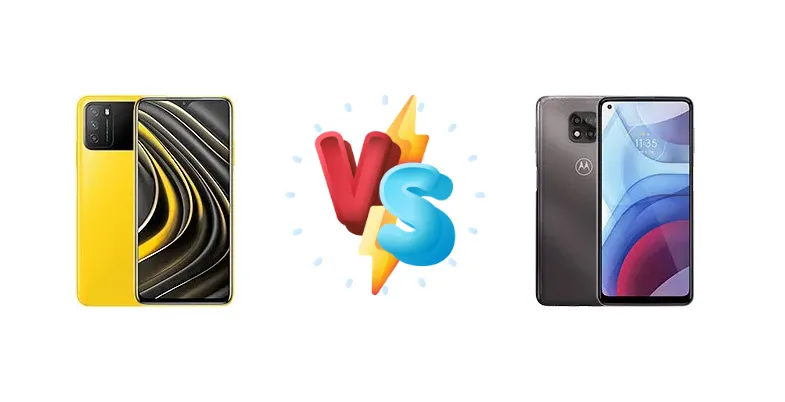
|
🏆 Quick Verdict
For most users, the Xiaomi Poco M3 emerges as the slightly better choice. While both phones share the same Snapdragon 662 chipset, the Poco M3’s superior display brightness and contrast ratio, coupled with its reverse wired charging capability, provide a more versatile experience, despite similar battery endurance.
| PHONES | ||
|---|---|---|
| Phone Names | Xiaomi Poco M3 | Motorola Moto G Power (2021) |
| Network | ||
|---|---|---|
| 2G bands | GSM 850 / 900 / 1800 / 1900 | GSM 850 / 900 / 1800 / 1900 |
| 3G bands | HSDPA 850 / 900 / 1700(AWS) / 1900 / 2100 | HSDPA 850 / 900 / 1700(AWS) / 1900 / 2100 |
| 4G bands | 1, 2, 3, 4, 5, 7, 8, 20, 28, 38, 40, 41 | 1, 2, 3, 4, 5, 7, 8, 12, 13, 14, 17, 25, 26, 29, 30, 38, 41, 66, 71 |
| Speed | HSPA, LTE | HSPA, LTE |
| Technology | GSM / HSPA / LTE | GSM / CDMA / HSPA / EVDO / LTE |
| - | CDMA2000 1xEV-DO | |
| Launch | ||
|---|---|---|
| Announced | 2020, November 24 | 2021, January 08 |
| Status | Available. Released 2020, November 27 | Available. Released 2021, January 14 |
| Body | ||
|---|---|---|
| Build | Glass front (Gorilla Glass 3), plastic back, plastic frame | Glass front, plastic back, plastic frame |
| Dimensions | 162.3 x 77.3 x 9.6 mm (6.39 x 3.04 x 0.38 in) | 165.3 x 75.9 x 9.5 mm (6.51 x 2.99 x 0.37 in) |
| SIM | Nano-SIM + Nano-SIM | Nano-SIM |
| Weight | 198 g (6.98 oz) | 206.5 g (7.30 oz) |
| - | Water-repellent coating | |
| Display | ||
|---|---|---|
| Protection | Corning Gorilla Glass 3 | - |
| Resolution | 1080 x 2340 pixels, 19.5:9 ratio (~395 ppi density) | 720 x 1600 pixels, 20:9 ratio (~266 ppi density) |
| Size | 6.53 inches, 104.7 cm2 (~83.4% screen-to-body ratio) | 6.6 inches, 105.2 cm2 (~83.8% screen-to-body ratio) |
| Type | IPS LCD, 400 nits (typ) | IPS LCD |
| Platform | ||
|---|---|---|
| CPU | Octa-core (4x2.0 GHz Kryo 260 Gold & 4x1.8 GHz Kryo 260 Silver) | Octa-core (4x2.0 GHz Kryo 260 Gold & 4x1.8 GHz Kryo 260 Silver) |
| Chipset | Qualcomm SM6115 Snapdragon 662 (11 nm) | Qualcomm SM6115 Snapdragon 662 (11 nm) |
| GPU | Adreno 610 | Adreno 610 |
| OS | Android 10, MIUI 12 | Android 10 |
| Memory | ||
|---|---|---|
| Card slot | microSDXC (dedicated slot) | microSDXC (dedicated slot) |
| Internal | 64GB 4GB RAM, 64GB 6GB RAM, 128GB 4GB RAM, 128GB 6GB RAM | 32GB 3GB RAM, 64GB 4GB RAM |
| UFS 2.1 - 64GB UFS 2.2 - 128GB | eMMC 5.1 | |
| Main Camera | ||
|---|---|---|
| Features | LED flash, HDR, panorama | LED flash, HDR, panorama |
| Triple | 48 MP, f/1.8, (wide), 1/2.0", 0.8µm, PDAF 2 MP (macro) Auxiliary lens | 48 MP, f/1.7, (wide), 1/2.0", 0.8µm, PDAF 2 MP (macro) Auxiliary lens |
| Video | 1080p@30fps | 1080p@30/60fps, gyro-EIS |
| Selfie camera | ||
|---|---|---|
| Features | Panorama | HDR |
| Single | 8 MP, f/2.1, (wide), 1/4.0", 1.12µm | 8 MP, f/2.0, 1.12µm |
| Video | 1080p@30fps | 1080p@30fps, gyro-EIS |
| Sound | ||
|---|---|---|
| 3.5mm jack | Yes | Yes |
| 35mm jack | Yes | Yes |
| Loudspeaker | Yes, with dual speakers | Yes |
| 24-bit/192kHz audio | - | |
| Comms | ||
|---|---|---|
| Bluetooth | 5.0, A2DP, LE | 5.0, A2DP, LE |
| Infrared port | Yes | - |
| NFC | No | No |
| Positioning | GPS, GLONASS, BDS, GALILEO | GPS, GLONASS, GALILEO |
| Radio | FM radio | FM radio |
| USB | USB Type-C 2.0, OTG | USB Type-C 2.0 |
| WLAN | Wi-Fi 802.11 a/b/g/n/ac, dual-band, Wi-Fi Direct | Wi-Fi 802.11 a/b/g/n/ac, dual-band, Wi-Fi Direct |
| Features | ||
|---|---|---|
| Sensors | Fingerprint (side-mounted), accelerometer, proximity, compass | Fingerprint (side-mounted), accelerometer, gyro, proximity, compass, barometer |
| Battery | ||
|---|---|---|
| Charging | 18W wired 2.5W reverse wired | 15W wired |
| Type | Li-Po 6000 mAh | Li-Po 5000 mAh |
| Misc | ||
|---|---|---|
| Colors | Cool Blue, Poco Yellow, Power Black | Flash Gray, Polar Silver |
| Models | M2010J19CG, M2010J19CI | - |
| Price | $ 130.00 / ₹ 11,590 | About 60 EUR |
| SAR | 1.09 W/kg (head) 1.00 W/kg (body) | - |
| SAR EU | 0.60 W/kg (head) 0.81 W/kg (body) | - |
| Tests | ||
|---|---|---|
| Battery life | Endurance rating 154h | - |
| Camera | Photo / Video | - |
| Display | Contrast ratio: 1567:1 (nominal) | - |
| Loudspeaker | -26.5 LUFS (Good) | - |
| Performance | AnTuTu: 177904 (v8) GeekBench: 1398 (v5.1) GFXBench: 5.9fps (ES 3.1 onscreen) | - |
Xiaomi Poco M3
- Brighter and higher contrast display
- Reverse wired charging capability
- Slightly more versatile feature set
- MIUI software can be polarizing
- Potentially more bloatware
Motorola Moto G Power (2021)
- Clean, near-stock Android experience
- Potentially faster software updates
- Simpler user interface
- Less detailed display specifications
- Slower charging speed
Display Comparison
The Poco M3 boasts a display with a measured peak brightness of 439 nits and a 1567:1 contrast ratio. This translates to a more visually engaging experience, particularly outdoors or in brightly lit environments, compared to the Moto G Power (2021), for which display specs are not provided. The higher contrast ratio on the Poco M3 means deeper blacks and more vivid colors. While both likely utilize IPS LCD panels, the Poco M3’s specifications suggest a more refined viewing experience. The lack of detailed display information for the Moto G Power makes a precise comparison difficult, but the Poco M3 clearly has a quantifiable advantage in brightness and contrast.
Camera Comparison
Both phones feature a 'Photo / Video' camera system, but detailed specifications are lacking. Without sensor size, aperture, or image processing details, a meaningful comparison is impossible. It’s reasonable to assume both phones will offer adequate image quality in good lighting conditions, but struggle in low-light scenarios. The presence of a 2MP macro camera on either device is unlikely to significantly impact the overall camera experience, serving primarily as a marketing feature. The lack of Optical Image Stabilization (OIS) on either phone suggests that video recording will be susceptible to shakiness.
Performance
Both the Poco M3 and Moto G Power (2021) are powered by the Qualcomm Snapdragon 662 (11 nm) chipset, featuring an octa-core CPU configuration with 4x2.0 GHz Kryo 260 Gold and 4x1.8 GHz Kryo 260 Silver cores. This means performance will be nearly identical for everyday tasks like browsing, social media, and light gaming. Neither device is a powerhouse, but the Snapdragon 662 is capable of handling common smartphone workloads. The absence of information regarding RAM speed (LPDDR4X is likely on both) and thermal management solutions suggests that sustained performance will be limited by thermal throttling, but this will likely be consistent across both devices.
Battery Life
The Poco M3 has an endurance rating of 154 hours, indicating excellent battery life. The Moto G Power (2021) lacks a published endurance rating, but its 'Power' branding suggests a similar focus on longevity. The Poco M3 supports 18W wired charging and 2.5W reverse wired charging, a feature absent on the Moto G Power (2021), which is limited to 15W wired charging. While the difference in charging speed isn’t dramatic, the Poco M3’s reverse charging capability allows it to function as a power bank for smaller accessories, adding to its versatility. The similar endurance ratings suggest comparable real-world battery life, but the Poco M3’s faster charging and reverse charging provide a slight edge.
Buying Guide
Buy the Xiaomi Poco M3 if you prioritize a brighter, more vibrant display for media consumption and appreciate the convenience of reverse charging to top up accessories. Buy the Motorola Moto G Power (2021) if you specifically value a cleaner, near-stock Android experience and prefer a potentially simpler software update path, though the hardware is largely equivalent.