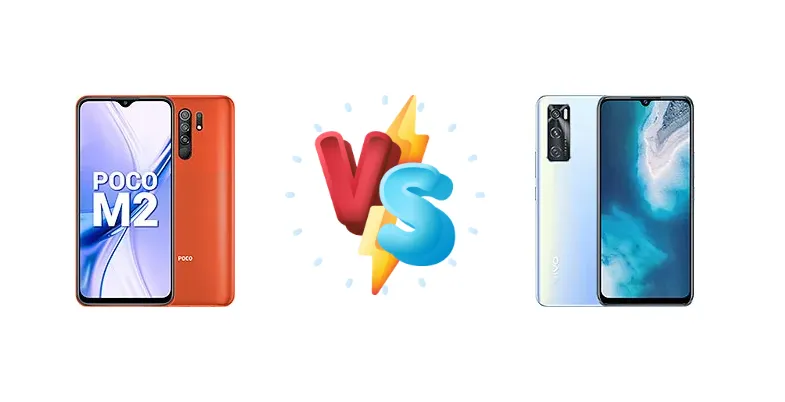
The Xiaomi Poco M2 and Vivo V20 SE represent two distinct approaches to the sub-₹11,000 smartphone market. The Poco M2 prioritizes gaming performance with its Mediatek Helio G80 chipset, while the Vivo V20 SE focuses on a streamlined user experience and notably faster charging speeds. This comparison dissects their strengths and weaknesses to determine which device delivers the best value.
🏆 Quick Verdict
For users prioritizing gaming and sustained performance, the Poco M2 is the better choice, leveraging the Helio G80's Cortex-A75 cores. However, the Vivo V20 SE wins for those who value rapid charging – reaching 62% in just 30 minutes – and a smoother, less demanding software experience.
| Network |
|---|
| 2G bands | GSM 850 / 900 / 1800 / 1900 | GSM 850 / 900 / 1800 / 1900 |
| 3G bands | HSDPA 850 / 900 / 1900 / 2100 | HSDPA 850 / 900 / 2100 |
| 4G bands | 1, 3, 5, 8, 40, 41 | 1, 3, 5, 7, 8, 38, 39, 40, 41 |
| Speed | HSPA, LTE | HSPA, LTE |
| Technology | GSM / HSPA / LTE | GSM / HSPA / LTE |
| Launch |
|---|
| Announced | 2020, September 08 | 2020, September 24. Released 2020, October 13 |
| Status | Available. Released 2020, September 15 | Discontinued |
| Body |
|---|
| Build | Glass front (Gorilla Glass 3), plastic back, plastic frame | Glass front, plastic back, plastic frame |
| Dimensions | 163.3 x 77 x 9.1 mm (6.43 x 3.03 x 0.36 in) | 161 x 74.1 x 7.8 mm (6.34 x 2.92 x 0.31 in) |
| SIM | Nano-SIM + Nano-SIM | Nano-SIM + Nano-SIM |
| Weight | 198 g (6.98 oz) | 171 g (6.03 oz) |
| | Water-repellent coating | - |
| Display |
|---|
| Protection | Corning Gorilla Glass 3 | - |
| Resolution | 1080 x 2340 pixels, 19.5:9 ratio (~395 ppi density) | 1080 x 2400 pixels, 20:9 ratio (~409 ppi density) |
| Size | 6.53 inches, 104.7 cm2 (~83.2% screen-to-body ratio) | 6.44 inches, 100.1 cm2 (~83.9% screen-to-body ratio) |
| Type | IPS LCD, 400 nits (typ) | AMOLED |
| Platform |
|---|
| CPU | Octa-core (2x2.0 GHz Cortex-A75 & 6x1.8 GHz Cortex-A55) | Octa-core (4x2.0 GHz Kryo 260 Gold & 4x1.8 GHz Kryo 260 Silver) |
| Chipset | Mediatek MT6769V/CU Helio G80 (12 nm) | Qualcomm SDM665 Snapdragon 665 (11 nm) |
| GPU | Mali-G52 MC2 | Adreno 610 |
| OS | Android 10, MIUI 12 | Android 10, Funtouch 11 |
| Memory |
|---|
| Call records | - | 30 dialed, 30 received, 30 missed calls |
| Card slot | microSDXC (dedicated slot) | microSDXC (dedicated slot) |
| Internal | 64GB 6GB RAM, 128GB 6GB RAM | 128GB 8GB RAM |
| Phonebook | - | 1000 contacts, Photo call |
| | eMMC 5.1 | - |
| Main Camera |
|---|
| Features | LED flash, HDR, panorama | Dual-LED dual-tone flash, HDR, panorama |
| Quad | 13 MP, f/2.2, 28mm (wide), 1/3.1", 1.12µm, PDAF
8 MP, f/2.2, 118˚ (ultrawide), 1/4.0", 1.12µm
5 MP (macro)
Auxiliary lens | - |
| Single | - | 1.3 MP |
| Triple | - | 48 MP, f/1.8, 25mm (wide), 1/2.0", 0.8µm, PDAF
8 MP, f/2.2, 16mm (ultrawide), 1/4.0", 1.12µm, AF
Auxiliary lens |
| Video | 1080p@30fps | 1080p@30fps |
| Selfie camera |
|---|
| Features | HDR | HDR |
| Single | 8 MP, f/2.0, 27mm (wide), 1/4.0", 1.12µm | 32 MP, f/2.0, (wide), 1/2.8", 0.8µm |
| Video | 1080p@30fps | 1080p@30fps |
| Sound |
|---|
| 3.5mm jack | Yes | Yes |
| 35mm jack | Yes | Yes |
| Loudspeaker | Yes | Yes |
| Comms |
|---|
| Bluetooth | 5.0, A2DP, LE | 5.0, A2DP, LE |
| Infrared port | Yes | - |
| NFC | No | Yes (market/region dependent) |
| Positioning | GPS, GLONASS, BDS | GPS, GLONASS, GALILEO, BDS |
| Radio | Wireless FM radio (no wired headphones required) | FM radio |
| USB | USB Type-C 2.0, OTG | USB Type-C 2.0, OTG |
| WLAN | Wi-Fi 802.11 a/b/g/n/ac, dual-band, Wi-Fi Direct | Wi-Fi 802.11 a/b/g/n/ac, dual-band, Wi-Fi Direct |
| Features |
|---|
| Browser | - | WAP 2.0/xHTML, HTML |
| Games | - | Yes |
| Java | - | Yes, MIDP 2.0 |
| Messaging | - | SMS, MMS, Email, Instant Messaging |
| Sensors | Fingerprint (rear-mounted), accelerometer, proximity, compass | Fingerprint (under display, optical), accelerometer, gyro, proximity, compass |
| Battery |
|---|
| Charging | 18W wired | 33W wired, 62% in 30 min |
| Type | Li-Po 5000 mAh | 4100 mAh |
| Misc |
|---|
| Colors | Brick Red, Pitch Black, Slate Blue | Gravity Black, Oxygen Blue |
| Models | MZB9919IN, M2004J19PI | V2022, V2023 |
| Price | About 130 EUR | About 250 EUR |
| SAR | 0.85 W/kg (head) 0.42 W/kg (body) | - |
| Pricing |
|---|
| 128GB 6GB RAM | ₹ 10,499 | - |
| 64GB 6GB RAM | ₹ 10,799 | - |
Xiaomi Poco M2
- Stronger CPU performance for gaming
- More powerful GPU for graphics-intensive tasks
- Potentially larger battery capacity
- Slower charging speed (18W)
- May run warmer under sustained load
vivo V20 SE
- Significantly faster 33W charging
- More efficient processor for longer battery life in typical use
- Smoother software experience for everyday tasks
- Weaker CPU and GPU performance for gaming
- Less capable for demanding multitasking
Display Comparison
Neither device boasts a standout display. Both likely utilize LCD panels, common in this price bracket. The key difference lies elsewhere. While specific display specs (resolution, brightness) are missing, the focus should be on the overall user experience. The Poco M2's larger size (implied by its focus on gaming) may offer a more immersive experience, but the V20 SE's potentially smaller form factor could appeal to users preferring one-handed use. Color accuracy is likely similar, leaning towards the 'good enough' range for casual viewing.
Camera Comparison
Camera performance is difficult to assess without detailed sensor information. Both phones likely feature a multi-camera setup, but the emphasis is on the main sensor. The V20 SE's image processing is likely tuned for social media-ready shots with boosted colors and smoothing, typical of Vivo's approach. The Poco M2 may offer a more natural, less processed look. Given the price point, expect limitations in low-light conditions on both devices. Any 2MP macro or depth sensors are likely to offer minimal benefit and shouldn't be a deciding factor.
Performance
The core battleground is the chipset. The Poco M2’s Mediatek Helio G80 (12nm) features a dual-cluster CPU design with 2x2.0 GHz Cortex-A75 cores and 6x1.8 GHz Cortex-A55 cores. This configuration provides a performance boost in gaming and multitasking compared to the Vivo V20 SE’s Qualcomm Snapdragon 665 (11nm). The Snapdragon 665 uses 4x2.0 GHz Kryo 260 Gold and 4x1.8 GHz Kryo 260 Silver cores. While the 11nm process *should* offer slightly better efficiency, the Cortex-A75 cores in the Helio G80 provide a significant architectural advantage in CPU-intensive tasks. The G80 also has a more capable GPU, making the Poco M2 the clear winner for gamers.
Battery Life
The Poco M2 features 18W wired charging, while the Vivo V20 SE boasts a significantly faster 33W wired charging capability, reaching 62% charge in just 30 minutes. While the Poco M2 may have a slightly larger battery capacity (spec not provided), the V20 SE’s faster charging dramatically reduces downtime. This is a crucial advantage for users who frequently need to top up their phone quickly. The Snapdragon 665's efficiency may also contribute to slightly better battery life in everyday use, offsetting any capacity difference.
Buying Guide
Buy the Xiaomi Poco M2 if you're a mobile gamer on a tight budget and need the most processing power for the price. Its Helio G80 chipset offers a tangible advantage in demanding titles. Buy the vivo V20 SE if you prioritize convenience and fast charging, and prefer a phone that handles everyday tasks smoothly without pushing the processor to its limits. It's ideal for social media users and those who dislike long charging times.
Frequently Asked Questions
❓ Will the Poco M2's Helio G80 overheat during prolonged gaming sessions?
The Helio G80 is known to generate more heat than the Snapdragon 665. While the Poco M2 likely has thermal management features, extended gaming at maximum settings *could* lead to throttling, reducing performance over time. Using a game booster app and managing graphics settings can help mitigate this.
❓ Is the 33W charging on the Vivo V20 SE compatible with any charger I already own?
While the V20 SE supports 33W charging, it's best to use the included charger for optimal speed and safety. Using a lower wattage charger will still charge the phone, but at a slower rate. Ensure any third-party charger is Power Delivery (PD) compatible for best results.
❓ Does the Snapdragon 665 in the Vivo V20 SE support PUBG Mobile at high frame rates?
The Snapdragon 665 can run PUBG Mobile, but achieving consistently high frame rates (60fps) at high graphics settings may be challenging. You'll likely need to balance graphics settings and frame rates for a smooth experience. The Poco M2, with its Helio G80, will offer a more consistent high-frame-rate experience.
❓ How does the software experience differ between the Poco M2 and Vivo V20 SE?
The Poco M2 runs MIUI, Xiaomi's custom Android skin, which is feature-rich but can be resource-intensive and include pre-installed apps. The Vivo V20 SE uses Funtouch OS, which is generally lighter and more streamlined, prioritizing a smoother user experience. This difference impacts overall responsiveness and battery life.