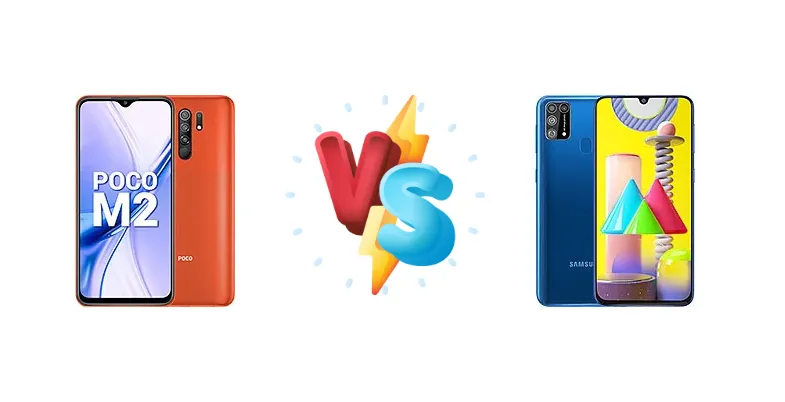
The Xiaomi Poco M2 and Samsung Galaxy M31 Prime represent compelling options in the fiercely competitive sub-₹11,000 smartphone segment. While both aim to deliver essential features at an accessible price, they diverge significantly in their core hardware, particularly in chipset choice and charging capabilities. This comparison dissects these differences to determine which device offers the best value for your money.
🏆 Quick Verdict
For most users, the Poco M2 emerges as the stronger contender. Its Mediatek Helio G80 chipset, built on a more efficient 12nm process, provides a noticeable performance edge over the Samsung Galaxy M31 Prime’s 10nm Exynos 9611, especially in gaming. While the M31 Prime offers a larger display, the Poco M2’s superior processing power and slightly faster charging make it the better all-rounder.
| Network |
|---|
| 2G bands | GSM 850 / 900 / 1800 / 1900 | GSM 850 / 900 / 1800 / 1900 |
| 3G bands | HSDPA 850 / 900 / 1900 / 2100 | HSDPA 850 / 900 / 1700(AWS) / 1900 / 2100 |
| 4G bands | 1, 3, 5, 8, 40, 41 | 1, 2, 3, 4, 5, 7, 8, 12, 13, 17, 20, 26, 28, 38, 40, 41, 66 |
| EDGE | - | Yes |
| GPRS | - | Class 10 |
| Speed | HSPA, LTE | HSPA, LTE |
| Technology | GSM / HSPA / LTE | GSM / HSPA / LTE |
| Launch |
|---|
| Announced | 2020, September 08 | 2020, October 14. Released 2020, October 17 |
| Status | Available. Released 2020, September 15 | Discontinued |
| Body |
|---|
| Build | Glass front (Gorilla Glass 3), plastic back, plastic frame | Glass front (Gorilla Glass 3), plastic back, plastic frame |
| Dimensions | 163.3 x 77 x 9.1 mm (6.43 x 3.03 x 0.36 in) | 159.2 x 75.1 x 8.9 mm (6.27 x 2.96 x 0.35 in) |
| SIM | Nano-SIM + Nano-SIM | Nano-SIM + Nano-SIM |
| Weight | 198 g (6.98 oz) | 191 g (6.74 oz) |
| | Water-repellent coating | - |
| Display |
|---|
| Protection | Corning Gorilla Glass 3 | Corning Gorilla Glass 3 |
| Resolution | 1080 x 2340 pixels, 19.5:9 ratio (~395 ppi density) | 1080 x 2340 pixels, 19.5:9 ratio (~403 ppi density) |
| Size | 6.53 inches, 104.7 cm2 (~83.2% screen-to-body ratio) | 6.4 inches, 100.5 cm2 (~84.1% screen-to-body ratio) |
| Type | IPS LCD, 400 nits (typ) | Super AMOLED, 420 nits (peak) |
| Platform |
|---|
| CPU | Octa-core (2x2.0 GHz Cortex-A75 & 6x1.8 GHz Cortex-A55) | Octa-core (4x2.3 GHz Cortex-A73 & 4x1.7 GHz Cortex-A53) |
| Chipset | Mediatek MT6769V/CU Helio G80 (12 nm) | Exynos 9611 (10 nm) |
| GPU | Mali-G52 MC2 | Mali-G72 MP3 |
| OS | Android 10, MIUI 12 | Android 10, One UI 2.0 |
| Memory |
|---|
| Call records | - | Yes |
| Card slot | microSDXC (dedicated slot) | microSDXC (dedicated slot) |
| Internal | 64GB 6GB RAM, 128GB 6GB RAM | 64GB 6GB RAM, 128GB 6GB RAM |
| Phonebook | - | Yes |
| | eMMC 5.1 | UFS 2.1 |
| Main Camera |
|---|
| Features | LED flash, HDR, panorama | LED flash, panorama, HDR |
| Quad | 13 MP, f/2.2, 28mm (wide), 1/3.1", 1.12µm, PDAF
8 MP, f/2.2, 118˚ (ultrawide), 1/4.0", 1.12µm
5 MP (macro)
Auxiliary lens | 64 MP, f/1.8, 26mm (wide), 1/1.72", 0.8µm, PDAF
8 MP, f/2.2, 123˚ (ultrawide), 1/4.0", 1.12µm
5 MP (macro)
Auxiliary lens |
| Single | - | 3.15 MP |
| Video | 1080p@30fps | 4K@30fps, 1080p@30fps, gyro-EIS |
| Selfie camera |
|---|
| Features | HDR | HDR |
| Single | 8 MP, f/2.0, 27mm (wide), 1/4.0", 1.12µm | 32 MP, f/2.0, 26mm (wide), 1/2.8", 0.8µm |
| Video | 1080p@30fps | 4K@30fps, 1080p@30fps |
| Sound |
|---|
| 3.5mm jack | Yes | Yes |
| 35mm jack | Yes | Yes |
| Loudspeaker | Yes | Yes |
| Comms |
|---|
| Bluetooth | 5.0, A2DP, LE | 5.0, A2DP, LE |
| Infrared port | Yes | - |
| NFC | No | No |
| Positioning | GPS, GLONASS, BDS | GPS, GLONASS, GALILEO, BDS |
| Radio | Wireless FM radio (no wired headphones required) | FM radio, RDS, recording |
| USB | USB Type-C 2.0, OTG | USB Type-C 2.0 |
| WLAN | Wi-Fi 802.11 a/b/g/n/ac, dual-band, Wi-Fi Direct | Wi-Fi 802.11 a/b/g/n/ac, dual-band, Wi-Fi Direct |
| Features |
|---|
| Games | - | Downloadable |
| Java | - | Yes |
| Messaging | - | SMS, MMS, Email, Push Email, IM |
| Sensors | Fingerprint (rear-mounted), accelerometer, proximity, compass | Fingerprint (rear-mounted), accelerometer, gyro, compass |
| | - | Virtual proximity sensing |
| Battery |
|---|
| Charging | 18W wired | 15W wired |
| Stand-by | - | Up to 150 h |
| Talk time | - | Up to 1 h 30 min |
| Type | Li-Po 5000 mAh | Li-Po 6000 mAh |
| Misc |
|---|
| Colors | Brick Red, Pitch Black, Slate Blue | Ocean Blue, Space Black, Iceberg Blue |
| Models | MZB9919IN, M2004J19PI | SM-M315F/DS |
| Price | About 130 EUR | About 190 EUR |
| SAR | 0.85 W/kg (head) 0.42 W/kg (body) | 0.38 W/kg (head) |
| Pricing |
|---|
| 128GB 6GB RAM | ₹ 10,499 | - |
| 64GB 6GB RAM | ₹ 10,799 | - |
Xiaomi Poco M2
- More powerful Mediatek Helio G80 chipset
- Faster 18W wired charging
- Potentially better thermal management
- Display specifications are basic
- Camera details are limited
Samsung Galaxy M31 Prime
- Likely better display quality due to Samsung’s expertise
- Familiar Samsung user interface
- Potentially better image processing
- Older and less efficient Exynos 9611 chipset
- Slower 15W wired charging
- May experience more thermal throttling
Display Comparison
Both devices lack detailed display specifications beyond size. However, the Samsung Galaxy M31 Prime likely benefits from Samsung’s display expertise, potentially offering slightly better color accuracy and viewing angles. The Poco M2’s display, while adequate, doesn’t boast any standout features. The larger screen real estate of the M31 Prime will be preferred by those who consume a lot of video content, but the difference in resolution isn't specified and likely isn't significant.
Camera Comparison
Detailed camera specs are missing, but both phones likely feature a multi-camera setup with a primary sensor. The focus should be on the main sensor resolution and aperture. Without this data, it’s difficult to definitively declare a winner. However, Samsung’s image processing algorithms are generally well-regarded, potentially offering more pleasing results in certain scenarios. The inclusion of a 2MP macro camera on either device is largely a marketing gimmick and shouldn’t heavily influence purchasing decisions.
Performance
The core difference lies in the chipsets. The Poco M2’s Mediatek Helio G80 (12nm) utilizes a dual-cluster CPU design with 2x2.0 GHz Cortex-A75 cores and 6x1.8 GHz Cortex-A55 cores, geared towards gaming. The Galaxy M31 Prime’s Exynos 9611 (10nm) features 4x2.3 GHz Cortex-A73 cores and 4x1.7 GHz Cortex-A53 cores. While the Exynos has higher clocked cores, the Helio G80’s newer architecture and more efficient process node generally translate to better sustained performance and thermal management. The Poco M2 will likely exhibit less throttling during extended gaming sessions. The 6GB of RAM in both variants ensures smooth multitasking, but the chipset is the limiting factor.
Battery Life
The battery capacity isn’t specified for either device, but both likely fall in the 5000mAh range, typical for this price segment. The Poco M2’s 18W wired charging is faster than the Galaxy M31 Prime’s 15W charging. This translates to quicker top-ups, reducing downtime. While a larger battery capacity *could* offset the slower charging, the difference is unlikely to be substantial enough to negate the benefit of the Poco M2’s faster charging speed.
Buying Guide
Buy the Xiaomi Poco M2 if you prioritize gaming performance, responsiveness in everyday tasks, and a more modern chipset architecture. It’s ideal for users who frequently stream videos, play mobile games, or multitask between applications. Buy the Samsung Galaxy M31 Prime if you value a larger screen for media consumption and prefer the Samsung ecosystem, understanding that you’ll be making a trade-off in raw processing power and charging speed.
Frequently Asked Questions
❓ Does the Exynos 9611 in the Galaxy M31 Prime tend to overheat during prolonged gaming sessions?
The Exynos 9611, being built on a 10nm process, is more prone to thermal throttling than the Poco M2’s Helio G80 (12nm). Expect performance to dip after extended gaming, potentially leading to a less smooth experience. The Poco M2 is better equipped to handle sustained loads.
❓ Is the 18W charging on the Poco M2 a significant improvement over the 15W charging on the Galaxy M31 Prime?
Yes, while the difference may not seem substantial, 18W charging will noticeably reduce charging times. Expect a faster 0-100% charge on the Poco M2, minimizing downtime and keeping you connected for longer. This is particularly beneficial for users who frequently need to top up their battery throughout the day.
❓ How does the CPU architecture of the Helio G80 compare to the Exynos 9611 in terms of real-world performance?
The Helio G80’s Cortex-A75 cores are more efficient than the Exynos 9611’s Cortex-A73 cores. This, combined with the 12nm process, results in better single-core and multi-core performance, especially in tasks that benefit from sustained processing power like gaming and video editing. The Exynos 9611 relies on higher clock speeds, but the Helio G80’s architecture provides a more balanced and efficient experience.