
Xiaomi Poco F8 Ultra vs OnePlus 11R: A Deep Dive into Performance and Value
| Phones Images | |||||
|---|---|---|---|---|---|
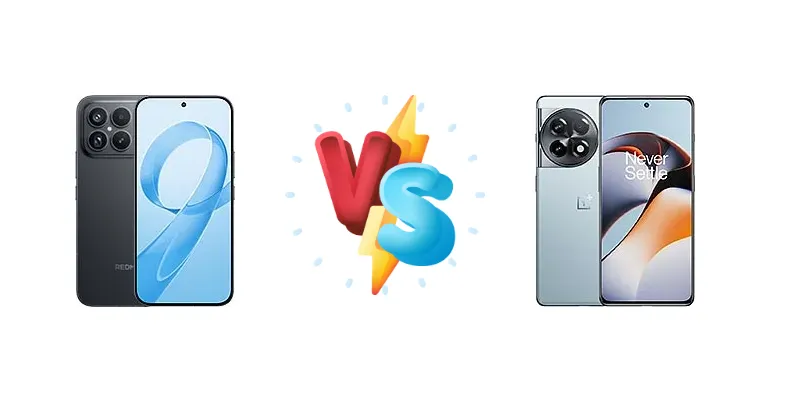
|
🏆 Quick Verdict
For users prioritizing absolute performance and future-proofing, the Xiaomi Poco F8 Ultra is the clear winner, thanks to its Snapdragon 8 Elite Gen 5. However, the OnePlus 11R provides excellent value, delivering a smooth experience and 100W charging at a potentially lower price point, making it ideal for budget-conscious gamers and everyday users.
| PHONES | ||
|---|---|---|
| Phone Names | Xiaomi Poco F8 Ultra | OnePlus 11R |
| Network | ||
|---|---|---|
| 2G bands | GSM 850 / 900 / 1800 / 1900 | GSM 850 / 900 / 1800 / 1900 |
| 3G bands | HSDPA 800 / 850 / 900 / 1700(AWS) / 1900 / 2100 | HSDPA 850 / 900 / 1700(AWS) / 2100 |
| 4G bands | 1, 2, 3, 4, 5, 7, 8, 18, 19, 20, 26, 28, 38, 40, 41, 42, 48, 66, 71 | 1, 3, 4, 5, 8, 28, 34, 38, 39, 40, 41 |
| 5G bands | 1, 2, 3, 5, 7, 8, 20, 26, 28, 38, 40, 41, 48, 66, 71, 77, 78 SA/NSA | 1, 3, 5, 8, 28, 40, 41, 77, 78 SA/NSA |
| Speed | HSPA, LTE, 5G | HSPA, LTE (3CA), 5G |
| Technology | GSM / HSPA / LTE / 5G | GSM / CDMA / HSPA / LTE / 5G |
| - | CDMA 800 | |
| Launch | ||
|---|---|---|
| Announced | 2025, November 26 | 2023, February 07 |
| Status | Available. Released 2025, November 26 | Available. Released 2023, February 21 |
| Body | ||
|---|---|---|
| Build | Glass front (Poco Shield Glass), aluminum alloy frame, fiber-reinforced plastic back or silicone polymer back | Glass front, glass back (Gorilla Glass 5), plastic frame |
| Dimensions | 163.3 x 77.8 x 7.9 mm or 8.3 mm | 163.4 x 74.3 x 8.7 mm (6.43 x 2.93 x 0.34 in) |
| SIM | · Nano-SIM + Nano-SIM + eSIM + eSIM (max 2 at a time)· Nano-SIM + Nano-SIM + eSIM (max 2 at a time) | Nano-SIM + Nano-SIM |
| Weight | 218 g or 220 g (7.69 oz) | 204 g (7.20 oz) |
| Display | ||
|---|---|---|
| Protection | Poco Shield Glass | - |
| Resolution | 1200 x 2608 pixels, 19.5:9 ratio (~416 ppi density) | 1240 x 2772 pixels, 20:9 ratio (~451 ppi density) |
| Size | 6.9 inches, 116.6 cm2 (~91.8% screen-to-body ratio) | 6.74 inches, 109.2 cm2 (~90.0% screen-to-body ratio) |
| Type | AMOLED, 68B colors, 2560Hz PWM, 120Hz, Dolby Vision, HDR10+, 2000 nits (HBM), 3500 nits (peak) | Fluid AMOLED, 1B colors, 120Hz, HDR10+, 1450 nits (peak) |
| Platform | ||
|---|---|---|
| CPU | Octa-core (2x4.6 GHz Oryon V3 Phoenix L + 6x3.62 GHz Oryon V3 Phoenix M) | Octa-core (1x3.0 GHz Cortex-X2 & 3x2.5 GHz Cortex-A710 & 4x1.80 GHz Cortex-A510) |
| Chipset | Qualcomm SM8850-AC Snapdragon 8 Elite Gen 5 (3 nm) | Qualcomm SM8475 Snapdragon 8+ Gen 1 (4 nm) |
| GPU | Adreno 840 | Adreno 730 |
| OS | Android 16, HyperOS 3 | Android 13, upgradable to Android 15, OxygenOS 15 |
| Memory | ||
|---|---|---|
| Card slot | No | No |
| Internal | 256GB 12GB RAM, 512GB 16GB RAM | 128GB 8GB RAM, 256GB 16GB RAM, 512GB 18GB RAM |
| - | UFS 3.1 | |
| Main Camera | ||
|---|---|---|
| Features | Color spectrum sensor, LED flash, HDR, panorama | Color spectrum sensor, LED flash, HDR, panorama |
| Single | - | 16 MP, f/2.4, 24mm (wide), 1/3.09", 1.0µm |
| Triple | 50 MP, f/1.7, 23mm (wide), 1/1.31", 1.2µm, dual pixel PDAF, OIS 50 MP, f/3.0, 115mm (periscope telephoto), 1/2.76", 0.64µm, PDAF (30cm - ∞), OIS, 5x optical zoom 50 MP, f/2.4, 18mm, 102˚ (ultrawide), 1/2.88", 0.61µm | 50 MP, f/1.8, 24mm (wide), 1/1.56", 1.0µm, multi-directional PDAF, OIS 8 MP, f/2.2, 120˚ (ultrawide), 1/4.0", 1.12µm 2 MP (macro) |
| Video | 8K@30fps, 4K@30/60fps, 1080p@30/60/120/240/960fps, 720p@1920fps, gyro-EIS, HDR10+ | 4K@30/60fps, 1080p@30/60/240fps, gyro-EIS |
| Selfie camera | ||
|---|---|---|
| Features | HDR | HDR |
| Single | 32 MP, f/2.2, 21mm (wide), 1/3.44", 0.64µm | 16 MP, f/2.4, 24mm (wide), 1/3.09", 1.0µm |
| Video | 4K@30fps, 1080p@30/60fps | 1080p@30fps |
| Sound | ||
|---|---|---|
| 3.5mm jack | - | No |
| 35mm jack | No | No |
| Loudspeaker | Yes, with stereo speakers (with Dolby Atmos) | Yes, with stereo speakers |
| - | 24-bit/192kHz audio | |
| Comms | ||
|---|---|---|
| Bluetooth | 6.0, A2DP, LE, aptX HD, aptX Adaptive, LHDC 5.0, ASHA, MIHC | 5.3, A2DP, LE, aptX HD |
| Infrared port | Yes | Yes |
| NFC | Yes (market/region dependent) | Yes |
| Positioning | GPS (L1+L5), BDS (B1I+B1c+B2a), GALILEO (E1+E5a), QZSS (L1+L5), NavIC (L5), GLONASS | GPS (L1+L5), GLONASS (G1), BDS (B1I+B1c+B2a), GALILEO (E1+E5a), QZSS (L1+L5) |
| Radio | No | No |
| USB | USB Type-C 3.2, Display Port, OTG | USB Type-C 2.0 |
| WLAN | Wi-Fi 802.11 a/b/g/n/ac/6/7, dual-band, Wi-Fi Direct | Wi-Fi 802.11 a/b/g/n/ac/6, dual-band |
| Features | ||
|---|---|---|
| Sensors | Fingerprint (under display, ultrasonic), accelerometer, proximity, gyro, compass | Fingerprint (under display, optical), accelerometer, gyro, proximity, compass |
| Battery | ||
|---|---|---|
| Charging | 100W wired, PD3.0, QC3+, 100W PPS, 100% in 38 mins 50W wireless, 50% in 31 mins 22.5W reverse wireless | 100W wired |
| Type | 6500 mAh | Li-Po 5000 mAh |
| Misc | ||
|---|---|---|
| Colors | Black, White, Denim Blue | Galactic Silver, Sonic Black, Solar Red |
| Models | 25102PCBEG | CPH2487 |
| Price | £ 549.00 / € 659.46 | About 600 EUR |
| SAR | - | 1.16 W/kg (head) 0.61 W/kg (body) |
Xiaomi Poco F8 Ultra
- Cutting-edge Snapdragon 8 Elite Gen 5 chipset
- 100W wired and 50W wireless charging
- High peak display brightness (1077 nits)
- Potentially higher price point
- May run hotter under sustained load
OnePlus 11R
- Excellent value for money
- Proven Snapdragon 8+ Gen 1 performance
- 100W wired charging
- Lacks wireless charging
- Older chipset technology
Display Comparison
The Poco F8 Ultra boasts a peak brightness of 1077 nits, suggesting a vibrant and easily viewable display even in direct sunlight. While the OnePlus 11R’s display specs aren’t provided, OnePlus typically utilizes AMOLED panels with excellent color accuracy. The F8 Ultra’s brightness advantage is significant, potentially offering a superior outdoor viewing experience. Without knowing the OnePlus 11R’s refresh rate or PWM dimming frequency, it’s difficult to assess potential eye strain differences, but the F8 Ultra’s higher brightness could also translate to higher power consumption.
Camera Comparison
Detailed camera specs are missing for both devices. However, given the market positioning, we can infer that the Poco F8 Ultra likely features a more advanced camera system. The Snapdragon 8 Elite Gen 5’s ISP (Image Signal Processor) is significantly more capable than the 8+ Gen 1’s, enabling features like improved low-light performance and faster image processing. Without sensor size or aperture information, it’s difficult to make a definitive judgment, but the F8 Ultra’s chipset advantage suggests superior image quality, particularly in challenging conditions. We'd expect both phones to offer capable main cameras, but the F8 Ultra likely has the edge in computational photography.
Performance
The core difference lies in the chipsets: the Poco F8 Ultra’s Snapdragon 8 Elite Gen 5 (3nm) versus the OnePlus 11R’s Snapdragon 8+ Gen 1 (4nm). The 3nm process of the Snapdragon 8 Elite Gen 5 promises significant gains in power efficiency and transistor density, leading to potentially higher sustained performance and reduced thermal throttling. The F8 Ultra’s CPU configuration – octa-core with 2x4.6 GHz Oryon V3 Phoenix L cores and 6x3.62 GHz Oryon V3 Phoenix M cores – is designed for peak performance, while the 11R’s octa-core (1x3.0 GHz Cortex-X2 & 3x2.5 GHz Cortex-A710 & 4x1.80 GHz Cortex-A510) offers a more traditional flagship configuration. The F8 Ultra is expected to excel in demanding tasks like gaming and video editing, while the 11R will provide a very smooth experience for most users.
Battery Life
The Poco F8 Ultra delivers an impressive 18:52h of active use, showcasing excellent battery optimization despite its powerful chipset. It supports 100W wired charging, reaching 100% in just 38 minutes, alongside 50W wireless charging (50% in 31 mins) and 22.5W reverse wireless. The OnePlus 11R offers 100W wired charging, but lacks wireless charging capabilities. While the OnePlus 11R’s battery capacity isn’t specified, the F8 Ultra’s combination of efficient chipset and fast charging provides a compelling advantage for users who prioritize minimizing downtime.
Buying Guide
Buy the Xiaomi Poco F8 Ultra if you demand the fastest possible Android performance, need the latest chipset technology, and value the benefits of 100W wired *and* 50W wireless charging. Buy the OnePlus 11R if you prioritize a balanced experience, excellent value for money, and a proven track record of stable performance without necessarily needing the absolute bleeding edge of processing power.