
Xiaomi Poco F8 Ultra vs. Apple iPhone 14 Pro Max: A Deep Dive Comparison
| Phones Images | |||||
|---|---|---|---|---|---|
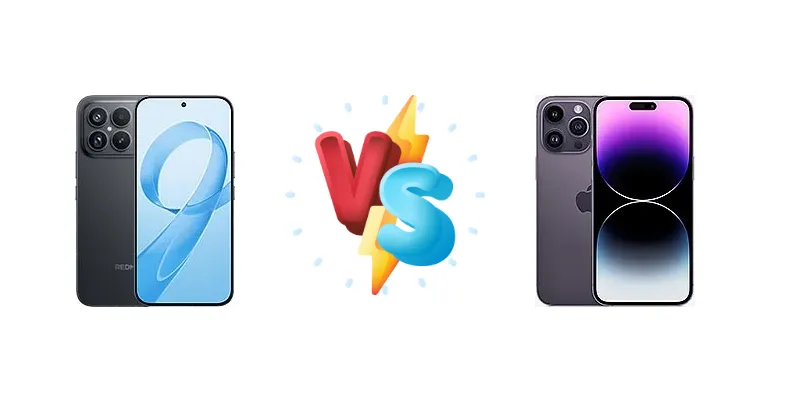
|
🏆 Quick Verdict
For the power user prioritizing raw performance and charging speed, the Xiaomi Poco F8 Ultra emerges as the winner. Its Snapdragon 8 Elite Gen 5 and 100W charging offer a compelling advantage. However, the iPhone 14 Pro Max retains its crown for ecosystem integration, refined software, and consistently excellent camera performance.
| PHONES | ||
|---|---|---|
| Phone Names | Xiaomi Poco F8 Ultra | Apple iPhone 14 Pro Max |
| Network | ||
|---|---|---|
| 2G bands | GSM 850 / 900 / 1800 / 1900 | GSM 850 / 900 / 1800 / 1900 |
| 3G bands | HSDPA 800 / 850 / 900 / 1700(AWS) / 1900 / 2100 | HSDPA 850 / 900 / 1700(AWS) / 1900 / 2100 |
| 4G bands | 1, 2, 3, 4, 5, 7, 8, 18, 19, 20, 26, 28, 38, 40, 41, 42, 48, 66, 71 | 1, 2, 3, 4, 5, 7, 8, 12, 13, 17, 18, 19, 20, 25, 26, 28, 30, 32, 34, 38, 39, 40, 41, 42, 46, 48, 66 - A2894, A2896 |
| 5G bands | 1, 2, 3, 5, 7, 8, 20, 26, 28, 38, 40, 41, 48, 66, 71, 77, 78 SA/NSA | 1, 2, 3, 5, 7, 8, 12, 20, 25, 26, 28, 30, 38, 40, 41, 48, 66, 70, 77, 78, 79 SA/NSA/Sub6 - A2894, A2896 |
| Speed | HSPA, LTE, 5G | HSPA, LTE, 5G, EV-DO Rev.A 3.1 Mbps |
| Technology | GSM / HSPA / LTE / 5G | GSM / CDMA / HSPA / EVDO / LTE / 5G |
| - | 1, 2, 3, 5, 7, 8, 12, 20, 25, 26, 28, 30, 38, 40, 41, 48, 66, 70, 77, 78, 79 SA/NSA/Sub6 - A2895 | |
| Launch | ||
|---|---|---|
| Announced | 2025, November 26 | 2022, September 07 |
| Status | Available. Released 2025, November 26 | Available. Released 2022, September 16 |
| Body | ||
|---|---|---|
| Build | Glass front (Poco Shield Glass), aluminum alloy frame, fiber-reinforced plastic back or silicone polymer back | Glass front, glass back, stainless steel frame |
| Dimensions | 163.3 x 77.8 x 7.9 mm or 8.3 mm | 160.7 x 77.6 x 7.9 mm (6.33 x 3.06 x 0.31 in) |
| SIM | · Nano-SIM + Nano-SIM + eSIM + eSIM (max 2 at a time)· Nano-SIM + Nano-SIM + eSIM (max 2 at a time) | · Nano-SIM + eSIM + eSIM (max 2 at a time; International)· eSIM + eSIM (8 or more, max 2 at a time; USA)· Nano-SIM + Nano-SIM (China) |
| Weight | 218 g or 220 g (7.69 oz) | 240 g (8.47 oz) |
| - | IP68 dust/water resistant (up to 6m for 30 min) Apple Pay (Visa, MasterCard, AMEX certified) | |
| Display | ||
|---|---|---|
| Protection | Poco Shield Glass | Ceramic Shield glass |
| Resolution | 1200 x 2608 pixels, 19.5:9 ratio (~416 ppi density) | 1290 x 2796 pixels, 19.5:9 ratio (~460 ppi density) |
| Size | 6.9 inches, 116.6 cm2 (~91.8% screen-to-body ratio) | 6.7 inches, 110.2 cm2 (~88.3% screen-to-body ratio) |
| Type | AMOLED, 68B colors, 2560Hz PWM, 120Hz, Dolby Vision, HDR10+, 2000 nits (HBM), 3500 nits (peak) | LTPO Super Retina XDR OLED, 120Hz, HDR10, Dolby Vision, 1000 nits (typ), 2000 nits (HBM) |
| - | Always-On display | |
| Platform | ||
|---|---|---|
| CPU | Octa-core (2x4.6 GHz Oryon V3 Phoenix L + 6x3.62 GHz Oryon V3 Phoenix M) | Hexa-core (2x3.46 GHz Everest + 4x2.02 GHz Sawtooth) |
| Chipset | Qualcomm SM8850-AC Snapdragon 8 Elite Gen 5 (3 nm) | Apple A16 Bionic (4 nm) |
| GPU | Adreno 840 | Apple GPU (5-core graphics) |
| OS | Android 16, HyperOS 3 | iOS 16, upgradable to iOS 26.1 |
| Memory | ||
|---|---|---|
| Card slot | No | No |
| Internal | 256GB 12GB RAM, 512GB 16GB RAM | 128GB 6GB RAM, 256GB 6GB RAM, 512GB 6GB RAM, 1TB 6GB RAM |
| - | NVMe | |
| Main Camera | ||
|---|---|---|
| Features | Color spectrum sensor, LED flash, HDR, panorama | Dual-LED dual-tone flash, HDR (photo/panorama) |
| Single | - | 12 MP, f/1.9, 23mm (wide), 1/3.6", PDAF, OIS (unconfirmed) SL 3D, (depth/biometrics sensor) |
| Triple | 50 MP, f/1.7, 23mm (wide), 1/1.31", 1.2µm, dual pixel PDAF, OIS 50 MP, f/3.0, 115mm (periscope telephoto), 1/2.76", 0.64µm, PDAF (30cm - ∞), OIS, 5x optical zoom 50 MP, f/2.4, 18mm, 102˚ (ultrawide), 1/2.88", 0.61µm | 48 MP, f/1.8, 24mm (wide), 1/1.28", 1.22µm, dual pixel PDAF, sensor-shift OIS 12 MP, f/2.8, 77mm (telephoto), 1/3.5", 1.0µm, PDAF, OIS, 3x optical zoom 12 MP, f/2.2, 13mm, 120˚ (ultrawide), 1/2.55", 1.4µm, dual pixel PDAF TOF 3D LiDAR scanner (depth) |
| Video | 8K@30fps, 4K@30/60fps, 1080p@30/60/120/240/960fps, 720p@1920fps, gyro-EIS, HDR10+ | 4K@24/25/30/60fps, 1080p@25/30/60/120/240fps, 10-bit HDR, Dolby Vision HDR (up to 60fps), ProRes, stereo sound rec. |
| Selfie camera | ||
|---|---|---|
| Features | HDR | HDR |
| Single | 32 MP, f/2.2, 21mm (wide), 1/3.44", 0.64µm | 12 MP, f/1.9, 23mm (wide), 1/3.6", 1.0µm, PDAF, OIS SL 3D, (depth/biometrics sensor) |
| Video | 4K@30fps, 1080p@30/60fps | 4K@24/25/30/60fps, 1080p@25/30/60/120fps, gyro-EIS |
| Sound | ||
|---|---|---|
| 3.5mm jack | - | No |
| 35mm jack | No | No |
| Loudspeaker | Yes, with stereo speakers (with Dolby Atmos) | Yes, with stereo speakers |
| Comms | ||
|---|---|---|
| Bluetooth | 6.0, A2DP, LE, aptX HD, aptX Adaptive, LHDC 5.0, ASHA, MIHC | 5.3, A2DP, LE |
| Infrared port | Yes | - |
| NFC | Yes (market/region dependent) | Yes |
| Positioning | GPS (L1+L5), BDS (B1I+B1c+B2a), GALILEO (E1+E5a), QZSS (L1+L5), NavIC (L5), GLONASS | GPS (L1+L5), GLONASS, GALILEO, BDS, QZSS |
| Radio | No | No |
| USB | USB Type-C 3.2, Display Port, OTG | Lightning, USB 2.0 |
| WLAN | Wi-Fi 802.11 a/b/g/n/ac/6/7, dual-band, Wi-Fi Direct | Wi-Fi 802.11 a/b/g/n/ac/6, dual-band, hotspot |
| Features | ||
|---|---|---|
| Sensors | Fingerprint (under display, ultrasonic), accelerometer, proximity, gyro, compass | Face ID, accelerometer, gyro, proximity, compass, barometer |
| - | Ultra Wideband (UWB) support Emergency SOS via satellite (SMS sending/receiving) | |
| Battery | ||
|---|---|---|
| Charging | 100W wired, PD3.0, QC3+, 100W PPS, 100% in 38 mins 50W wireless, 50% in 31 mins 22.5W reverse wireless | Wired, PD2.0, 50% in 30 min 15W wireless (MagSafe) 15W wireless (Qi2) - requires iOS 17.2 update |
| Type | 6500 mAh | Li-Ion 4323 mAh (16.68 Wh) |
| Misc | ||
|---|---|---|
| Colors | Black, White, Denim Blue | Space Black, Silver, Gold, Deep Purple |
| Models | 25102PCBEG | A2894, A2651, A2893, A2895, A2896, iphone15,3 |
| Price | £ 549.00 / € 659.46 | € 530.79 / $ 489.81 / £ 446.75 |
| SAR | - | 1.15 W/kg (head) 1.07 W/kg (body) |
| SAR EU | - | 0.99 W/kg (head) 0.98 W/kg (body) |
| Tests | ||
|---|---|---|
| Battery life | - | Endurance rating 121h |
| Camera | - | Photo / Video |
| Display | - | Contrast ratio: Infinite (nominal) |
| Loudspeaker | - | -24.3 LUFS (Very good) |
| Performance | - | AnTuTu: 955884 (v9) GeekBench: 5423 (v5.1) GFXBench: 54fps (ES 3.1 onscreen) |
Xiaomi Poco F8 Ultra
- Blazing-fast 100W wired and 50W wireless charging
- Potentially higher sustained performance due to 3nm Snapdragon 8 Elite Gen 5
- Likely more affordable price point
- Reverse wireless charging capability
- Lower display brightness compared to iPhone
- Less refined software experience (Android vs. iOS)
- Battery endurance significantly lower than iPhone
Apple iPhone 14 Pro Max
- Superior display brightness and contrast
- Highly optimized iOS ecosystem and software
- Exceptional camera performance and video recording
- Industry-leading battery endurance
- Slower charging speeds
- Higher price point
- Less customization options compared to Android
Display Comparison
The iPhone 14 Pro Max boasts a significantly brighter display at 1760 nits, exceeding the Poco F8 Ultra’s 1077 nits. This translates to superior visibility in direct sunlight. While both utilize advanced display technology, the iPhone’s infinite contrast ratio (nominal) provides deeper blacks and more vibrant colors. The Poco F8 Ultra’s display specifications don’t mention refresh rate or panel type, but given its positioning, a high refresh rate LTPO panel is expected, though it doesn’t match the iPhone’s peak brightness. The iPhone’s ProMotion technology dynamically adjusts the refresh rate up to 120Hz, optimizing for both smoothness and power efficiency.
Camera Comparison
The context data for both devices is limited regarding camera specifics. However, the iPhone 14 Pro Max is known for its exceptional computational photography and video recording capabilities, leveraging Apple’s advanced image signal processor. The Poco F8 Ultra, while likely equipped with a high-resolution sensor, will rely heavily on software optimization to compete. The iPhone’s cinematic mode and ProRes video recording are significant advantages for content creators. Without detailed sensor size and aperture information for the Poco F8 Ultra, it’s difficult to assess its low-light performance relative to the iPhone.
Performance
The core of the battle lies in the chipsets. The Poco F8 Ultra’s Qualcomm SM8850-AC Snapdragon 8 Elite Gen 5 (3nm) features an octa-core configuration with a split design – 2x4.6 GHz Oryon V3 Phoenix L cores for peak performance and 6x3.62 GHz Oryon V3 Phoenix M cores for efficiency. This contrasts with the iPhone 14 Pro Max’s hexa-core Apple A16 Bionic (4nm) with 2x3.46 GHz Everest cores and 4x2.02 GHz Sawtooth cores. While core count isn’t everything, the Snapdragon 8 Elite Gen 5’s newer 3nm process should offer improved thermal efficiency and potentially higher sustained performance. However, Apple’s A16 Bionic is renowned for its exceptional single-core performance and optimized software integration, which often translates to a smoother user experience despite the lower clock speeds. The Poco F8 Ultra likely benefits from faster LPDDR5x RAM, further enhancing its multitasking capabilities.
Battery Life
The iPhone 14 Pro Max boasts an endurance rating of 121 hours, a testament to Apple’s efficient hardware and software optimization. The Poco F8 Ultra, with an active use score of 18:52h, falls significantly behind in endurance. However, the Poco F8 Ultra compensates with its revolutionary charging capabilities. 100W wired charging delivers a full charge in just 38 minutes, while 50W wireless charging reaches 50% in 31 minutes. The iPhone 14 Pro Max’s charging is comparatively slow, taking 30 minutes for a 50% charge with wired PD2.0. The Poco F8 Ultra also offers 22.5W reverse wireless charging, a feature absent on the iPhone.
Buying Guide
Buy the Xiaomi Poco F8 Ultra if you need uncompromising processing power for demanding tasks like gaming and video editing, coupled with the convenience of incredibly fast wired and wireless charging. Buy the Apple iPhone 14 Pro Max if you prioritize a seamless user experience, a mature and optimized software ecosystem, and a consistently reliable camera system, even if it means sacrificing some charging speed and raw CPU benchmarks.