
Poco F7 vs Nothing Phone (2): A Deep Dive into Performance, Battery, and Design
| Phones Images | |||||
|---|---|---|---|---|---|
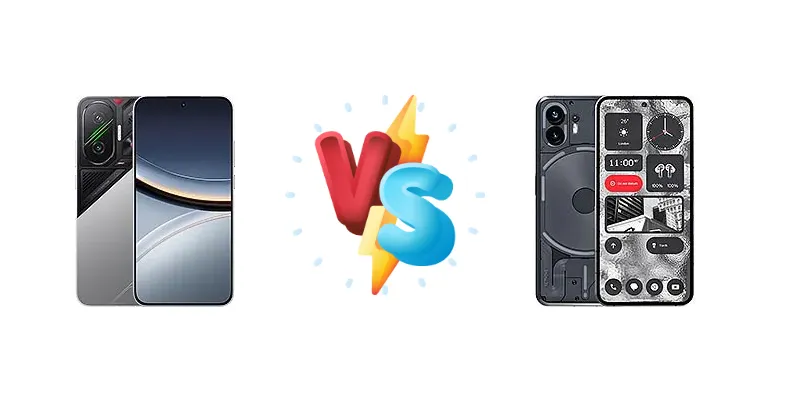
|
🏆 Quick Verdict
For users prioritizing raw performance and fast charging, the Poco F7 is the clear winner. Its Snapdragon 8s Gen 4 chipset and 90W charging significantly outperform the Nothing Phone (2)'s Snapdragon 8+ Gen 1 and 45W charging. However, the Nothing Phone (2) remains a compelling option for those valuing wireless charging and a distinctive design.
| PHONES | ||
|---|---|---|
| Phone Names | Xiaomi Poco F7 | Nothing Phone (2) |
| Network | ||
|---|---|---|
| 2G bands | GSM 850 / 900 / 1800 / 1900 | GSM 850 / 900 / 1800 / 1900 |
| 3G bands | HSDPA 800 / 850 / 900 / 1700(AWS) / 1900 / 2100 | HSDPA 800 / 850 / 900 / 1700(AWS) / 1900 / 2100 |
| 4G bands | 1, 2, 3, 4, 5, 7, 8, 18, 19, 20, 26, 28, 38, 40, 41, 42, 48, 66 | 1, 2, 3, 4, 5, 7, 8, 12, 17, 18, 19, 20, 25, 26, 28, 30, 32, 34, 38, 39, 40, 41, 42, 48, 66, 71 |
| 5G bands | 1, 2, 3, 5, 7, 8, 20, 28, 38, 40, 41, 48, 66, 77, 78 SA/NSA/Sub6 | 1, 2, 3, 5, 7, 8, 12, 20, 25, 28, 30, 38, 40, 41, 66, 71, 75, 77, 78 SA/NSA |
| Speed | HSPA, LTE, 5G | HSPA, LTE, 5G |
| Technology | GSM / HSPA / LTE / 5G | GSM / HSPA / LTE / 5G |
| Launch | ||
|---|---|---|
| Announced | 2025, June 24 | 2023, July 11 |
| Status | Available. Released 2025, June 24 | Available. Released 2023, July 17 |
| Body | ||
|---|---|---|
| Build | Glass front (Gorilla Glass 7i), aluminum frame, glass back | Glass front (Gorilla Glass 5), glass back (Gorilla Glass 5), aluminum frame |
| Dimensions | 163.1 x 77.9 x 8.2 mm (6.42 x 3.07 x 0.32 in) | 162.1 x 76.4 x 8.6 mm (6.38 x 3.01 x 0.34 in) |
| SIM | Nano-SIM + Nano-SIM | Nano-SIM + Nano-SIM |
| Weight | 215.7 g (7.62 oz) | 201.2 g (7.09 oz) |
| Display | ||
|---|---|---|
| Protection | Corning Gorilla Glass 7i, Mohs level 5 | Corning Gorilla Glass 5 |
| Resolution | 1280 x 2772 pixels, 19.5:9 ratio (~447 ppi density) | 1080 x 2412 pixels, 20:9 ratio (~394 ppi density) |
| Size | 6.83 inches, 114.5 cm2 (~90.2% screen-to-body ratio) | 6.7 inches, 108.0 cm2 (~87.2% screen-to-body ratio) |
| Type | AMOLED, 68B colors, 120Hz, 3840Hz PWM, Dolby Vision, HDR10+, 700 nits (typ), 1700 nits (HBM), 3200 nits (peak | LTPO OLED, 1B colors, 120Hz, 1920Hz PWM, HDR10+, 1600 nits (HBM), 1600 nits (peak) |
| Platform | ||
|---|---|---|
| CPU | Octa-core (1x3.21 GHz Cortex-X4 & 3x3.0 GHz Cortex-A720 & 2x2.8 GHz Cortex-A720 & 2x2.0 GHz Cortex-A720) | Octa-core (1x3.0 GHz Cortex-X2 & 3x2.5 GHz Cortex-A710 & 4x1.80 GHz Cortex-A510) |
| Chipset | Qualcomm SM8735 Snapdragon 8s Gen 4 (4 nm) | Qualcomm SM8475 Snapdragon 8+ Gen 1 (4 nm) |
| GPU | Adreno 825 | Adreno 730 |
| OS | Android 15, HyperOS 2 | Android 13, upgradable to Android 15, up to 3 major Android upgrades, Nothing OS 3.0 |
| Memory | ||
|---|---|---|
| Card slot | No | No |
| Internal | 256GB 12GB RAM, 512GB 12GB RAM | 128GB 8GB RAM, 256GB 12GB RAM, 512GB 12GB RAM |
| Main Camera | ||
|---|---|---|
| Dual | 50 MP, f/1.5, 26mm (wide), 1/1.95", 0.8µm, PDAF, OIS 8 MP, f/2.2, 15mm (ultrawide), 1/4.0", 1.12µm | 50 MP, f/1.9, 24mm (wide), 1/1.56", 1.0µm, PDAF, OIS 50 MP, f/2.2, 114˚ (ultrawide), 1/2.76", 0.64µm, AF |
| Features | LED flash, HDR, panorama | LED flash, panorama, HDR |
| Video | 4K@30/60fps, 1080p@30/60/120/240/960fps, gyro-EIS | 4K@30/60fps, 1080p@30/60fps, gyro-EIS, live HDR, OIS |
| Selfie camera | ||
|---|---|---|
| Features | HDR | HDR |
| Single | 20 MP, f/2.2, (wide), 1/4" | 32 MP, f/2.5, (wide), 1/2.74", 0.8µm |
| Video | 1080p@30/60fps | 1080p@30fps |
| Sound | ||
|---|---|---|
| 35mm jack | No | No |
| Loudspeaker | Yes, with stereo speakers | Yes, with stereo speakers |
| Comms | ||
|---|---|---|
| Bluetooth | 6.0, A2DP, LE, aptX HD, aptX Adaptive, LHDC 5 | 5.3, A2DP, LE, aptX HD, aptX Adaptive |
| Infrared port | Yes | - |
| NFC | Yes | Yes |
| Positioning | GPS (L1+L5), BDS (B1I+B1c+B2a), GALILEO (E1+E5a), QZSS (L1+L5), NavIC (L5), GLONASS | GPS (L1+L5), GLONASS (L1), BDS (B1I+B1c), GALILEO (E1), QZSS (L1), NavIC |
| Radio | No | No |
| USB | USB Type-C 2.0, OTG | USB Type-C 2.0, OTG |
| WLAN | Wi-Fi 802.11 a/b/g/n/ac/6/7, dual-band, Wi-Fi Direct | Wi-Fi 802.11 a/b/g/n/ac/6, dual-band, Wi-Fi Direct |
| Features | ||
|---|---|---|
| Sensors | Fingerprint (under display, optical), accelerometer, gyro, proximity, compass | Fingerprint (under display, optical), accelerometer, proximity, gyro, compass |
| Battery | ||
|---|---|---|
| Charging | 90W wired, PD3.0, QC3+, 80% in 30 min 22.5W reverse wired | 45W wired, PD3.0, PPS, QC4, 100% in 55 min 15W wireless, 100% in 130 min 5W reverse wireless |
| Type | Market-dependent versions:· 6500 mAh - International model· Si/C Li-Ion 7550 mAh - India model | Li-Ion 4700 mAh |
| Misc | ||
|---|---|---|
| Colors | Black, White, Cyber Silver | White, Dark Gray |
| Models | 25053PC47G, 25053PC47I | A065 |
| Price | € 329.90 / $ 376.57 / £ 289.00 | $ 379.99 / £ 370.00 |
| EU LABEL | ||
|---|---|---|
| Battery | 64:03h endurance, 1000 cycles | - |
| Energy | Class B | - |
| Free fall | Class D (45 falls) | - |
| Repairability | Class C | - |
Xiaomi Poco F7
- Significantly faster charging (90W)
- More powerful processor (Snapdragon 8s Gen 4)
- Brighter display (1525 nits)
- No wireless charging
- Limited camera information available
Nothing Phone (2)
- Wireless charging support (15W)
- Unique and stylish design
- Balanced feature set
- Slower charging (45W)
- Older processor (Snapdragon 8+ Gen 1)
Display Comparison
The Poco F7 boasts a brighter display, reaching a measured peak brightness of 1525 nits, compared to the Nothing Phone (2)'s 998 nits. This translates to better visibility under direct sunlight. While both utilize 4nm chipsets, the display brightness difference is significant. Neither specification details refresh rate or panel type, but given the price point, both are likely to be high refresh rate AMOLED panels. The higher brightness of the Poco F7 will be particularly beneficial for HDR content consumption.
Camera Comparison
The provided data lacks detailed camera specifications for both devices. However, the Nothing Phone (2) explicitly mentions 'Photo / Video' capabilities, suggesting a greater emphasis on camera features. Given Nothing’s marketing, we can expect a focus on computational photography and a distinctive visual style. Without sensor size or aperture information, it’s difficult to make a definitive judgment. The absence of any camera details for the Poco F7 suggests it may not be a primary selling point, focusing instead on performance. We can assume both phones will have multi-camera setups, but the quality and features will likely differ significantly.
Performance
The Poco F7’s Qualcomm SM8735 Snapdragon 8s Gen 4 represents a generational leap over the Nothing Phone (2)’s Snapdragon 8+ Gen 1. The 8s Gen 4’s Cortex-X4 prime core, clocked at 3.21 GHz, offers a substantial performance advantage over the 8+ Gen 1’s 3.0 GHz Cortex-X2. The CPU configuration of the Poco F7 (1+3+2+2) also suggests a more balanced approach to multi-core workloads. While the 8+ Gen 1 remains a capable chip, the 8s Gen 4 will deliver noticeably smoother performance in demanding games and applications. The 4nm process node used by both chips contributes to thermal efficiency, but the newer architecture of the 8s Gen 4 should result in better sustained performance.
Battery Life
The Poco F7 offers significantly faster charging at 90W wired, capable of reaching 80% charge in just 30 minutes, compared to the Nothing Phone (2)’s 45W charging which takes 55 minutes for a full charge. The Poco F7 also includes 22.5W reverse wired charging, while the Nothing Phone (2) offers 5W reverse wireless charging. While the Nothing Phone (2) boasts a slightly higher endurance rating of 103 hours (based on older data) compared to the Poco F7’s 64:03h, the active use score is very close (14:45h vs 14:21h). The faster charging of the Poco F7 mitigates any potential concerns about slightly lower endurance.
Buying Guide
Buy the Xiaomi Poco F7 if you need uncompromising gaming performance, rapid charging speeds, and are less concerned with wireless convenience or a unique visual style. Buy the Nothing Phone (2) if you prefer a more refined design, appreciate the convenience of wireless charging, and prioritize a balanced experience over absolute peak performance.