
Poco F7 Pro vs iQOO 12 Pro: A Deep Dive into Performance and Charging
| Phones Images | |||||
|---|---|---|---|---|---|
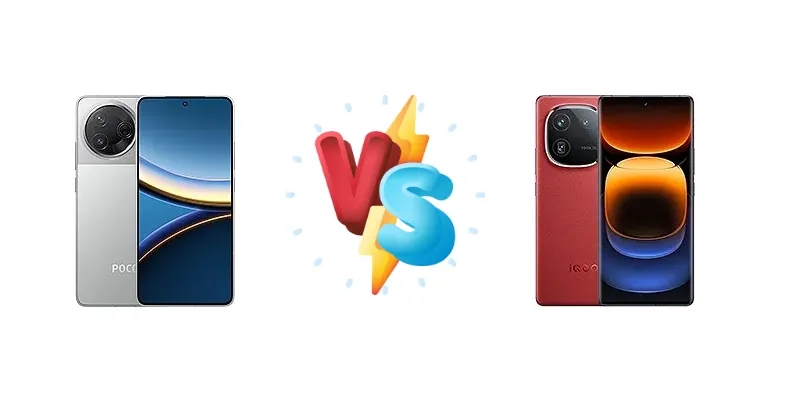
|
🏆 Quick Verdict
For the average user, the iQOO 12 Pro emerges as the slightly stronger contender. Its 120W charging dramatically reduces downtime, and the inclusion of 50W wireless charging adds convenience. While the Poco F7 Pro boasts impressive battery endurance, the iQOO’s charging advantage is more impactful in daily use.
| PHONES | ||
|---|---|---|
| Phone Names | Xiaomi Poco F7 Pro | vivo iQOO 12 Pro |
| Network | ||
|---|---|---|
| 2G bands | GSM 850 / 900 / 1800 / 1900 | GSM 850 / 900 / 1800 / 1900 |
| 3G bands | HSDPA 800 / 850 / 900 / 1700(AWS) / 2100 | HSDPA 800 / 850 / 900 / 1700(AWS) / 1900 / 2100 |
| 4G bands | 1, 2, 3, 4, 5, 7, 8, 18, 19, 20, 26, 28, 38, 40, 41, 42, 48, 66 | 1, 2, 3, 4, 5, 7, 8, 12, 17, 18, 19, 20, 25, 26, 28, 34, 38, 39, 40, 41, 42, 66 |
| 5G bands | 1, 2, 3, 5, 7, 8, 20, 26, 28, 38, 40, 41, 48, 66, 77, 78 SA/NSA | 1, 2, 3, 5, 7, 8, 12, 20, 25, 26, 28, 66, 38, 40, 41, 77, 78 SA/NSA |
| Speed | HSPA, LTE, 5G | HSPA, LTE, 5G |
| Technology | GSM / HSPA / LTE / 5G | GSM / CDMA / HSPA / CDMA2000 / LTE / 5G |
| Launch | ||
|---|---|---|
| Announced | 2025, March 27 | 2023, November 07 |
| Status | Available. Released 2025, March 27 | Available. Released 2023, November 14 |
| Body | ||
|---|---|---|
| Build | Glass front (Gorilla Glass 7i), glass back, aluminum frame | - |
| Dimensions | 160.3 x 75 x 8.1 mm (6.31 x 2.95 x 0.32 in) | 164.6 x 75.4 x 8.6 mm or 8.8 mm |
| SIM | Nano-SIM + Nano-SIM | Nano-SIM + Nano-SIM |
| Weight | 206 g (7.27 oz) | 205 g or 210 g (7.23 oz) |
| Display | ||
|---|---|---|
| Protection | Corning Gorilla Glass 7i, Mohs level 5 | - |
| Resolution | 1440 x 3200 pixels, 20:9 ratio (~526 ppi density) | 1440 x 3200 pixels, 20:9 ratio (~518 ppi density) |
| Size | 6.67 inches, 107.4 cm2 (~89.3% screen-to-body ratio) | 6.78 inches, 111.0 cm2 (~89.4% screen-to-body ratio) |
| Type | AMOLED, 68B colors, 120Hz, 3840Hz PWM, Dolby Vision, HDR10+, 1800 nits (HBM), 3200 nits (peak) | LTPO AMOLED, 1B colors, 144Hz, HDR10+, 1600 nits (HBM), 3000 nits (peak) |
| Platform | ||
|---|---|---|
| CPU | Octa-core (1x3.3 GHz Cortex-X4 & 3x3.2 GHz Cortex-A720 & 2x3.0 GHz Cortex-A720 & 2x2.3 GHz Cortex-A520) | Octa-core (1x3.3 GHz Cortex-X4 & 3x3.2 GHz Cortex-A720 & 2x3.0 GHz Cortex-A720 & 2x2.3 GHz Cortex-A520) |
| Chipset | Qualcomm SM8650-AB Snapdragon 8 Gen 3 (4 nm) | Qualcomm SM8650-AB Snapdragon 8 Gen 3 (4 nm) |
| GPU | Adreno 750 | Adreno 750 |
| OS | Android 15, HyperOS 2 | Android 14, up to 2 major Android upgrades, Funtouch 14 (International), OriginOS 4 (China) |
| Memory | ||
|---|---|---|
| Card slot | No | No |
| Internal | 256GB 12GB RAM, 512GB 12GB RAM | 256GB 16GB RAM, 512GB 16GB RAM, 1TB 16GB RAM |
| Main Camera | ||
|---|---|---|
| Dual | 50 MP, f/1.6, 24mm (wide), 1/1.55", 1.0µm, dual pixel PDAF, OIS 8 MP, f/2.2, (ultrawide), 1/4.0", 1.12µm | - |
| Features | Color spectrum sensor, LED flash, HDR, panorama | Color spectrum sensor, Dual-LED flash, HDR, panorama |
| Triple | - | 50 MP, f/1.7, 23mm (wide), 1/1.3", 1.2µm, ulti-directional PDAF, OIS 64 MP, f/2.6, 70mm (periscope telephoto), 1/2.0", PDAF, OIS, 3x optical zoom 50 MP, f/2.0, 15mm, 119˚ (ultrawide), AF |
| Video | 8K@24fps, 4K@24/30/60fps, 1080p@30/60/120/240/960fps, 720p@1920fps, gyro-EIS | 8K@30fps, 4K@24/30/60fps, 1080p@30/60/120/240fps, gyro-EIS |
| Selfie camera | ||
|---|---|---|
| Features | HDR | HDR |
| Single | 20 MP, (wide) | 16 MP, f/2.5, (wide) |
| Video | 1080p@30/60fps, gyro-EIS | 1080p@30fps, gyro-EIS |
| Sound | ||
|---|---|---|
| 35mm jack | No | No |
| Loudspeaker | Yes, with stereo speakers | Yes, with stereo speakers |
| Comms | ||
|---|---|---|
| Bluetooth | 5.4, A2DP, LE, aptX HD, aptX Adaptive, aptX Lossless, LHDC 5 | 5.4, A2DP, LE, aptX HD, aptX Adaptive, aptX Lossless |
| Infrared port | Yes | Yes |
| NFC | Yes | Yes |
| Positioning | GPS (L1+L5), GLONASS (G1), BDS (B1I+B1c+B2a), GALILEO (E1+E5a), QZSS (L1+L5), NavIC (L5) | GPS (L1+L5), GLONASS (G1), BDS (B1I+B1c+B2a), GALILEO (E1+E5a), QZSS (L1+L5) |
| Radio | No | No |
| USB | USB Type-C, OTG | USB Type-C 2.0, OTG |
| WLAN | Wi-Fi 802.11 a/b/g/n/ac/6e/7, dual-band, Wi-Fi Direct | Wi-Fi 802.11 a/b/g/n/ac/6/7, tri-band, Wi-Fi Direct |
| Features | ||
|---|---|---|
| Sensors | Fingerprint (under display, ultrasonic), accelerometer, proximity, gyro, compass | Fingerprint (under display, ultrasonic), accelerometer, gyro, proximity, compass |
| Battery | ||
|---|---|---|
| Charging | 90W wired, PD3.0, QC3+, 100% in 37 min | 120W wired 50W wireless 10W reverse wireless |
| Type | Li-Po 6000 mAh | 5100 mAh |
| Misc | ||
|---|---|---|
| Colors | Black, Blue, Silver | Black, Red, White (BMW M branding) |
| Models | 24117RK2CG | V2329A |
| Price | € 395.57 / $ 579.99 / £ 349.00 | About 650 EUR |
| EU LABEL | ||
|---|---|---|
| Battery | 70:08h endurance, 1000 cycles | - |
| Energy | Class A | - |
| Free fall | Class C (90 falls) | - |
| Repairability | Class C | - |
Xiaomi Poco F7 Pro
- Exceptional battery endurance (70:08h)
- High battery cycle count (1000 cycles)
- Bright display (1478 nits)
- Slower charging speed (90W)
- No wireless charging
vivo iQOO 12 Pro
- Ultra-fast 120W wired charging
- Convenient 50W wireless charging
- Potential for superior thermal management
- Likely shorter battery endurance than Poco F7 Pro
- Battery cycle count not specified
Display Comparison
Both devices are expected to feature high-quality displays, though specific panel details are not provided. The Poco F7 Pro’s measured peak brightness of 1478 nits indicates a vibrant and easily viewable screen, even in direct sunlight. The iQOO 12 Pro, given vivo’s display expertise, likely matches or exceeds this brightness. Without knowing refresh rates or panel technology (LTPO vs. standard OLED), it’s difficult to definitively declare a winner, but the Poco’s measured brightness gives it a slight edge.
Camera Comparison
The provided data lacks camera specifications. However, given the market positioning of both brands, we can infer that the iQOO 12 Pro will likely feature a more sophisticated camera system, potentially with larger sensors and more advanced image processing algorithms. iQOO often focuses on camera capabilities as a key selling point. The Poco F7 Pro, while likely capable, will probably prioritize value over cutting-edge camera technology. Without specific sensor details, a definitive comparison is impossible.
Performance
The core performance is identical: both the Poco F7 Pro and iQOO 12 Pro utilize the Qualcomm SM8650-AB Snapdragon 8 Gen 3 (4nm). The CPU configuration – Octa-core (1x3.3 GHz Cortex-X4 & 3x3.2 GHz Cortex-A720 & 2x3.0 GHz Cortex-A720 & 2x2.3 GHz Cortex-A520) – is also identical. Therefore, raw processing power will be nearly indistinguishable. Thermal management, however, is a crucial differentiator not covered in the provided data. iQOO phones often prioritize aggressive cooling solutions, potentially allowing for sustained peak performance during extended gaming sessions, while the Poco may throttle slightly sooner. RAM configurations (LPDDR5x speed) are unknown, but will also impact real-world performance.
Battery Life
This is where the most significant difference lies. The Poco F7 Pro boasts a remarkable 70:08h endurance score and is rated for 1000 battery cycles, suggesting exceptional longevity. However, it’s limited to 90W wired charging, taking 37 minutes to reach 100%. The iQOO 12 Pro, conversely, offers a blistering 120W wired charging solution, significantly reducing charging times. Furthermore, it adds 50W wireless charging and 10W reverse wireless charging for added convenience. While the Poco’s endurance is impressive, the iQOO’s charging speed is a game-changer for users who frequently need to top up their battery.
Buying Guide
Buy the Xiaomi Poco F7 Pro if you prioritize maximizing screen-on time and value long-term battery health, as its 70:08h endurance and 1000 cycle rating suggest a longer lifespan. Buy the vivo iQOO 12 Pro if you demand the fastest possible charging speeds and appreciate the convenience of wireless charging, even if it means slightly less overall battery endurance.