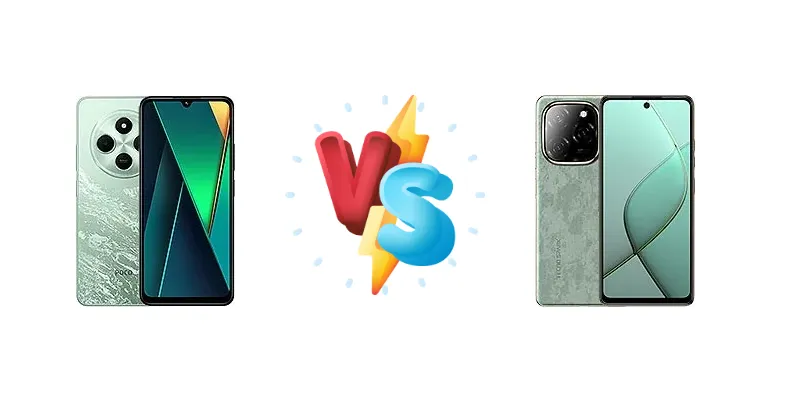
The sub-$200 smartphone market is fiercely competitive, and the Xiaomi Poco C75 and Tecno Spark 20 Pro 5G are two recent entrants vying for dominance. While both offer 5G connectivity, they take distinctly different approaches to performance and charging speed, making the choice less about brand loyalty and more about prioritizing your needs.
🏆 Quick Verdict
For the average user prioritizing a smoother, more responsive experience and faster charging, the Tecno Spark 20 Pro 5G is the better choice. Its Dimensity 6080 chipset, built on a more efficient 6nm process, provides a noticeable performance uplift over the Poco C75’s Helio G81, and the 33W charging significantly reduces downtime.
| Network |
|---|
| 2G bands | GSM 850 / 900 / 1800 / 1900 | GSM 850 / 900 / 1800 / 1900 |
| 3G bands | HSDPA 850 / 900 / 1700(AWS) / 1900 / 2100 | HSDPA 850 / 900 / 1700(AWS) / 1900 / 2100 |
| 4G bands | 1, 2, 3, 4, 5, 7, 8, 20, 28, 38, 40, 41, 66 | LTE |
| 5G bands | - | SA/NSA |
| Speed | HSPA, LTE | HSPA, LTE, 5G |
| Technology | GSM / HSPA / LTE | GSM / HSPA / LTE / 5G |
| Launch |
|---|
| Announced | 2024, October 26 | 2024, June 17 |
| Status | Available. Released 2024, November 05 | Available. Released 2024, June 20 |
| Body |
|---|
| Dimensions | 171.9 x 77.8 x 8.2 mm (6.77 x 3.06 x 0.32 in) | 168.5 x 76.2 x 8.3 mm or 8.5 mm |
| SIM | Nano-SIM + Nano-SIM | Nano-SIM + Nano-SIM |
| Weight | 204 g (7.20 oz) | 200 g or 201.5 g (7.05 oz) |
| Display |
|---|
| Resolution | 720 x 1640 pixels (~260 ppi density) | 1080 x 2460 pixels (~396 ppi density) |
| Size | 6.88 inches, 112.4 cm2 (~84.0% screen-to-body ratio) | 6.78 inches, 109.2 cm2 (~85.0% screen-to-body ratio) |
| Type | IPS LCD, 120Hz, 450 nits (typ), 600 nits (HBM) | IPS LCD, 120Hz |
| Platform |
|---|
| CPU | Octa-core (2x2.0 GHz Cortex-A75 & 6x1.8 GHz Cortex-A55) | Octa-core (2x2.4 GHz Cortex-A76 & 6x2.0 GHz Cortex-A55) |
| Chipset | Mediatek Helio G81 Ultra (12 nm) | Mediatek Dimensity 6080 (6 nm) |
| GPU | Mali-G52 MC2 | Mali-G57 MC2 |
| OS | Android 14, HyperOS | Android 14 |
| Memory |
|---|
| Card slot | microSDXC (dedicated slot) | microSDXC (dedicated slot) |
| Internal | 128GB 6GB RAM, 256GB 8GB RAM | 128GB 8GB RAM, 256GB 8GB RAM |
| Main Camera |
|---|
| Dual | - | 108 MP, f/1.8, (wide), 1/1.67", 0.64µm, PDAF
2 MP (macro) |
| Features | LED flash, HDR | Quad-LED flash |
| Single | 50 MP, f/1.8, 28mm (wide), PDAF
Auxiliary lens | - |
| Video | 1080p@30fps | 1440p@30fps, 1080p@30fps |
| Selfie camera |
|---|
| Features | HDR | Dual-LED dual-tone flash |
| Single | 13 MP, f/2.0, (wide) | 8 MP, (wide) |
| Video | 1080p@30fps | 1440p@30fps, 1080p@30fps |
| Sound |
|---|
| 35mm jack | Yes | No |
| Loudspeaker | Yes | Yes, with stereo speakers |
| Comms |
|---|
| Bluetooth | 5.4, A2DP, LE | 5.3, A2DP, LE |
| NFC | Yes (market/region dependent) | Yes |
| Positioning | GPS, GLONASS, GALILEO, BDS | GPS, GLONASS |
| Radio | FM radio | FM radio |
| USB | USB Type-C 2.0 | USB Type-C |
| WLAN | Wi-Fi 802.11 a/b/g/n/ac, dual-band | Wi-Fi 802.11 a/b/g/n/ac, dual-band |
| Features |
|---|
| Sensors | Fingerprint (side-mounted), accelerometer, compass | Fingerprint (side-mounted), accelerometer, proximity, compass |
| Battery |
|---|
| Charging | 18W wired, PD | 33W wired |
| Type | 5160 mAh | 5000 mAh |
| Misc |
|---|
| Colors | Black, Green, Gold | Startrail Black, Glossy White, Neon Green |
| Models | 2410FPCC5G | KJ8 |
| Price | $ 134.99 / € 135.00 / £ 94.99 | About 180 EUR |
| SAR | 1.03 W/kg (head) 1.08 W/kg (body) | - |
| SAR EU | 0.98 W/kg (head) 0.98 W/kg (body) | - |
Xiaomi Poco C75
- Potentially lower price point
- PD support for charging compatibility
- Reliable brand reputation (Xiaomi)
- Older, less efficient chipset (Helio G81)
- Slower charging speed (18W)
- Likely less responsive user experience
Tecno Spark 20 Pro 5G
- More powerful and efficient chipset (Dimensity 6080)
- Faster charging speed (33W)
- Improved multitasking and app loading times
- May be slightly more expensive
- Tecno brand recognition is lower in some markets
- Potential for more software bloatware
Display Comparison
Neither device boasts a standout display. Both likely utilize LCD panels, common in this price bracket. However, details like peak brightness and color gamut coverage are missing. The focus here isn't on visual fidelity, but on functionality. Bezels are expected to be relatively thick on both, impacting the overall screen-to-body ratio. Without specific display specs, it's difficult to declare a clear winner; both will likely offer a standard viewing experience.
Camera Comparison
Without detailed camera specs beyond the chipsets, a direct comparison is limited. Both phones likely feature a primary camera and supporting lenses, but the sensor size and image processing algorithms are crucial. Given the price point, expect image quality to be adequate in good lighting conditions, but struggle in low light. The presence of a 2MP macro camera on either device is largely a marketing tactic, offering minimal practical benefit. The Dimensity 6080’s ISP (Image Signal Processor) *may* offer slightly better image processing capabilities, but this is speculative without further information.
Performance
The core difference lies in the chipsets. The Tecno Spark 20 Pro 5G’s Mediatek Dimensity 6080 (6nm) is a significant upgrade over the Poco C75’s Helio G81 Ultra (12nm). The 6nm process inherently offers better power efficiency, translating to less heat generation and potentially sustained performance. The Dimensity 6080’s CPU, with 2x2.4 GHz Cortex-A76 cores, outperforms the Poco’s 2x2.0 GHz Cortex-A75 cores in single-core tasks, resulting in snappier app launches and smoother multitasking. While both are octa-core CPUs, the architectural improvements in the Dimensity 6080 provide a tangible advantage. The GPU within the Dimensity 6080 will also deliver a better gaming experience, though neither phone is a gaming powerhouse.
Battery Life
The Poco C75 features 18W wired charging with PD support, while the Tecno Spark 20 Pro 5G steps up to 33W wired charging. This is a substantial difference in charging speed. While battery capacity isn’t specified, the faster charging of the Spark 20 Pro 5G will significantly reduce the time spent tethered to a wall outlet. A full charge on the Poco C75 will likely take well over two hours, whereas the Spark 20 Pro 5G should achieve a full charge in under 90 minutes. This difference is particularly impactful for users who rely heavily on their phones throughout the day.
Buying Guide
Buy the Xiaomi Poco C75 if you need a functional, basic 5G smartphone and are on an extremely tight budget, prioritizing cost savings above all else. Buy the Tecno Spark 20 Pro 5G if you prefer a more fluid user experience, faster app loading times, and quicker charging, even if it means spending a little more. The Spark 20 Pro 5G is geared towards users who actively use their phones for social media, streaming, and light gaming.
Frequently Asked Questions
❓ Will the Dimensity 6080 in the Tecno Spark 20 Pro 5G handle demanding games like PUBG Mobile?
While the Dimensity 6080 isn't a flagship gaming chip, it's capable of running PUBG Mobile at medium settings with reasonable frame rates. Expect some frame drops during intense action, but it will provide a playable experience. The Helio G81 in the Poco C75 will struggle more with consistent performance in demanding titles.
❓ Does the faster charging on the Tecno Spark 20 Pro 5G affect battery health over time?
Modern smartphones employ sophisticated charging management systems to mitigate the impact of fast charging on battery health. While faster charging *can* generate more heat, the Tecno Spark 20 Pro 5G's charging circuitry is designed to minimize degradation. The convenience of faster charging generally outweighs the minimal potential impact on long-term battery health.
❓ Is the difference in chipset performance between the Helio G81 and Dimensity 6080 noticeable in everyday tasks?
Yes, the difference is noticeable. The Dimensity 6080's more modern architecture and higher clock speeds result in snappier app launches, smoother scrolling, and quicker multitasking. While both phones can handle basic tasks like browsing and social media, the Tecno Spark 20 Pro 5G will feel more responsive overall.