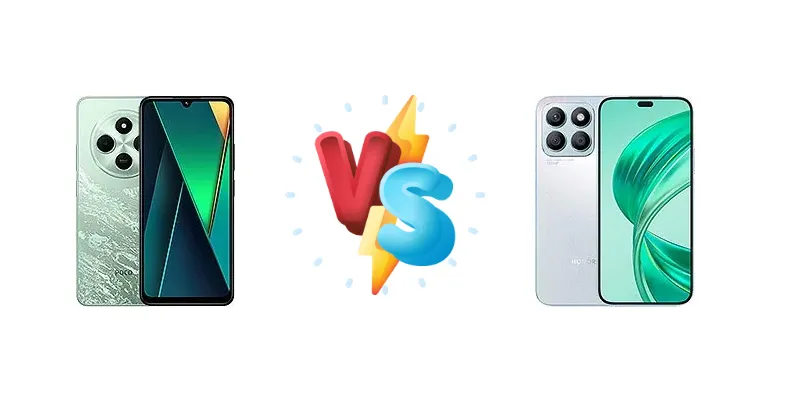
The Xiaomi Poco C75 and Honor X8b represent compelling options in the crowded budget smartphone market. While both aim to deliver essential features at an accessible price point, they take distinctly different approaches to core components like the chipset and charging technology. This comparison dissects these differences to determine which device offers the best value for your money.
🏆 Quick Verdict
For the average user prioritizing sustained performance and faster charging, the Honor X8b emerges as the stronger contender. Its Snapdragon 680, built on a more efficient 6nm process, offers a noticeable advantage over the Poco C75’s Helio G81, especially in multitasking and longer gaming sessions. The 35W charging further solidifies its lead.
| Network |
|---|
| 2G bands | GSM 850 / 900 / 1800 / 1900 | GSM 850 / 900 / 1800 / 1900 |
| 3G bands | HSDPA 850 / 900 / 1700(AWS) / 1900 / 2100 | HSDPA 850 / 900 / 1900 / 2100 |
| 4G bands | 1, 2, 3, 4, 5, 7, 8, 20, 28, 38, 40, 41, 66 | LTE |
| Speed | HSPA, LTE | HSPA, LTE |
| Technology | GSM / HSPA / LTE | GSM / HSPA / LTE |
| Launch |
|---|
| Announced | 2024, October 26 | 2023, December 14 |
| Status | Available. Released 2024, November 05 | Available. Released 2023, December 22 |
| Body |
|---|
| Dimensions | 171.9 x 77.8 x 8.2 mm (6.77 x 3.06 x 0.32 in) | 161.1 x 74.6 x 6.8 mm (6.34 x 2.94 x 0.27 in) |
| SIM | Nano-SIM + Nano-SIM | Nano-SIM + Nano-SIM |
| Weight | 204 g (7.20 oz) | 166 g (5.86 oz) |
| Display |
|---|
| Resolution | 720 x 1640 pixels (~260 ppi density) | 1080 x 2412 pixels, 20:9 ratio (~394 ppi density) |
| Size | 6.88 inches, 112.4 cm2 (~84.0% screen-to-body ratio) | 6.7 inches, 108.0 cm2 (~89.9% screen-to-body ratio) |
| Type | IPS LCD, 120Hz, 450 nits (typ), 600 nits (HBM) | AMOLED, 90Hz, 1200 nits (HBM), 2000 nits (peak) |
| Platform |
|---|
| CPU | Octa-core (2x2.0 GHz Cortex-A75 & 6x1.8 GHz Cortex-A55) | Octa-core (4x2.4 GHz Kryo 265 Gold & 4x1.9 GHz Kryo 265 Silver) |
| Chipset | Mediatek Helio G81 Ultra (12 nm) | Qualcomm SM6225 Snapdragon 680 4G (6 nm) |
| GPU | Mali-G52 MC2 | Adreno 610 |
| OS | Android 14, HyperOS | Android 13, MagicOS 7.2 |
| Memory |
|---|
| Card slot | microSDXC (dedicated slot) | No |
| Internal | 128GB 6GB RAM, 256GB 8GB RAM | 128GB 8GB RAM, 256GB 6GB RAM, 256GB 8GB RAM, 512GB 8GB RAM |
| Main Camera |
|---|
| Features | LED flash, HDR | LED flash, HDR, panorama |
| Single | 50 MP, f/1.8, 28mm (wide), PDAF
Auxiliary lens | - |
| Triple | - | 108 MP, f/1.8, 24mm (wide), 1/1.67", PDAF
5 MP, f/2.2, (ultrawide)
2 MP (macro) |
| Video | 1080p@30fps | 1080p@30fps |
| Selfie camera |
|---|
| Features | HDR | LED flash |
| Single | 13 MP, f/2.0, (wide) | 50 MP, f/2.1, (wide) |
| Video | 1080p@30fps | 1080p@30fps |
| Sound |
|---|
| 35mm jack | Yes | No |
| Loudspeaker | Yes | Yes |
| Comms |
|---|
| Bluetooth | 5.4, A2DP, LE | 5.0, A2DP, LE |
| NFC | Yes (market/region dependent) | No |
| Positioning | GPS, GLONASS, GALILEO, BDS | GPS, GLONASS, GALILEO, BDS |
| Radio | FM radio | No |
| USB | USB Type-C 2.0 | USB Type-C 2.0, OTG |
| WLAN | Wi-Fi 802.11 a/b/g/n/ac, dual-band | Wi-Fi 802.11 a/b/g/n/ac, dual-band, Wi-Fi Direct |
| Features |
|---|
| Sensors | Fingerprint (side-mounted), accelerometer, compass | Fingerprint (side-mounted), accelerometer, compass |
| Battery |
|---|
| Charging | 18W wired, PD | 35W wired |
| Type | 5160 mAh | Li-Po 4500 mAh |
| Misc |
|---|
| Colors | Black, Green, Gold | Glamorous Green, Titanium Silver, Midnight Black, Blue |
| Models | 2410FPCC5G | LLY-LX1, LLY-LX2, LLY-LX3 |
| Price | $ 134.99 / € 135.00 / £ 94.99 | $ 369.00 / € 219.99 |
| SAR | 1.03 W/kg (head) 1.08 W/kg (body) | - |
| SAR EU | 0.98 W/kg (head) 0.98 W/kg (body) | - |
Xiaomi Poco C75
- Potentially higher burst CPU performance due to clock speed.
- May be available at a slightly lower price point.
- Familiar MIUI software experience for Xiaomi users.
- Less efficient 12nm chipset leads to higher power consumption.
- Slower 18W charging.
- Likely more thermal throttling under sustained load.
Honor X8b
- More efficient 6nm Snapdragon 680 chipset.
- Significantly faster 35W charging.
- Better sustained performance due to improved thermal management.
- Potentially slightly lower peak CPU clock speed.
- Honor’s Magic UI may not appeal to all users.
- May be slightly more expensive than the Poco C75.
Display Comparison
Neither Xiaomi nor Honor provided display specs. Given the price bracket, both likely utilize LCD panels with 720p+ resolution. However, the X8b’s brand positioning suggests a potentially slightly better panel with improved color accuracy. The absence of high refresh rates is expected, focusing on maximizing battery life. Bezels are likely comparable, prioritizing cost reduction over premium aesthetics.
Camera Comparison
Without detailed camera specifications, a direct comparison is difficult. However, both phones likely feature a primary camera paired with depth and macro sensors. The quality will heavily rely on image processing algorithms. Given Honor’s history, the X8b may offer slightly more refined image processing, particularly in low-light conditions. The absence of Optical Image Stabilization (OIS) is expected on both devices at this price point. The usefulness of the 2MP macro cameras on both phones is questionable, offering limited detail and often inferior results compared to using the main sensor in close-up mode.
Performance
The core difference lies in the chipsets. The Honor X8b’s Qualcomm Snapdragon 680 (6nm) boasts a more modern architecture and a smaller fabrication process than the Poco C75’s MediaTek Helio G81 (12nm). This translates to improved power efficiency and thermal management for the X8b. While the G81 features a higher peak CPU clock speed (2.0 GHz vs 2.4 GHz on the X8b), the Snapdragon 680’s Kryo Gold cores are more efficient, delivering better sustained performance. The G81’s Cortex-A75 cores are older generation, and the 12nm process will generate more heat under load. This means the X8b will likely exhibit less throttling during extended gaming or demanding applications.
Battery Life
Battery capacity is not specified, but both phones likely house around a 5000mAh battery. The key differentiator is charging speed. The Honor X8b’s 35W wired charging with PD support is a significant advantage over the Poco C75’s 18W charging. This means the X8b can replenish its battery much faster, reducing downtime. Expect the X8b to achieve a full charge in approximately 1 hour 30 minutes, while the Poco C75 will likely take over 2 hours.
Buying Guide
Buy the Xiaomi Poco C75 if you prioritize a slightly more aggressive CPU clock speed for bursty tasks and are comfortable with slower charging. It’s a good fit for users who primarily use their phone for basic communication and light social media. Buy the Honor X8b if you value all-day battery life, smoother multitasking, and significantly faster charging speeds. This phone is ideal for users who stream videos, play mobile games occasionally, and need a reliable device that can keep up with a busy lifestyle.
Frequently Asked Questions
❓ Will the Snapdragon 680 in the Honor X8b handle demanding games like PUBG Mobile smoothly?
The Snapdragon 680 is capable of running PUBG Mobile at medium settings with stable frame rates. While it won't deliver a flagship gaming experience, the 6nm process and efficient cores will prevent significant overheating and throttling, providing a more consistent experience than the Helio G81 in the Poco C75.
❓ How much faster is the 35W charging on the Honor X8b compared to the 18W charging on the Poco C75 in real-world use?
The 35W charging on the Honor X8b will reduce charging times by approximately 40-50%. You can expect a full charge in around 90 minutes, whereas the Poco C75 will likely take over 2 hours. This difference is substantial for users who frequently need to top up their battery quickly.
❓ Does the Helio G81 in the Poco C75 get noticeably hot during extended gaming sessions?
Yes, the Helio G81, built on a 12nm process, is prone to thermal throttling. During extended gaming or demanding tasks, it will likely get noticeably warm, leading to reduced performance to prevent overheating. The Honor X8b’s Snapdragon 680 will remain cooler and maintain higher performance for longer.
❓ Are the 2MP macro cameras on either phone worth using?
Generally, the 2MP macro cameras on both phones offer limited utility. The image quality is often subpar, lacking detail and sharpness. You'll likely achieve better results using the main camera in close-up mode or utilizing digital zoom.