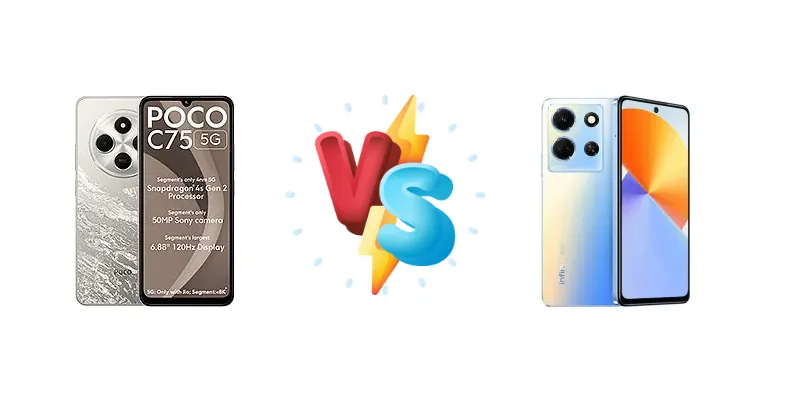
The sub-$200 5G smartphone market is heating up, with the Xiaomi Poco C75 5G and Infinix Note 30 5G vying for dominance. Both phones aim to deliver 5G connectivity and a modern smartphone experience without breaking the bank, but they take different approaches to achieving this goal – one prioritizing efficiency with a newer Snapdragon, the other leaning on a more powerful, albeit older, Dimensity chip.
🏆 Quick Verdict
For the average user prioritizing sustained performance and faster charging, the Infinix Note 30 5G emerges as the stronger contender. Its Dimensity 6080 chipset offers a noticeable CPU performance advantage, and the 45W charging significantly reduces downtime. However, the Poco C75 5G’s 4nm process offers potential efficiency gains.
| Network |
|---|
| 2G bands | GSM 850 / 900 / 1800 / 1900 | GSM 850 / 900 / 1800 / 1900 |
| 3G bands | HSDPA 850 / 900 / 2100 | HSDPA 850 / 900 / 1700(AWS) / 1900 / 2100 |
| 4G bands | 1, 3, 5, 8, 28, 40, 41 | 1, 2, 3, 4, 5, 7, 8, 12, 17, 20, 28, 38, 40, 41, 66 |
| 5G bands | 1, 3, 5, 8, 28, 40, 78 SA/NSA | 1, 3, 5, 7, 8, 12, 22, 28, 38, 40, 41, 66, 77, 78 |
| Speed | HSPA, LTE, 5G | HSPA, LTE, 5G |
| Technology | GSM / HSPA / LTE / 5G | GSM / HSPA / LTE / 5G |
| Launch |
|---|
| Announced | 2024, December 17 | 2023, May 22 |
| Status | Available. Released 2024, December 20 | Available. Released 2023, May 22 |
| Body |
|---|
| Build | Glass front, plastic frame | Glass front, plastic frame, glass or leather back |
| Dimensions | 171.9 x 77.8 x 8.2 mm (6.77 x 3.06 x 0.32 in) | 168.5 x 76.5 x 8.5 mm (6.63 x 3.01 x 0.33 in) |
| SIM | Nano-SIM + Nano-SIM | Nano-SIM + Nano-SIM |
| Weight | 212.4 g (7.51 oz) | 205 g (7.23 oz) |
| Display |
|---|
| Resolution | 720 x 1640 pixels (~260 ppi density) | 1080 x 2460 pixels (~396 ppi density) |
| Size | 6.88 inches, 112.4 cm2 (~84.0% screen-to-body ratio) | 6.78 inches, 109.2 cm2 (~84.7% screen-to-body ratio) |
| Type | IPS LCD, 120Hz, 450 nits (typ), 600 nits (HBM) | IPS LCD, 120Hz, 580 nits (peak) |
| Platform |
|---|
| CPU | Octa-core (2x2.0 GHz Cortex-A78 & 6x1.8 GHz Cortex-A55) | Octa-core (2x2.4 GHz Cortex-A76 & 6x2.0 GHz Cortex-A55) |
| Chipset | Qualcomm SM4635 Snapdragon 4s Gen 2 (4 nm) | Mediatek Dimensity 6080 (6 nm) |
| GPU | Adreno 611 | Mali-G57 MC2 |
| OS | Android 14, up to 2 major Android upgrades, HyperOS | Android 13 |
| Memory |
|---|
| Card slot | microSDXC (dedicated slot) | microSDXC (dedicated slot) |
| Internal | 64GB 4GB RAM, 128GB 4GB RAM | 128GB 4GB RAM, 256GB 8GB RAM |
| Main Camera |
|---|
| Features | LED flash, HDR | Quad-LED flash, HDR, panorama |
| Single | 50 MP, f/1.8, (wide)
Auxiliary lens | - |
| Triple | - | 108 MP, f/1.75, 26mm (wide), 1/1.67", 0.64µm, PDAF
Auxiliary lenses |
| Video | 1080p@30fps | 1440p@30fps, 1080p@30/60fps |
| Selfie camera |
|---|
| Features | - | Dual-LED flash, HDR |
| Single | 5 MP, f/2.2, (wide) | 16 MP, f/2.0, (wide) |
| Video | 1080p@30fps | 1080p@30fps |
| Sound |
|---|
| 35mm jack | Yes | Yes |
| Loudspeaker | Yes | Yes, with dual speakers |
| Comms |
|---|
| Bluetooth | 5.3, A2DP, LE | Yes |
| NFC | No | Yes |
| Positioning | GPS, GALILEO, GLONASS, BDS | GPS |
| Radio | FM radio, recording | FM radio |
| USB | USB Type-C | USB Type-C 2.0, OTG |
| WLAN | Wi-Fi 802.11 a/b/g/n/ac, dual-band | Wi-Fi 802.11 a/b/g/n/ac, dual-band, Wi-Fi Direct |
| Features |
|---|
| Sensors | Fingerprint (side-mounted), accelerometer, compass | Fingerprint (side-mounted), accelerometer, gyro, proximity, compass |
| Battery |
|---|
| Charging | 18W wired | 45W wired, bypass charging |
| Type | Li-Po 5160 mAh | 5000 mAh |
| Misc |
|---|
| Colors | Aqua Bliss, Enchanted Green, Silver Stardust | Magic Black, Interstellar Blue, Sunset Gold |
| Models | MZB0IDJIN | X6711 |
| Price | ₹ 7,499 | - |
| SAR | 0.85 W/kg (head) 0.86 W/kg (body) | - |
Xiaomi Poco C75 5G
- Potentially better power efficiency due to 4nm process
- Established brand with wider software support
- Competitive price point
- Slower charging speed (18W)
- Less powerful CPU compared to the Dimensity 6080
- Display specifications are currently unknown
Infinix Note 30 5G
- Faster 45W charging with bypass charging
- Brighter display with higher contrast ratio
- More powerful CPU (Dimensity 6080)
- 6nm process may result in slightly higher power consumption
- Infinix’s software update track record is less consistent than Xiaomi’s
- Potential for more bloatware
Display Comparison
The Infinix Note 30 5G boasts a significantly brighter display, reaching a measured 607 nits, compared to an unspecified brightness for the Poco C75 5G. This higher peak brightness translates to better visibility outdoors. While both likely utilize IPS LCD panels (given the price point), the Note 30 5G’s 1521:1 contrast ratio suggests a more vibrant image. The Poco C75 5G’s display specifications are currently unknown, making it difficult to assess its color accuracy or viewing angles relative to the Infinix.
Camera Comparison
Without detailed camera specifications for either device, a direct comparison is challenging. However, given the price bracket, both are likely to feature a primary sensor paired with auxiliary lenses of limited utility. The focus should be on image processing capabilities, which are brand-specific. It's reasonable to expect the Infinix Note 30 5G to leverage MediaTek’s Imagiq ISP, while the Poco C75 5G will rely on Qualcomm’s Spectra ISP. Real-world testing would be needed to determine which phone produces more pleasing images in various lighting conditions.
Performance
The core difference lies in the chipsets. The Infinix Note 30 5G’s MediaTek Dimensity 6080 (6nm) features two Cortex-A76 cores clocked at 2.4 GHz, offering a clear advantage in single-core performance over the Poco C75 5G’s Snapdragon 4s Gen 2 (4nm) with its 2.0 GHz Cortex-A78 cores. While the Snapdragon 4s Gen 2 benefits from a more efficient 4nm process, the Dimensity 6080’s architectural advantage provides a noticeable boost in CPU-intensive tasks. Both phones utilize an octa-core configuration with six Cortex-A55 efficiency cores, but the higher clock speeds and core architecture of the Dimensity 6080 will likely result in smoother multitasking and faster app loading times.
Battery Life
The Infinix Note 30 5G’s 45W wired charging is a significant advantage over the Poco C75 5G’s 18W charging. 45W charging, coupled with bypass charging (allowing charging while in use), drastically reduces charging times. While battery capacity isn’t specified for either device, the faster charging speed of the Infinix Note 30 5G mitigates the impact of a potentially smaller battery. The 4nm process of the Snapdragon 4s Gen 2 in the Poco C75 5G *could* translate to longer battery life during light usage, but the Dimensity 6080’s faster charging will likely be more appreciated by most users.
Buying Guide
Buy the Xiaomi Poco C75 5G if you prioritize long-term software support from a well-established brand and potentially better power efficiency for everyday tasks. Buy the Infinix Note 30 5G if you value faster charging speeds, a brighter display, and a more powerful processor for demanding applications and light gaming.
Frequently Asked Questions
❓ Does the MediaTek Dimensity 6080 in the Infinix Note 30 5G get hot during extended gaming sessions?
While the Dimensity 6080 is a capable chip, it's built on a 6nm process. Expect some heat buildup during prolonged gaming, but the Infinix Note 30 5G likely incorporates thermal management solutions to prevent significant throttling. Performance will likely remain consistent for moderate gaming sessions.
❓ Is the 18W charging on the Poco C75 5G slow compared to other phones in this price range?
Yes, 18W charging is relatively slow compared to the 33W or 45W charging offered by many competitors, including the Infinix Note 30 5G. Expect a full charge to take significantly longer, potentially over 2 hours, which can be inconvenient for users who need a quick top-up.
❓ How does the software experience differ between Xiaomi's MIUI and Infinix's XOS?
Xiaomi's MIUI is a more mature and widely recognized software experience, generally offering more frequent updates and a larger community for support. Infinix's XOS, while improving, is often criticized for pre-installed bloatware and a less refined user interface. MIUI also tends to have better optimization for gaming.
❓ Will either phone receive major Android version updates beyond the initial release?
Xiaomi typically provides at least two major Android updates for its devices, while Infinix's update policy is less predictable. Expect the Poco C75 5G to have a longer software support lifespan than the Infinix Note 30 5G.