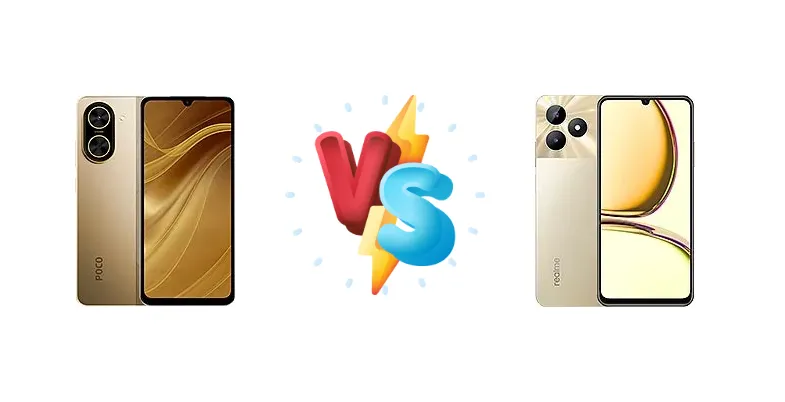
The sub-₹10,000 (approximately $120 USD) smartphone segment is fiercely competitive, and the Xiaomi Poco C71 and Realme C53 (India variant) are two contenders vying for dominance. Both rely on Unisoc chipsets to deliver an affordable experience, but subtle differences in CPU configuration and charging capabilities could make one a better fit for your needs. This comparison dissects those differences to reveal which phone offers the most value.
🏆 Quick Verdict
For the average user prioritizing consistent performance in everyday tasks, the Realme C53 (India) edges out the Poco C71. The slightly faster Cortex-A55 cores in the Tiger T612 chipset, coupled with 18W charging, provide a smoother experience and quicker top-ups, making it the more practical choice.
| Network |
|---|
| 2G bands | GSM 850 / 900 / 1800 / 1900 | GSM 850 / 900 / 1800 / 1900 |
| 3G bands | HSDPA 850 / 900 / 1700(AWS) / 1900 / 2100 - Global | HSDPA 850 / 900 / 2100 |
| 4G bands | 1, 2, 3, 4, 5, 7, 8, 18, 19, 20, 26, 28, 38, 40, 41, 66 - Global | 1, 3, 5, 8, 38, 40, 41 |
| Speed | HSPA, LTE | HSPA, LTE |
| Technology | GSM / HSPA / LTE | GSM / HSPA / LTE |
| Launch |
|---|
| Announced | 2025, April 04 | 2023, July 19 |
| Status | Available. Released 2025, April 08 | Available. Released 2023, July 26 |
| Body |
|---|
| Build | - | Glass front, plastic frame, plastic back |
| Dimensions | 171.8 x 77.8 x 8.3 mm (6.76 x 3.06 x 0.33 in) | 167.2 x 76.7 x 8 mm (6.58 x 3.02 x 0.31 in) |
| SIM | Nano-SIM + Nano-SIM | Nano-SIM + Nano-SIM |
| Weight | 193 g (6.81 oz) | 186 g (6.56 oz) |
| Display |
|---|
| Resolution | 720 x 1640 pixels (~260 ppi density) | 1080 x 2400 pixels, 20:9 ratio (~390 ppi density) |
| Size | 6.88 inches, 112.4 cm2 (~84.1% screen-to-body ratio) | 6.74 inches, 109.7 cm2 (~85.5% screen-to-body ratio) |
| Type | IPS LCD, 120Hz, 450 nits (typ), 600 nits (HBM) | IPS LCD, 90Hz, 560 nits (peak) |
| Platform |
|---|
| CPU | Octa-core (2x1.8 GHz Cortex-A75 & 6x1.6 GHz Cortex-A55) | Octa-core (2x1.8 GHz Cortex-A75 & 6x1.8 GHz Cortex-A55) |
| Chipset | Unisoc T7250 (12 nm) | Unisoc Tiger T612 (12 nm) |
| GPU | Mali-G57 MP1 | Mali-G57 |
| OS | Android 15 or Android 15 (Go edition), up to 2 major Android upgrades | Android 13, Realme UI |
| Memory |
|---|
| Card slot | microSDXC (dedicated slot) | microSDXC (dedicated slot) |
| Internal | 64GB 3GB RAM, 64GB 4GB RAM, 128GB 4GB RAM, 128GB 6GB RAM | 64GB 6GB RAM, 128GB 4GB RAM, 128GB 6GB RAM |
| Main Camera |
|---|
| Dual | - | 108 MP, (wide), PDAF
Auxiliary lens |
| Features | LED flash, HDR | LED flash, HDR, panorama |
| Single | 32 MP, f/1.8, (wide)
Auxiliary lens | - |
| Video | 1080p@30fps | 1080p@30fps |
| Selfie camera |
|---|
| Features | HDR | HDR |
| Single | 8 MP, f/2.0, (wide) | 8 MP, (wide) |
| Video | 1080p@30fps | 720p@30fps |
| Sound |
|---|
| 35mm jack | Yes | Yes |
| Loudspeaker | Yes | Yes |
| Comms |
|---|
| Bluetooth | 5.2, A2DP, LE | 5.0, A2DP, LE |
| NFC | No | No |
| Positioning | GPS | GPS, GLONASS, GALILEO |
| Radio | FM radio, recording | Unspecified |
| USB | USB Type-C 2.0 | USB Type-C 2.0 |
| WLAN | Wi-Fi 802.11 a/b/g/n/ac, dual-band | Wi-Fi 802.11 a/b/g/n/ac, dual-band |
| Features |
|---|
| Sensors | Fingerprint (side-mounted), accelerometer, compass | Fingerprint (side-mounted), accelerometer, gyro, proximity, compass |
| Battery |
|---|
| Charging | 15W wired | 18W wired |
| Type | 5200 mAh | 5000 mAh |
| Misc |
|---|
| Colors | Power Black, Cool Blue, Desert Gold | Gold, Black |
| Models | 25028PC03I, 25028PC03G | RMX3762 |
| Price | £ 59.98 / € 76.41 / ₹ 6,199 | About 110 EUR |
| SAR | 0.82 W/kg (head) 0.77 W/kg (body) | - |
Xiaomi Poco C71
- Potentially slightly better peak CPU performance due to the A75 cores.
- Xiaomi’s MIUI offers extensive customization options.
- Competitive pricing.
- Slower 15W charging.
- Less efficient Cortex-A55 cores.
- Limited information on display quality.
Realme C53 (India)
- Faster 18W charging for quicker top-ups.
- More efficient Cortex-A55 cores for smoother multitasking.
- Realme UI is generally considered cleaner and more user-friendly.
- Potentially slightly lower peak CPU performance.
- Camera performance relies heavily on software processing.
- Limited information on display quality.
Display Comparison
Neither Xiaomi nor Realme provide display specifications beyond size in their marketing materials. Given the price point, both likely utilize IPS LCD panels with 720p+ resolution. The absence of details like peak brightness or color gamut coverage suggests a focus on cost reduction. Bezels are expected to be substantial on both devices, impacting the overall immersive experience. Color accuracy will likely be standard for this segment, prioritizing vibrancy over absolute fidelity.
Camera Comparison
Both phones are expected to feature a primary camera alongside depth and macro sensors. However, detailed sensor information is scarce. Given the price bracket, image quality will be heavily reliant on software processing. The 2MP macro cameras on both devices are unlikely to deliver significant detail and are primarily for marketing purposes. The Realme C53 may benefit from Realme’s established camera algorithms, potentially offering slightly better image processing than the Poco C71. Without specific sensor sizes or aperture details, a definitive camera comparison is impossible.
Performance
The core difference lies in the chipsets: the Poco C71 uses the Unisoc T7250, while the Realme C53 (India) features the Tiger T612. Both are 12nm chips with a dual-core Cortex-A75 setup for peak performance, but the Realme C53’s T612 boasts 6x1.8 GHz Cortex-A55 cores compared to the Poco C71’s 6x1.6 GHz Cortex-A55 cores. This higher clock speed on the efficiency cores translates to snappier responsiveness during multitasking and less lag in less demanding apps. While the A75 cores are identical, the sustained performance will likely favor the Realme C53 due to the more efficient A55 cluster. RAM configurations are not specified, but both will likely offer options around 4GB, impacting multitasking capabilities.
Battery Life
Battery capacity is not explicitly stated for either device, but both are likely to house a 5000mAh battery, standard for this price range. The key differentiator is charging speed: the Realme C53 supports 18W wired charging, while the Poco C71 is limited to 15W. This 3W difference translates to a noticeably faster 0-100% charge time on the Realme C53, potentially shaving off 30-60 minutes. For users who frequently need to top up their phones throughout the day, the Realme C53’s faster charging is a significant advantage.
Buying Guide
Buy the Xiaomi Poco C71 if you prioritize a slightly more powerful Cortex-A75 core for occasional demanding tasks and are comfortable with slower 15W charging. Buy the Realme C53 (India) if you prefer a more consistently responsive experience for daily use, benefit from faster charging speeds, and value a slightly more refined software experience typical of Realme's UI.
Frequently Asked Questions
❓ Will the Unisoc Tiger T612 in the Realme C53 handle demanding games like PUBG Mobile?
The Tiger T612 can run PUBG Mobile, but expect to play at lower graphics settings (Balanced or Low) to maintain a stable frame rate. The chipset isn't designed for high-end gaming, and prolonged sessions may result in some thermal throttling. The Poco C71 will offer a similar gaming experience.
❓ How long will it take to fully charge the Realme C53 (India) with the 18W charger?
While a precise time isn't available, expect a full charge from 0-100% to take approximately 2-2.5 hours with the included 18W charger. This is noticeably faster than the Poco C71’s 15W charging, which could take closer to 3 hours.
❓ Is the software experience significantly different between Realme UI and Xiaomi's MIUI?
Yes. Realme UI is generally considered cleaner and closer to stock Android, with fewer pre-installed apps (bloatware). MIUI is highly customizable but often includes more pre-installed apps and a more complex user interface. Preference is subjective, but many users find Realme UI more streamlined.
❓ Does either phone support reverse charging?
Neither Xiaomi nor Realme explicitly mention reverse charging support for these models. Given their budget nature, it's highly unlikely that either phone offers this feature.