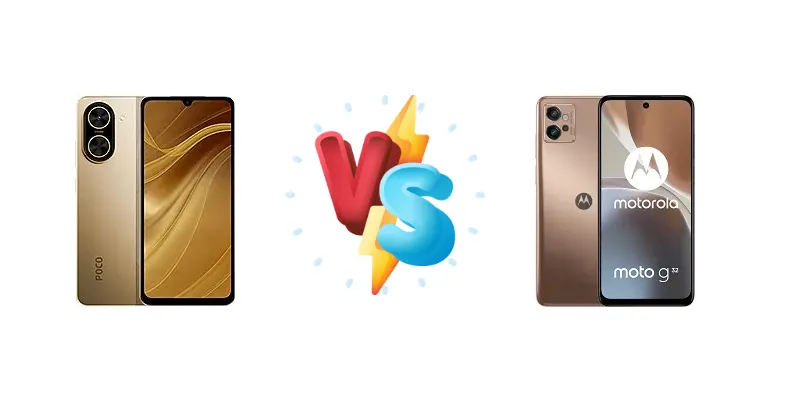
The Xiaomi Poco C71 and Motorola Moto G32 represent compelling options in the ultra-budget smartphone space. While both aim to deliver essential functionality at a low price point, they take distinctly different approaches to achieving this, primarily through their chipset choices. This comparison dissects those differences, focusing on performance, charging, and overall user experience.
🏆 Quick Verdict
For the average user prioritizing quick top-ups and a slightly smoother experience, the Motorola Moto G32 emerges as the better choice. Its Snapdragon 680, fabricated on a 6nm process, offers improved efficiency and 30W charging significantly outperforms the Poco C71’s 15W charging, making it more convenient for daily use.
| Network |
|---|
| 2G bands | GSM 850 / 900 / 1800 / 1900 | GSM 850 / 900 / 1800 / 1900 |
| 3G bands | HSDPA 850 / 900 / 1700(AWS) / 1900 / 2100 - Global | HSDPA 850 / 900 / 1900 / 2100 |
| 4G bands | 1, 2, 3, 4, 5, 7, 8, 18, 19, 20, 26, 28, 38, 40, 41, 66 - Global | 1, 3, 5, 7, 8, 20, 28, 38, 40, 41 |
| Speed | HSPA, LTE | HSPA, LTE |
| Technology | GSM / HSPA / LTE | GSM / HSPA / LTE |
| Launch |
|---|
| Announced | 2025, April 04 | 2022, July 28 |
| Status | Available. Released 2025, April 08 | Available. Released 2022, August 16 |
| Body |
|---|
| Build | - | Glass front, plastic frame, plastic back |
| Dimensions | 171.8 x 77.8 x 8.3 mm (6.76 x 3.06 x 0.33 in) | 161.8 x 73.8 x 8.5 mm (6.37 x 2.91 x 0.33 in) |
| SIM | Nano-SIM + Nano-SIM | · Nano-SIM· Nano-SIM + Nano-SIM |
| Weight | 193 g (6.81 oz) | 184 g (6.49 oz) |
| | - | Water-repellent design |
| Display |
|---|
| Resolution | 720 x 1640 pixels (~260 ppi density) | 1080 x 2400 pixels, 20:9 ratio (~405 ppi density) |
| Size | 6.88 inches, 112.4 cm2 (~84.1% screen-to-body ratio) | 6.5 inches, 102.0 cm2 (~85.4% screen-to-body ratio) |
| Type | IPS LCD, 120Hz, 450 nits (typ), 600 nits (HBM) | IPS LCD, 90Hz |
| Platform |
|---|
| CPU | Octa-core (2x1.8 GHz Cortex-A75 & 6x1.6 GHz Cortex-A55) | Octa-core (4x2.4 GHz Kryo 265 Gold & 4x1.9 GHz Kryo 265 Silver) |
| Chipset | Unisoc T7250 (12 nm) | Qualcomm SM6225 Snapdragon 680 4G (6 nm) |
| GPU | Mali-G57 MP1 | Adreno 610 |
| OS | Android 15 or Android 15 (Go edition), up to 2 major Android upgrades | Android 12, upgradable to Android 13 |
| Memory |
|---|
| Card slot | microSDXC (dedicated slot) | microSDXC (dedicated slot) |
| Internal | 64GB 3GB RAM, 64GB 4GB RAM, 128GB 4GB RAM, 128GB 6GB RAM | 64GB 4GB RAM, 128GB 4GB RAM, 128GB 6GB RAM, 128GB 8GB RAM, 256GB 8GB RAM |
| Main Camera |
|---|
| Features | LED flash, HDR | LED flash, HDR, panorama |
| Single | 32 MP, f/1.8, (wide)
Auxiliary lens | - |
| Triple | - | 50 MP, f/1.8 (wide), 1/2.76", 0.64µm, PDAF
8 MP, f/2.2, 118˚ (ultrawide), 1/4.0", 1.12µm
2 MP, f/2.4, (macro/depth) |
| Video | 1080p@30fps | 1080p@30fps |
| Selfie camera |
|---|
| Features | HDR | - |
| Single | 8 MP, f/2.0, (wide) | 16 MP, f/2.4, (wide), 1.0µm |
| Video | 1080p@30fps | 1080p@30fps |
| Sound |
|---|
| 3.5mm jack | - | Yes |
| 35mm jack | Yes | Yes |
| Loudspeaker | Yes | Yes, with stereo speakers |
| Comms |
|---|
| Bluetooth | 5.2, A2DP, LE | 5.2, A2DP, LE |
| NFC | No | Yes (market/region dependent) |
| Positioning | GPS | GPS, GLONASS, GALILEO |
| Radio | FM radio, recording | FM radio |
| USB | USB Type-C 2.0 | USB Type-C 2.0 |
| WLAN | Wi-Fi 802.11 a/b/g/n/ac, dual-band | Wi-Fi 802.11 a/b/g/n/ac, dual-band, Wi-Fi Direct |
| Features |
|---|
| Sensors | Fingerprint (side-mounted), accelerometer, compass | Fingerprint (side-mounted), accelerometer, gyro, proximity, compass |
| Battery |
|---|
| Charging | 15W wired | 30W wired |
| Type | 5200 mAh | Li-Po 5000 mAh |
| Misc |
|---|
| Colors | Power Black, Cool Blue, Desert Gold | Mineral Grey, Satin Silver, Rose Gold |
| Models | 25028PC03I, 25028PC03G | XT2235-2, XT2235-3 |
| Price | £ 59.98 / € 76.41 / ₹ 6,199 | ₹ 8,990 |
| SAR | 0.82 W/kg (head) 0.77 W/kg (body) | - |
Xiaomi Poco C71
- Potentially lower price point
- Cortex-A75 cores offer burst performance
- May offer slightly larger battery capacity (speculation)
- Less efficient Unisoc T7250 chipset
- Significantly slower 15W charging
- Likely less optimized software experience
Motorola Moto G32
- More efficient Snapdragon 680 chipset (6nm)
- Faster 30W wired charging
- Mature Qualcomm software optimization
- Potentially higher price
- May have a slightly smaller battery capacity (speculation)
- Peak CPU clock speeds are lower than Poco C71
Display Comparison
Neither device boasts a standout display. Details regarding panel type (IPS vs AMOLED) and resolution are missing, suggesting both likely utilize standard LCD panels common in this price bracket. The focus here shifts to processing power, as display quality is unlikely to be a differentiating factor. Bezels are expected to be relatively thick on both, consistent with their budget positioning.
Camera Comparison
Without detailed sensor information, a direct camera comparison is difficult. However, the market segment suggests both phones will feature primary sensors around the 13-50MP range. The Moto G32’s image signal processor (ISP) within the Snapdragon 680 likely offers superior image processing capabilities, potentially resulting in better dynamic range and noise reduction. The presence of a dedicated ISP is a significant advantage, even with similar sensor resolutions. Expect both phones to include auxiliary lenses of limited utility (e.g., 2MP macro).
Performance
The core difference lies in the chipsets. The Motorola Moto G32’s Qualcomm Snapdragon 680 (6nm) benefits from a more modern fabrication process compared to the Xiaomi Poco C71’s Unisoc T7250 (12nm). This 6nm process translates to better power efficiency and potentially lower thermal throttling under sustained load. While the Poco C71’s CPU features Cortex-A75 cores for peak performance, the Snapdragon 680’s Kryo 265 Gold cores, clocked higher at 2.4 GHz, offer a more consistent and optimized experience. The Snapdragon 680’s architecture is also more mature, benefiting from Qualcomm’s extensive software optimization.
Battery Life
Battery capacity details are missing for both devices, but the charging speed is a clear differentiator. The Motorola Moto G32’s 30W wired charging is a substantial upgrade over the Poco C71’s 15W charging. This means the Moto G32 can replenish its battery significantly faster, reducing downtime. Even if the Poco C71 has a slightly larger battery capacity, the faster charging of the Moto G32 will likely result in a more convenient user experience, especially for those who frequently need to top up their phone throughout the day.
Buying Guide
Buy the Xiaomi Poco C71 if you prioritize maximizing value and are comfortable with slower charging speeds. It’s ideal for users who primarily need a phone for basic communication and light tasks. Buy the Motorola Moto G32 if you value faster charging, a more efficient processor, and a slightly more responsive user experience, even if it means spending a bit more upfront. This phone suits users who frequently find themselves needing a quick power boost.
Frequently Asked Questions
❓ Will the Unisoc T7250 in the Poco C71 struggle with multitasking compared to the Snapdragon 680?
Yes, the Snapdragon 680’s more efficient architecture and optimized software are better suited for handling multiple apps simultaneously. While the Poco C71 can manage basic multitasking, you may experience slowdowns with more demanding applications or a large number of open apps.
❓ How long will it take to fully charge the Motorola Moto G32 with the 30W charger?
While a precise time requires testing, the Moto G32’s 30W charging should fully charge the battery in approximately 60-90 minutes, depending on battery capacity. This is significantly faster than the Poco C71’s 15W charging, which could take over 2 hours.
❓ Is the Snapdragon 680 capable of playing popular mobile games like PUBG Mobile or Call of Duty Mobile on the Moto G32?
The Snapdragon 680 can handle PUBG Mobile and Call of Duty Mobile at medium settings with reasonable frame rates. However, don't expect to max out the graphics settings; you'll likely need to prioritize smoothness over visual fidelity for a consistent gaming experience.
❓ Does the Poco C71 support reverse charging, allowing it to charge other devices?
Based on the available specifications and the phone's positioning, it's highly unlikely the Poco C71 supports reverse charging. This feature is typically reserved for higher-end devices.