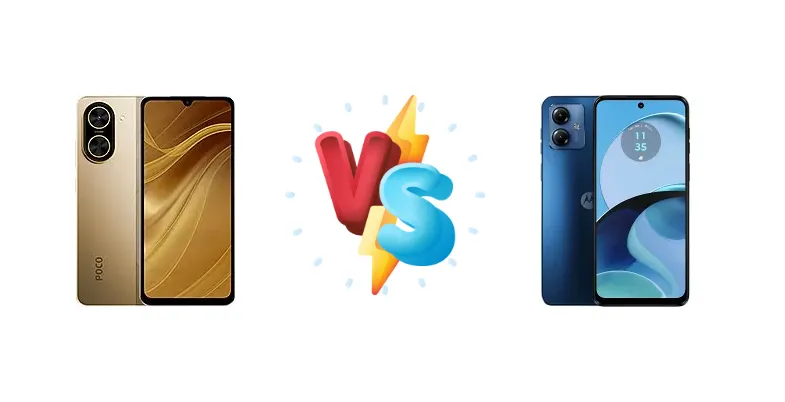
The Xiaomi Poco C71 and Motorola Moto G14 represent the fiercely competitive sub-$150 smartphone market. Both rely on Unisoc chipsets to deliver a functional Android experience, but subtle differences in CPU clock speeds and regional charging capabilities create distinct user experiences. This comparison dissects those differences to determine which phone offers the best value.
🏆 Quick Verdict
For most users, the Motorola Moto G14 edges out the Poco C71. The slightly faster CPU clock speeds in the T616 chipset, coupled with the potential for 20W charging in certain regions (like India), provide a more responsive and convenient experience. However, the Poco C71 remains a viable option for those prioritizing a lower initial cost.
| Network |
|---|
| 2G bands | GSM 850 / 900 / 1800 / 1900 | GSM 850 / 900 / 1800 / 1900 |
| 3G bands | HSDPA 850 / 900 / 1700(AWS) / 1900 / 2100 - Global | HSDPA 850 / 900 / 1900 / 2100 |
| 4G bands | 1, 2, 3, 4, 5, 7, 8, 18, 19, 20, 26, 28, 38, 40, 41, 66 - Global | 1, 2, 3, 5, 7, 8, 20, 28, 38, 40, 41 |
| Speed | HSPA, LTE | HSPA, LTE |
| Technology | GSM / HSPA / LTE | GSM / HSPA / LTE |
| Launch |
|---|
| Announced | 2025, April 04 | 2023, August 01 |
| Status | Available. Released 2025, April 08 | Available. Released 2023, August 08 |
| Body |
|---|
| Build | - | Glass front (Panda glass), plastic frame, plastic back |
| Dimensions | 171.8 x 77.8 x 8.3 mm (6.76 x 3.06 x 0.33 in) | 161.5 x 73.8 x 8 mm (6.36 x 2.91 x 0.31 in) |
| SIM | Nano-SIM + Nano-SIM | Nano-SIM + Nano-SIM |
| Weight | 193 g (6.81 oz) | 177 g (6.24 oz) |
| Display |
|---|
| Protection | - | Panda glass |
| Resolution | 720 x 1640 pixels (~260 ppi density) | 1080 x 2400 pixels, 20:9 ratio (~405 ppi density) |
| Size | 6.88 inches, 112.4 cm2 (~84.1% screen-to-body ratio) | 6.5 inches, 102.0 cm2 (~85.6% screen-to-body ratio) |
| Type | IPS LCD, 120Hz, 450 nits (typ), 600 nits (HBM) | IPS LCD |
| Platform |
|---|
| CPU | Octa-core (2x1.8 GHz Cortex-A75 & 6x1.6 GHz Cortex-A55) | Octa-core (2x2.0 GHz Cortex-A75 & 6x1.8 GHz Cortex-A55) |
| Chipset | Unisoc T7250 (12 nm) | Unisoc Tiger T616 (12 nm) |
| GPU | Mali-G57 MP1 | Mali-G57 MP1 |
| OS | Android 15 or Android 15 (Go edition), up to 2 major Android upgrades | Android 13, planned upgrade to Android 14 |
| Memory |
|---|
| Card slot | microSDXC (dedicated slot) | microSDXC (dedicated slot) |
| Internal | 64GB 3GB RAM, 64GB 4GB RAM, 128GB 4GB RAM, 128GB 6GB RAM | 128GB 4GB RAM, 256GB 8GB RAM |
| Main Camera |
|---|
| Dual | - | 50 MP, f/1.8, (wide), 0.64µm, PDAF
2 MP (macro) |
| Features | LED flash, HDR | LED flash, HDR, panorama |
| Single | 32 MP, f/1.8, (wide)
Auxiliary lens | - |
| Video | 1080p@30fps | 1080p@30fps |
| Selfie camera |
|---|
| Features | HDR | - |
| Single | 8 MP, f/2.0, (wide) | 8 MP, f/2.0, (wide), 1/4.0", 1.12µm |
| Video | 1080p@30fps | 1080p@30fps |
| Sound |
|---|
| 35mm jack | Yes | Yes |
| Loudspeaker | Yes | Yes, with stereo speakers |
| Comms |
|---|
| Bluetooth | 5.2, A2DP, LE | 5.0, A2DP, LE |
| NFC | No | Yes (market/region dependent) |
| Positioning | GPS | GPS, GLONASS, GALILEO |
| Radio | FM radio, recording | FM radio |
| USB | USB Type-C 2.0 | USB Type-C 2.0 |
| WLAN | Wi-Fi 802.11 a/b/g/n/ac, dual-band | Wi-Fi 802.11 a/b/g/n/ac, dual-band |
| Features |
|---|
| Sensors | Fingerprint (side-mounted), accelerometer, compass | Fingerprint (side-mounted), accelerometer, gyro, proximity, compass (market/region dependent) |
| Battery |
|---|
| Charging | 15W wired | 15W wired
20W wired (India) |
| Type | 5200 mAh | Li-Po 5000 mAh |
| Misc |
|---|
| Colors | Power Black, Cool Blue, Desert Gold | Steel Gray, Sky Blue, Butter Cream, Pale Lilac |
| Models | 25028PC03I, 25028PC03G | PAYF0010IN |
| Price | £ 59.98 / € 76.41 / ₹ 6,199 | $ 190.00 / £ 89.99 / € 149.90 |
| SAR | 0.82 W/kg (head) 0.77 W/kg (body) | - |
Xiaomi Poco C71
- Lowest possible price point
- Functional Android experience
- Likely long battery life
- Slower processor than Moto G14
- Standard 15W charging
- Potentially less refined software
Motorola Moto G14
- Faster processor for smoother performance
- Potential for 20W fast charging (India)
- Potentially better software optimization
- Slightly higher price than Poco C71
- Camera performance likely similar to Poco C71
- May not have 20W charging in all regions
Display Comparison
Neither device boasts a standout display. Both likely utilize LCD panels, common in this price bracket. Without specific brightness data, it's difficult to declare a winner, but the focus here is functionality over fidelity. Expect adequate viewing angles and color reproduction for everyday tasks. Bezels are likely to be substantial on both, maximizing screen real estate within a budget.
Camera Comparison
Camera performance will be heavily reliant on software processing, as both phones likely feature modest sensors. Without detailed sensor specifications, it’s difficult to make a definitive judgment. The inclusion of a 2MP macro camera on both devices is largely a marketing tactic, offering limited practical benefit. Image quality will likely be acceptable in good lighting conditions, but struggle in low-light scenarios. The G14 may have a slight edge due to potentially better image signal processing (ISP) capabilities within the T616 chipset.
Performance
The core difference lies in the chipsets. The Motorola Moto G14’s Unisoc Tiger T616 features 2x 2.0 GHz Cortex-A75 cores, compared to the Poco C71’s Unisoc T7250 with 2x 1.8 GHz Cortex-A75 cores. This 200 MHz clock speed advantage, while seemingly small, translates to snappier app launches and smoother multitasking on the Moto G14. Both utilize the same Cortex-A55 efficiency cores at slightly different clock speeds (1.8 GHz vs 1.6 GHz), impacting background task handling. Both phones likely feature similar RAM configurations, but the G14’s chipset is better positioned to leverage it effectively.
Battery Life
Both phones feature 15W wired charging as standard, but the Moto G14 offers 20W charging in the Indian market. This faster charging capability significantly reduces the time to reach a full charge, a crucial convenience factor. While battery capacity isn’t specified, both likely house around a 5000mAh cell, providing all-day battery life with moderate usage. The 20W charging on the G14 (where available) is a tangible benefit, offsetting any potential difference in battery capacity.
Buying Guide
Buy the Xiaomi Poco C71 if you need the absolute lowest possible price and are willing to accept slightly slower performance and slower charging. It's ideal for basic communication and light app usage. Buy the Motorola Moto G14 if you prefer a more responsive user experience, potentially faster charging (depending on your region), and a slightly more polished software experience. It's better suited for users who multitask or enjoy occasional gaming.
Frequently Asked Questions
❓ Does the Unisoc Tiger T616 in the Moto G14 struggle with demanding games like PUBG Mobile?
While the T616 isn't a gaming powerhouse, it can handle PUBG Mobile at lower graphics settings. Expect playable frame rates with reduced details. The Poco C71's T7250 will likely offer a similar, but slightly less smooth, gaming experience.
❓ Is the 15W charging on both phones slow compared to other smartphones?
Yes, 15W charging is relatively slow by today's standards. Expect a full charge to take around 2.5-3 hours. However, the Moto G14's 20W charging (in India) significantly improves this, reducing charge times to approximately 1.5-2 hours.
❓ How does the software experience differ between Xiaomi's MIUI and Motorola's near-stock Android?
Motorola's software is closer to stock Android, offering a cleaner and more streamlined experience with fewer pre-installed apps. Xiaomi's MIUI is heavily customized, offering more features but potentially feeling bloated and less responsive. This is a matter of personal preference.
❓ Will either phone receive significant software updates and security patches?
Both Xiaomi and Motorola have a mixed track record with software updates on budget devices. Expect at least one major Android update, but long-term support and frequent security patches are not guaranteed. Motorola generally offers a slightly better update commitment than Xiaomi in this price segment.