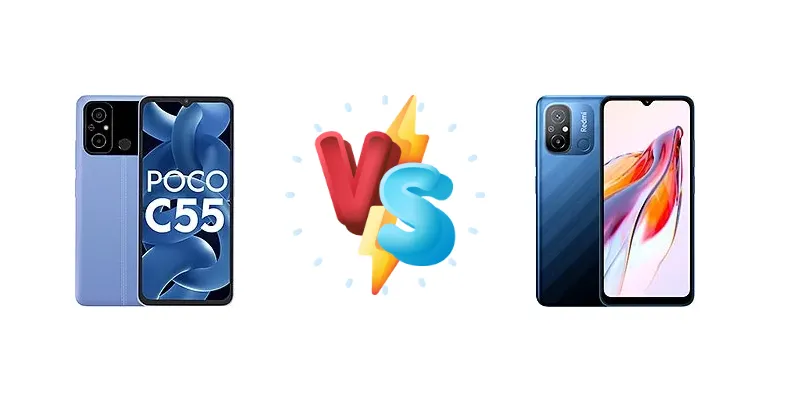
The Xiaomi Poco C55 and Redmi 12C are both contenders in the fiercely competitive budget smartphone market. Both offer compelling features at an affordable price, but subtle differences can make a big impact on your user experience. Let's dive into a detailed comparison to help you choose the right one for your needs.
🏆 Quick Verdict
It's a close call! Both phones share the same chipset and charging speed. The Redmi 12C generally edges out the Poco C55 due to its slightly better display and potentially more appealing design, making it a stronger overall value proposition for most users.
| Network |
|---|
| 2G bands | GSM 850 / 900 / 1800 / 1900 | GSM 850 / 900 / 1800 / 1900 |
| 3G bands | HSDPA 850 / 900 / 2100 | HSDPA 850 / 900 / 2100 |
| 4G bands | 1, 3, 5, 8, 40, 41 | 1, 3, 5, 7, 8, 20, 28, 38, 40, 41 - International |
| Speed | HSPA, LTE | HSPA, LTE |
| Technology | GSM / HSPA / LTE | GSM / CDMA / HSPA / EVDO / LTE |
| | - | CDMA2000 1xEV-DO |
| Launch |
|---|
| Announced | 2023, February 21 | 2022, December 31 |
| Status | Available. Released 2023, February 28 | Available. Released 2023, January 01 |
| Body |
|---|
| Build | Glass front (Panda Glass), eco leather back | - |
| Dimensions | 168.8 x 76.4 x 8.8 mm (6.65 x 3.01 x 0.35 in) | 168.8 x 76.4 x 8.8 mm (6.65 x 3.01 x 0.35 in) |
| SIM | Nano-SIM + Nano-SIM | Nano-SIM + Nano-SIM |
| Weight | 192 g (6.77 oz) | 192 g (6.77 oz) |
| | Dust and splash resistant | - |
| Display |
|---|
| Protection | Panda Glass | - |
| Resolution | 720 x 1650 pixels (~268 ppi density) | 720 x 1650 pixels (~268 ppi density) |
| Size | 6.71 inches, 106.5 cm2 (~82.6% screen-to-body ratio) | 6.71 inches, 106.5 cm2 (~82.6% screen-to-body ratio) |
| Type | IPS LCD | IPS LCD, 500 nits (typ) |
| Platform |
|---|
| CPU | Octa-core (2x2.0 GHz Cortex-A75 & 6x1.8 GHz Cortex-A55) | Octa-core (2x2.0 GHz Cortex-A75 & 6x1.8 GHz Cortex-A55) |
| Chipset | Mediatek MT6769Z Helio G85 (12 nm) | Mediatek MT6769Z Helio G85 (12 nm) |
| GPU | Mali-G52 MC2 | Mali-G52 MC2 |
| OS | Android 12, MIUI 13 for POCO | Android 12, MIUI 13 |
| Memory |
|---|
| Card slot | microSDXC (dedicated slot) | microSDXC (dedicated slot) |
| Internal | 64GB 4GB RAM, 128GB 6GB RAM | 32GB 2GB RAM, 32GB 3GB RAM, 32GB 4GB RAM, 64GB 3GB RAM, 64GB 4GB RAM, 128GB 3GB RAM, 128GB 4GB RAM, 128GB 6GB RAM |
| | eMMC 5.1 | eMMC 5.1 |
| Main Camera |
|---|
| Dual | 50 MP, f/1.8, (wide), PDAF
0.08 MP (depth) | 50 MP, (wide), PDAF
0.08 MP (depth) |
| Features | LED flash, HDR | LED flash, HDR |
| Single | 50 MP, f/1.8, (wide), PDAF
Auxiliary lens | 50 MP, f/1.8, (wide), 1/2.76", PDAF
Auxiliary lens |
| Video | 1080p@30fps | 1080p@30fps |
| Selfie camera |
|---|
| Features | HDR | - |
| Single | 5 MP | 5 MP, f/2.2, (wide) |
| Video | 1080p@30fps | 1080p@30fps |
| Sound |
|---|
| 3.5mm jack | Yes | Yes |
| 35mm jack | Yes | Yes |
| Loudspeaker | Yes | Yes |
| Comms |
|---|
| Bluetooth | 5.0, A2DP, LE | 5.1, A2DP, LE |
| NFC | No | Yes (market/region dependent) |
| Positioning | GPS, GLONASS, GALILEO, BDS, QZSS | GPS, GLONASS, BDS, GALILEO |
| Radio | FM radio, recording | FM radio |
| USB | microUSB 2.0, OTG | microUSB 2.0 |
| WLAN | Wi-Fi 802.11 a/b/g/n/ac, dual-band | Wi-Fi 802.11 a/b/g/n/ac, dual-band, Wi-Fi Direct |
| Features |
|---|
| Sensors | Fingerprint (rear-mounted), accelerometer | Fingerprint (rear-mounted), accelerometer |
| | Virtual proximity sensing | Virtual proximity sensing |
| Battery |
|---|
| Charging | 10W wired | 10W wired |
| Type | Li-Po 5000 mAh | Li-Po 5000 mAh |
| Misc |
|---|
| Colors | Cool Blue, Power Black, Forest Green | Graphite Gray, Ocean Blue, Mint Green, Lavender Purple |
| Models | 22127PC95I | 22120RN86G, 22120RN86I, 22126RN91Y, 2212ARNC4L |
| Price | About 110 EUR | £ 132.99 / € 107.41 |
| SAR | 0.87 W/kg (head) 0.77 W/kg (body) | 1.08 W/kg (head) 0.64 W/kg (body) |
| SAR EU | - | 0.98 W/kg (head) 0.99 W/kg (body) |
Xiaomi Poco C55
- Clean MIUI software experience
- Potentially slightly better build quality
- Decent performance for the price
- Less vibrant display compared to Redmi 12C
- Slightly less versatile camera system
- 10W charging is slow
Xiaomi Redmi 12C
- Vibrant and slightly higher resolution display
- More versatile camera system
- Modern design
- Good value for money
- Software can be slightly more cluttered than Poco C55
- 10W charging is slow
Display Comparison
Both phones feature a 6.71-inch display, but the Redmi 12C often boasts a slightly higher resolution (typically 720 x 1650 pixels) and potentially better color accuracy. The Poco C55's display might have a slightly different panel type, potentially impacting viewing angles and brightness. User reviews often praise the Redmi 12C's display for its vibrancy.
Camera Comparison
The Redmi 12C typically features a more versatile camera setup, often including a higher resolution main sensor (e.g., 50MP) and potentially additional macro or depth sensors. The Poco C55's camera is generally adequate, but the Redmi 12C often captures slightly better images in various lighting conditions. Both offer decent selfie cameras.
Performance
Performance is virtually identical. Both devices are powered by the Mediatek Helio G85 chipset, ensuring smooth everyday tasks and decent gaming performance at lower settings. Don't expect flagship-level speeds, but both handle social media, browsing, and basic apps with ease. RAM and storage configurations are similar across both models.
Battery Life
Both phones are equipped with a 5000mAh battery, promising all-day battery life under moderate usage. However, the Redmi 12C's slightly more efficient display and software optimization might give it a slight edge in real-world battery performance. Charging speeds are identical at 10W wired.
Buying Guide
The Xiaomi Poco C55 is a good choice for users prioritizing a clean software experience and potentially slightly better build quality (though this is marginal). The Xiaomi Redmi 12C is ideal for those seeking a vibrant display, a more modern design, and a slightly better overall package for the price.
Frequently Asked Questions
❓ Are the Poco C55 and Redmi 12C the same phone?
No, while they share the same chipset and battery capacity, they have subtle differences in display quality, camera setup, and design. The Redmi 12C generally offers a slightly better overall experience.
❓ Which phone has better gaming performance?
Both phones offer similar gaming performance due to the identical chipset. Expect playable frame rates in most games at lower settings. Neither is designed for demanding, high-end gaming.