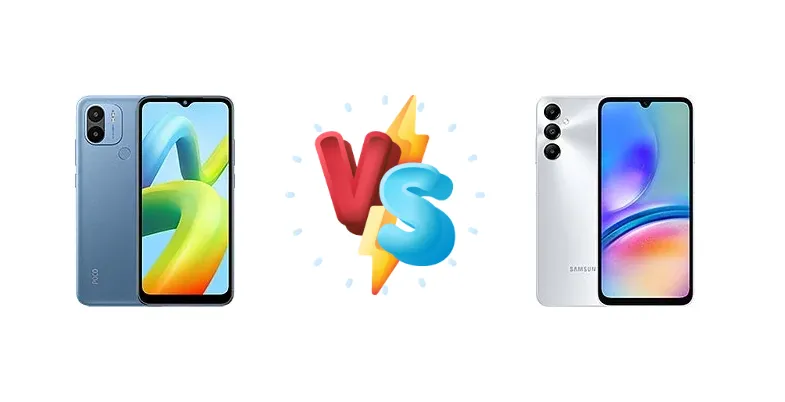
The sub-$150 smartphone market is fiercely competitive. The Xiaomi Poco C50 and Samsung Galaxy A05s represent two compelling options, but cater to different priorities. The Poco C50 aims for affordability above all else, while the Galaxy A05s attempts to balance cost with a more modern chipset and improved display characteristics. This comparison will dissect their key differences to determine which device delivers the best value.
🏆 Quick Verdict
For most users, the Samsung Galaxy A05s is the superior choice. Its Snapdragon 680 chipset offers significantly better performance and efficiency than the Poco C50’s Helio A22, translating to a smoother user experience and improved multitasking. While the Poco C50 is cheaper, the A05s’s brighter display and faster charging justify the price difference.
| Network |
|---|
| 2G bands | GSM 850 / 900 / 1800 / 1900 | GSM 850 / 900 / 1800 / 1900 |
| 3G bands | HSDPA 850 / 900 / 2100 | HSDPA 850 / 900 / 2100 |
| 4G bands | 1, 3, 5, 8, 40, 41 | 1, 3, 5, 7, 8, 20, 28, 38, 40, 41 |
| Speed | HSPA, LTE | HSPA, LTE |
| Technology | GSM / HSPA / LTE | GSM / HSPA / LTE |
| Launch |
|---|
| Announced | 2023, January 03 | 2023, September 25 |
| Status | Available. Released 2023, January 10 | Available. Released 2023, October 18 |
| Body |
|---|
| Build | - | Glass front, plastic back, plastic frame |
| Dimensions | 164.9 x 76.8 x 9.1 mm (6.49 x 3.02 x 0.36 in) | 168 x 77.8 x 8.8 mm (6.61 x 3.06 x 0.35 in) |
| SIM | Nano-SIM + Nano-SIM | · Nano-SIM· Nano-SIM + Nano-SIM |
| Weight | 192 g (6.77 oz) | 194 g (6.84 oz) |
| | Dust & splash resistant | - |
| Display |
|---|
| Resolution | 720 x 1600 pixels, 20:9 ratio (~269 ppi density) | 1080 x 2400 pixels, 20:9 ratio (~393 ppi density) |
| Size | 6.52 inches, 102.6 cm2 (~81.0% screen-to-body ratio) | 6.7 inches, 108.4 cm2 (~82.9% screen-to-body ratio) |
| Type | IPS LCD, 400 nits | PLS LCD, 90Hz |
| Platform |
|---|
| CPU | Quad-core 2.0 GHz Cortex-A53 | Octa-core (4x2.4 GHz Kryo 265 Gold & 4x1.9 GHz Kryo 265 Silver) |
| Chipset | Mediatek MT6761 Helio A22 (12 nm) | Qualcomm SM6225 Snapdragon 680 4G (6 nm) |
| GPU | PowerVR GE8320 | Adreno 610 |
| OS | Android 12 (Go edition) | Android 13, up to 2 major Android upgrades, One UI 7 |
| Memory |
|---|
| Card slot | microSDXC (dedicated slot) | microSDXC (dedicated slot) |
| Internal | 32GB 2GB RAM, 32GB 3GB RAM | 64GB 4GB RAM, 128GB 4GB RAM, 128GB 6GB RAM |
| | eMMC 5.1 | - |
| Main Camera |
|---|
| Dual | 8 MP, f/2.0, (wide)
0.08 MP (depth) | - |
| Features | Dual-LED flash, HDR | LED flash |
| Single | 8 MP, f/2.0, (wide)
Auxiliary lens | - |
| Triple | - | 50 MP, f/1.8, (wide), 1/2.8", 0.64µm, AF
2 MP (macro)
Auxiliary lens |
| Video | 1080p@30fps | 1080p@30/60fps |
| Selfie camera |
|---|
| Single | 5 MP, f/2.0 | 13 MP, f/2.0, (wide), 1/3.X", 1.12µm |
| Video | 1080p@30fps | 1080p@30fps |
| Sound |
|---|
| 3.5mm jack | Yes | - |
| 35mm jack | Yes | Yes |
| Loudspeaker | Yes | Yes |
| Comms |
|---|
| Bluetooth | 5.0, A2DP, LE | 5.1, A2DP, LE |
| NFC | No | Yes (market/region dependent) |
| Positioning | GPS, GLONASS, BDS | GPS, GLONASS, GALILEO, BDS, QZSS |
| Radio | FM radio, recording | Unspecified |
| USB | microUSB 2.0, OTG | USB Type-C 2.0 |
| WLAN | Wi-Fi 802.11 b/g/n | Wi-Fi 802.11 a/b/g/n/ac, dual-band, Wi-Fi Direct |
| Features |
|---|
| Sensors | Fingerprint (rear-mounted), accelerometer | Fingerprint (side-mounted), accelerometer, proximity |
| | Virtual proximity sensing | - |
| Battery |
|---|
| Charging | 10W wired | 25W wired |
| Type | Li-Po 5000 mAh | Li-Po 5000 mAh |
| Misc |
|---|
| Colors | Country Green, Royal Blue | Black, Silver, Light Green, Violet |
| Models | MZB0D3DIN, 220733SPI, 220733SPH | SM-A057F, SM-A057F/DS, SM-A057M, SM-A057M/DS, SM-A057G/DSN, SM-A057G |
| Price | About 80 EUR | $ 134.00 / C$ 146.99 / £ 83.94 / € 100.99 |
| SAR | 0.87 W/kg (head) 0.84 W/kg (body) | - |
| SAR EU | - | 0.58 W/kg (head) 1.31 W/kg (body) |
Xiaomi Poco C50
- Lowest possible price point
- Acceptable for basic communication tasks
- Simple and straightforward user experience
- Significantly underpowered processor
- Likely poor display quality
- Slow charging speed
Samsung Galaxy A05s
- Much faster and more efficient processor
- Brighter and higher contrast display
- Faster 25W charging
- Better camera image processing
- Slightly higher price
- May still struggle with very demanding games
- Build quality may be basic
Display Comparison
The Samsung Galaxy A05s boasts a significantly more usable display. While both phones likely utilize LCD panels, the A05s achieves a measured peak brightness of 468 nits, crucial for outdoor visibility, a metric the Poco C50’s specs don’t address. Furthermore, the A05s’s 1418:1 contrast ratio suggests deeper blacks and a more vibrant image compared to what we’d expect from the Poco C50’s likely lower contrast. The absence of display specifications for the Poco C50 indicates a focus on cost-cutting in this area.
Camera Comparison
Detailed camera specs are limited, but the A05s likely benefits from Qualcomm’s image signal processor (ISP) within the Snapdragon 680, offering improved image processing capabilities. While both phones likely feature a primary camera and potentially depth/macro sensors, the A05s’s chipset provides a foundation for better dynamic range and noise reduction. The Poco C50’s Helio A22 lacks the advanced ISP features found in the Snapdragon 680, resulting in potentially less refined image quality. We can assume the A05s will deliver more consistent results in varying lighting conditions.
Performance
The performance gap between these two devices is substantial. The Samsung Galaxy A05s’s Qualcomm Snapdragon 680, built on a 6nm process, features an octa-core CPU (4x2.4 GHz Kryo 265 Gold & 4x1.9 GHz Kryo 265 Silver) and a more capable GPU. This contrasts sharply with the Xiaomi Poco C50’s MediaTek Helio A22, a quad-core 2.0 GHz Cortex-A53 processor fabricated on a larger 12nm node. The 6nm process of the Snapdragon 680 translates to better power efficiency and reduced thermal throttling, meaning sustained performance is higher. The A05s will handle multitasking and moderately demanding apps with ease, while the Poco C50 will struggle with anything beyond basic operations.
Battery Life
The Samsung Galaxy A05s shines in battery performance, achieving an active use score of 11 hours and 32 minutes. While the Poco C50’s battery capacity isn’t specified, the A05s’s endurance is significantly enhanced by the Snapdragon 680’s power efficiency. Crucially, the A05s supports 25W wired charging, allowing for significantly faster top-ups compared to the Poco C50’s slow 10W charging. This means less downtime and more time using the device.
Buying Guide
Buy the Xiaomi Poco C50 if you absolutely need the lowest possible price and your smartphone usage is limited to basic tasks like calls, texts, and light social media. Buy the Samsung Galaxy A05s if you prioritize a more responsive experience, enjoy media consumption, or occasionally play mobile games – the Snapdragon 680 provides a noticeable performance uplift and the brighter display enhances visibility.
Frequently Asked Questions
❓ Will the Snapdragon 680 in the Galaxy A05s handle popular games like PUBG Mobile?
The Snapdragon 680 is capable of running PUBG Mobile, but likely at medium settings to maintain a stable frame rate. Don't expect to max out the graphics. The Helio A22 in the Poco C50 will struggle significantly with PUBG, even on the lowest settings.
❓ How much faster is the 25W charging on the Galaxy A05s compared to the Poco C50’s 10W charging?
The 25W charging on the A05s will dramatically reduce charging times. While exact 0-100% times aren’t available, expect the A05s to charge significantly faster – potentially cutting charging time in half compared to the Poco C50.
❓ Is the difference in processor performance between the Helio A22 and Snapdragon 680 noticeable in everyday use?
Absolutely. The Snapdragon 680 offers a much smoother and more responsive experience when navigating the user interface, opening apps, and multitasking. The Helio A22 will exhibit noticeable lag and slowdowns, especially with multiple apps open.
❓ Does the Samsung Galaxy A05s support software updates for security patches and Android versions?
Samsung generally provides several years of security updates for its A-series devices. While major Android version updates may be limited, the A05s is likely to receive consistent security patches, offering better long-term protection than the Poco C50, which may have limited software support.