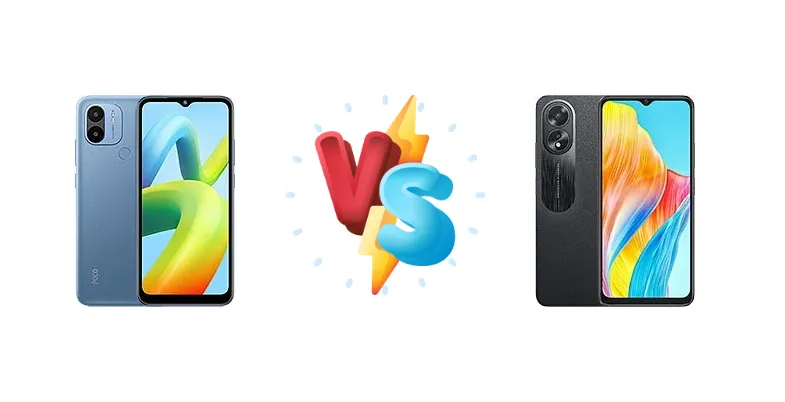
The Xiaomi Poco C50 and Oppo A18 represent the fiercely competitive sub-$150 smartphone market. Both aim to deliver essential smartphone functionality at an accessible price, but they take different approaches to achieving this. The Poco C50 prioritizes affordability with a basic chipset, while the Oppo A18 attempts to offer a more robust experience with a more powerful processor. This comparison will dissect their key differences to determine which device offers the best value.
🏆 Quick Verdict
For the average user prioritizing responsiveness and occasional gaming, the Oppo A18 is the clear winner. Its Helio G85 chipset provides a significantly more fluid experience than the Poco C50’s Helio A22. While the Poco C50 is cheaper, the performance deficit is too substantial to ignore for most users.
| Network |
|---|
| 2G bands | GSM 850 / 900 / 1800 / 1900 | GSM 850 / 900 / 1800 / 1900 |
| 3G bands | HSDPA 850 / 900 / 2100 | HSDPA 850 / 900 / 2100 |
| 4G bands | 1, 3, 5, 8, 40, 41 | 1, 3, 5, 7, 8, 20, 28, 38, 40, 41 |
| Speed | HSPA, LTE | HSPA, LTE |
| Technology | GSM / HSPA / LTE | GSM / HSPA / LTE |
| Launch |
|---|
| Announced | 2023, January 03 | 2023, September 27 |
| Status | Available. Released 2023, January 10 | Available. Released 2023, October 05 |
| Body |
|---|
| Dimensions | 164.9 x 76.8 x 9.1 mm (6.49 x 3.02 x 0.36 in) | 163.7 x 75 x 8.2 mm (6.44 x 2.95 x 0.32 in) |
| SIM | Nano-SIM + Nano-SIM | Nano-SIM + Nano-SIM |
| Weight | 192 g (6.77 oz) | 188 g (6.63 oz) |
| | Dust & splash resistant | - |
| Display |
|---|
| Resolution | 720 x 1600 pixels, 20:9 ratio (~269 ppi density) | 720 x 1612 pixels, 20:9 ratio (~269 ppi density) |
| Size | 6.52 inches, 102.6 cm2 (~81.0% screen-to-body ratio) | 6.56 inches, 103.4 cm2 (~84.2% screen-to-body ratio) |
| Type | IPS LCD, 400 nits | IPS LCD, 90Hz, 720 nits (peak) |
| Platform |
|---|
| CPU | Quad-core 2.0 GHz Cortex-A53 | Octa-core (2x2.0 GHz Cortex-A75 & 6x1.8 GHz Cortex-A55) |
| Chipset | Mediatek MT6761 Helio A22 (12 nm) | Mediatek MT6769 Helio G85 (12 nm) |
| GPU | PowerVR GE8320 | Mali-G52 MC2 |
| OS | Android 12 (Go edition) | Android 13, upgradable to Android 15, ColorOS 15 |
| Memory |
|---|
| Card slot | microSDXC (dedicated slot) | microSDXC |
| Internal | 32GB 2GB RAM, 32GB 3GB RAM | 64GB 4GB RAM, 128GB 4GB RAM |
| | eMMC 5.1 | - |
| Main Camera |
|---|
| Dual | 8 MP, f/2.0, (wide)
0.08 MP (depth) | 8 MP, f/2.0, (wide), AF
Auxiliary lens |
| Features | Dual-LED flash, HDR | LED flash, panorama |
| Single | 8 MP, f/2.0, (wide)
Auxiliary lens | - |
| Video | 1080p@30fps | 1080p@30fps |
| Selfie camera |
|---|
| Features | - | Panorama |
| Single | 5 MP, f/2.0 | 5 MP, f/2.2, (wide) |
| Video | 1080p@30fps | 1080p@30fps |
| Sound |
|---|
| 3.5mm jack | Yes | - |
| 35mm jack | Yes | Yes |
| Loudspeaker | Yes | Yes |
| Comms |
|---|
| Bluetooth | 5.0, A2DP, LE | 5.3, A2DP, LE, aptX HD |
| NFC | No | No |
| Positioning | GPS, GLONASS, BDS | GPS, GALILEO, GLONASS, BDS, QZSS |
| Radio | FM radio, recording | No |
| USB | microUSB 2.0, OTG | USB Type-C 2.0, OTG |
| WLAN | Wi-Fi 802.11 b/g/n | Wi-Fi 802.11 a/b/g/n/ac, dual-band |
| Features |
|---|
| Sensors | Fingerprint (rear-mounted), accelerometer | Fingerprint (side-mounted), accelerometer, proximity, compass |
| | Virtual proximity sensing | - |
| Battery |
|---|
| Charging | 10W wired | - |
| Type | Li-Po 5000 mAh | Li-Po 5000 mAh |
| Misc |
|---|
| Colors | Country Green, Royal Blue | Glowing Black, Glowing Blue |
| Models | MZB0D3DIN, 220733SPI, 220733SPH | CPH2591 |
| Price | About 80 EUR | ₹ 10,290 |
| SAR | 0.87 W/kg (head) 0.84 W/kg (body) | - |
Xiaomi Poco C50
- Lowest possible price point
- Functional for basic tasks
- Likely long battery life due to low power consumption
- Very slow performance
- Slow 10W charging
- Struggles with multitasking
Oppo A18
- Significantly better performance with Helio G85
- Smoother user experience
- Potentially faster charging
- Slightly higher price
- May not have a dramatically better camera
- Still a budget device with limitations
Display Comparison
Neither device boasts a standout display. Both likely utilize LCD panels, a common trait in this price bracket. However, detailed specs like resolution and peak brightness are missing. The focus here is on the internal hardware. The display quality will likely be similar, prioritizing visibility over color accuracy or high refresh rates. Bezels are expected to be noticeable on both devices, contributing to a larger overall footprint.
Camera Comparison
Without detailed camera specifications, a direct comparison is difficult. However, it’s safe to assume both phones feature basic camera setups. The market segment suggests a primary sensor paired with a depth or macro lens (often 2MP, and largely inconsequential). The Helio G85 in the Oppo A18 *may* offer slightly better image signal processing (ISP) capabilities, potentially leading to marginally improved image quality, but this is highly dependent on software optimization. Expect similar performance in good lighting conditions, with both devices struggling in low-light scenarios.
Performance
The core difference lies in the chipsets. The Poco C50’s MediaTek Helio A22, a quad-core processor clocked at 2.0 GHz, is designed for basic functionality. The Oppo A18’s MediaTek Helio G85, an octa-core processor with a mix of Cortex-A75 (2.0 GHz) and Cortex-A55 (1.8 GHz) cores, represents a significant upgrade. The G85’s architecture allows for better multitasking and smoother performance in demanding applications. The A75 cores in the G85 provide a substantial boost in single-core performance, crucial for app launch times and general responsiveness. This translates to a noticeably snappier experience on the Oppo A18, especially when switching between apps or browsing the web. The Poco C50 will likely struggle with more than a few apps open simultaneously.
Battery Life
Both devices likely feature similar battery capacities, typical for this price range (around 5000mAh). The Poco C50’s 10W charging is notably slow. While the Oppo A18’s charging speed isn’t specified, Oppo often includes slightly faster charging solutions even in their budget range. The Helio G85’s improved efficiency *could* translate to slightly better battery life on the Oppo A18, but the difference will likely be minimal. The primary bottleneck is the slow charging speed on the Poco C50, meaning longer periods tethered to a power outlet.
Buying Guide
Buy the Xiaomi Poco C50 if you absolutely need the lowest possible price and your smartphone usage is limited to basic tasks like calls, texts, and light social media. It’s a functional device for those on a very tight budget. Buy the Oppo A18 if you value a smoother user experience, enjoy occasional mobile gaming, and want a phone that feels more responsive in everyday use. The extra investment in the A18’s chipset pays dividends in usability.
Frequently Asked Questions
❓ Will the Oppo A18 be able to run popular games like PUBG Mobile?
The Helio G85 in the Oppo A18 is capable of running PUBG Mobile, but you’ll likely need to use lower graphics settings to maintain a playable frame rate. The Poco C50’s Helio A22 will struggle significantly with PUBG Mobile, even on the lowest settings.
❓ Is the difference in performance between the Helio A22 and Helio G85 really that noticeable in everyday use?
Yes, the difference is substantial. The Helio G85’s octa-core architecture and more powerful cores result in a much smoother and more responsive experience when navigating the user interface, opening apps, and browsing the web. The Poco C50 will feel sluggish in comparison.
❓ How long will it take to fully charge the Poco C50 with its 10W charging?
Expect a very long charging time with the Poco C50’s 10W charging. A full charge from 0% could take upwards of 3-4 hours, making it inconvenient for users who need a quick top-up.
❓ Does either phone support fast charging standards like Quick Charge or Power Delivery?
Neither phone is likely to support advanced fast charging standards. Both are entry-level devices and prioritize cost savings over advanced features. The Oppo A18 *might* have a proprietary fast charging solution, but it won't be as versatile as Quick Charge or Power Delivery.