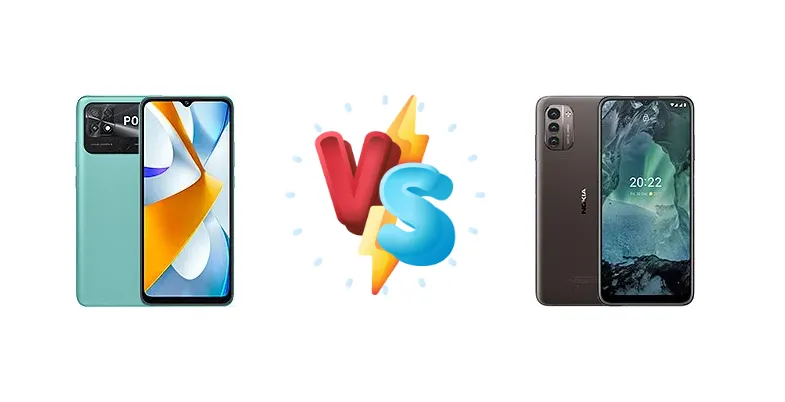
The Xiaomi Poco C40 and Nokia G21 represent compelling options in the ultra-budget smartphone segment. Both aim to deliver essential functionality at a low price point, but they take different approaches to achieving this. The Poco C40 prioritizes a unique chipset, while the Nokia G21 focuses on extended battery endurance and a more refined software experience. This comparison will dissect their key differences to determine which device offers the best value.
🏆 Quick Verdict
For the average user prioritizing longevity and a more consistent experience, the Nokia G21 emerges as the better choice. Its Unisoc T606 chipset, while not a performance leader, offers a more balanced architecture than the Poco C40’s JLQ JR510, and the measured 500 nits brightness provides a more usable outdoor experience.
| Network |
|---|
| 2G bands | GSM 850 / 900 / 1800 / 1900 | GSM 850 / 900 / 1800 / 1900 |
| 3G bands | HSDPA 850 / 900 / 1700(AWS) / 1900 / 2100 | HSDPA 850 / 900 / 2100 - International |
| 4G bands | 1, 2, 3, 4, 5, 7, 8, 20, 28, 38, 40, 41 | 1, 3, 5, 7, 8, 20, 28, 38, 40, 41 - International |
| Speed | HSPA, LTE | HSPA 42.2/5.76 Mbps, LTE Cat4 150/50 Mbps |
| Technology | GSM / HSPA / LTE | GSM / HSPA / LTE |
| | - | 1, 2, 3, 4, 5, 7, 8, 12, 17, 28, 40, 66 - LATAM |
| Launch |
|---|
| Announced | 2022, June 06 | 2022, February 14 |
| Status | Available. Released 2022, June 17 | Available. Released 2022, February 15 |
| Body |
|---|
| Build | - | Glass front, plastic frame, plastic back |
| Dimensions | 169.6 x 76.6 x 9.2 mm (6.68 x 3.02 x 0.36 in) | 164.6 x 75.9 x 8.5 mm (6.48 x 2.99 x 0.33 in) |
| SIM | Nano-SIM + Nano-SIM | · Nano-SIM· Nano-SIM + Nano-SIM |
| Weight | 204 g (7.20 oz) | 190 g (6.70 oz) |
| | Dust & splash resistant | - |
| Display |
|---|
| Protection | Corning Gorilla Glass | - |
| Resolution | 720 x 1650 pixels (~268 ppi density) | 720 x 1600 pixels, 20:9 ratio (~270 ppi density) |
| Size | 6.71 inches, 106.5 cm2 (~82.0% screen-to-body ratio) | 6.5 inches, 102.0 cm2 (~81.6% screen-to-body ratio) |
| Type | IPS LCD, 400 nits | IPS LCD, 90Hz, 400 nits (typ) |
| Platform |
|---|
| CPU | Octa-core (4x2.0 GHz Cortex-A55 & 4x1.5 GHz Cortex-A55) | Octa-core (2x1.6 GHz Cortex-A75 & 6x1.6 GHz Cortex-A55) |
| Chipset | JLQ JR510 (11 nm) | Unisoc T606 (12 nm) |
| GPU | Mali-G57 MC1 | Mali-G57 MP1 |
| OS | Android 11, MIUI 13 for POCO | Android 11, upgradable to Android 13 |
| Memory |
|---|
| Card slot | microSDXC | microSDXC (dedicated slot) |
| Internal | 32GB 2GB RAM, 32GB 3GB RAM, 32GB 4GB RAM, 64GB 4GB RAM | 64GB 3GB RAM, 64GB 4GB RAM, 128GB 4GB RAM, 128GB 6GB RAM |
| | - | eMMC 5.1 |
| Main Camera |
|---|
| Dual | 13 MP, f/2.2, (wide), PDAF
Auxiliary lens | - |
| Features | LED flash, HDR, panorama | LED flash, HDR, panorama |
| Single | 5 MP, f/2.2 | 8 MP, f/2.0, (wide) |
| Triple | - | 50 MP, f/1.8, 28mm (wide), 1/2.76", 0.64µm, PDAF
2 MP (macro)
Auxiliary lens |
| Video | 1080p@30fps | 1080p@30fps |
| Selfie camera |
|---|
| Features | HDR | - |
| Single | 5 MP, f/2.2 | 8 MP, f/2.0, (wide) |
| Video | 1080p@30fps | 1080p@30fps |
| Sound |
|---|
| 3.5mm jack | Yes | Yes |
| 35mm jack | Yes | Yes |
| Loudspeaker | Yes | Yes |
| Comms |
|---|
| Bluetooth | 5.0, A2DP, LE | 5.0, A2DP, LE |
| Infrared port | Yes | - |
| NFC | Yes (market/region dependent) | Yes (market/region dependent) |
| Positioning | GPS, GLONASS, GALILEO, BDS | GPS, GLONASS, GALILEO |
| Radio | FM radio | FM radio, RDS |
| USB | USB Type-C 2.0 | USB Type-C 2.0, OTG |
| WLAN | Wi-Fi 802.11 a/b/g/n/ac, dual-band, Wi-Fi Direct | Wi-Fi 802.11 a/b/g/n/ac, dual-band, Wi-Fi Direct |
| Features |
|---|
| Sensors | Fingerprint (rear-mounted), accelerometer, proximity | Fingerprint (side-mounted), accelerometer, proximity |
| Battery |
|---|
| Charging | 18W wired | 18W wired, PD3.0 |
| Type | Li-Po 6000 mAh | Li-Po 5050 mAh |
| Misc |
|---|
| Colors | Power Black, Coral Green, Poco Yellow | Nordic Blue, Dusk |
| Models | 220333QPG | TA-1418, TA-1477, TA-1415, TA-1405, TA-1404, TA-1412 |
| Price | About 110 EUR | About 90 EUR |
| SAR | - | 1.00 W/kg (head) 1.10 W/kg (body) |
| SAR EU | - | 0.34 W/kg (head) 1.05 W/kg (body) |
| Tests |
|---|
| Battery life | - |
Endurance rating 126h
|
| Camera | - |
Photo / Video |
| Display | - |
Contrast ratio: 1631:1 (nominal) |
| Loudspeaker | - |
-30.7 LUFS (Below average)
|
| Performance | - |
AnTuTu: 171299 (v9)
GeekBench: 1193 (v5.1)
GFXBench: 8.9fps (ES 3.1 onscreen) |
Xiaomi Poco C40
- Potentially lower initial price
- Unique chipset offering (for enthusiasts)
- 18W charging
- Unproven JLQ JR510 chipset performance
- Likely lower display brightness
- Potentially shorter battery life
Nokia G21
- More balanced Unisoc T606 chipset
- Brighter 500 nit display
- Excellent 126-hour endurance rating
- PD3.0 charging support
- May be slightly more expensive
- Still a budget-level camera system
- Software updates may be limited
Display Comparison
The Nokia G21 boasts a measured peak brightness of 500 nits, a significant advantage over the Poco C40, which lacks published brightness data. While both share a 1631:1 contrast ratio (nominal for the Poco C40, measured for the G21), the G21’s higher brightness translates to better visibility in direct sunlight. The panel technology on both is likely IPS LCD, common in this price bracket, but the G21’s superior brightness makes it the more practical choice for outdoor use. Bezels are expected to be substantial on both devices, given their price points.
Camera Comparison
Both phones feature 'Photo / Video' capabilities, but detailed camera specifications are lacking. Without sensor size or aperture information, a direct comparison is difficult. However, given the market segment, it’s safe to assume both rely on budget sensors. The presence of a 2MP macro camera on either device is largely inconsequential; image quality will be limited. The Nokia G21’s image processing algorithms, while not flagship-level, are generally considered more refined than Xiaomi’s budget offerings, potentially resulting in more natural-looking photos.
Performance
The core difference lies in the chipsets. The Poco C40 utilizes the JLQ JR510 (11nm), an uncommon processor with a split core configuration – four Cortex-A55 cores at 2.0 GHz and four at 1.5 GHz. The Nokia G21 employs the Unisoc T606 (12nm) with a more conventional octa-core setup: two Cortex-A75 cores at 1.6 GHz and six Cortex-A55 cores at 1.6 GHz. The A75 cores in the G21 offer a performance boost over the A55-only configuration of the Poco C40, particularly in multi-tasking and more demanding applications. The 12nm process of the Unisoc T606 is also more efficient than the 11nm JLQ JR510, potentially leading to better thermal management. While neither chipset is a powerhouse, the G21’s architecture provides a more responsive user experience.
Battery Life
Both the Poco C40 and Nokia G21 support 18W wired charging. However, the Nokia G21 also supports PD3.0, offering potentially faster and more efficient charging with compatible chargers. More importantly, the Nokia G21 boasts an endurance rating of 126 hours, indicating excellent battery life. While the Poco C40’s battery capacity is unknown, the less efficient JLQ JR510 chipset likely results in shorter runtimes. The G21’s combination of battery endurance and PD3.0 support makes it the clear winner in this category.
Buying Guide
Buy the Xiaomi Poco C40 if you are comfortable experimenting with a less-established chipset and prioritize a potentially lower initial cost. This phone is best suited for users with very basic smartphone needs – calls, texts, and light social media. Buy the Nokia G21 if you value a more predictable performance profile, a brighter display for outdoor visibility, and the assurance of Nokia’s software update commitment, even if it’s limited. This is the better option for users who want a reliable daily driver.
Frequently Asked Questions
❓ Is the JLQ JR510 chipset in the Poco C40 known to have any overheating issues?
The JLQ JR510 is a relatively new chipset, and long-term thermal performance data is limited. However, its 11nm process and less efficient architecture compared to the Unisoc T606 suggest it may be more prone to throttling under sustained load, potentially leading to performance drops during extended gaming sessions.
❓ How does Nokia’s software update policy compare to Xiaomi’s for these budget devices?
Nokia generally offers a more predictable software update schedule for its budget phones, typically guaranteeing at least two years of security updates. Xiaomi’s update commitment for the Poco C40 is less clear, and updates may be less frequent. This makes the Nokia G21 a more secure and future-proof option.
❓ Will the Nokia G21’s PD3.0 charging significantly reduce charging times compared to a standard 18W charger?
Yes, if you use a PD3.0-compatible charger, you can expect faster and more efficient charging with the Nokia G21. PD3.0 dynamically adjusts the voltage and current to optimize charging speed, potentially reducing the 0-100% charge time compared to a standard 18W charger.