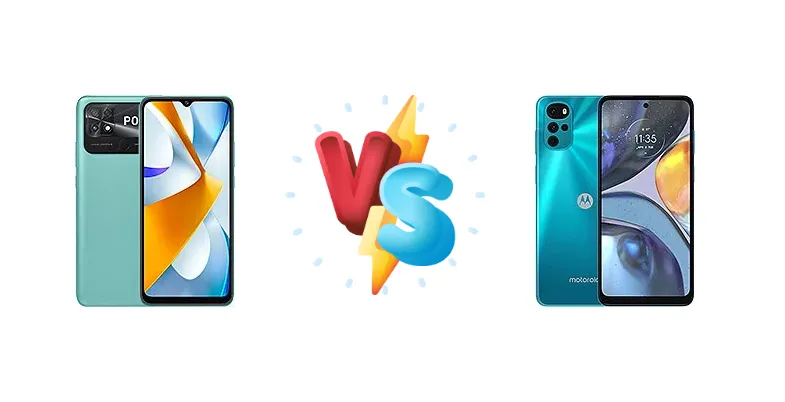
The Xiaomi Poco C40 and Motorola Moto G22 represent the fiercely competitive sub-$150 smartphone market. Both aim to deliver essential features at an accessible price, but they take different approaches to achieving this. The Poco C40 relies on a less common JLQ chipset, while the Moto G22 opts for MediaTek's Helio G37. This comparison dissects their key differences to determine which offers the best value.
🏆 Quick Verdict
For the average user prioritizing consistent performance and slightly faster charging, the Motorola Moto G22 is the better choice. Its Helio G37 chipset, built on a more efficient 12nm process, provides a noticeable advantage in everyday tasks and light gaming, despite the Poco C40's 18W charging.
| Network |
|---|
| 2G bands | GSM 850 / 900 / 1800 / 1900 | GSM 850 / 900 / 1800 / 1900 |
| 3G bands | HSDPA 850 / 900 / 1700(AWS) / 1900 / 2100 | HSDPA 850 / 900 / 1900 / 2100 |
| 4G bands | 1, 2, 3, 4, 5, 7, 8, 20, 28, 38, 40, 41 | 1, 3, 5, 7, 8, 20, 38, 40, 41 |
| Speed | HSPA, LTE | HSPA 42.2/5.76 Mbps, LTE Cat4 150/50 Mbps |
| Technology | GSM / HSPA / LTE | GSM / HSPA / LTE |
| Launch |
|---|
| Announced | 2022, June 06 | 2022, March 04 |
| Status | Available. Released 2022, June 17 | Available. Released 2022, March 04 |
| Body |
|---|
| Build | - | Glass front, plastic frame, plastic back |
| Dimensions | 169.6 x 76.6 x 9.2 mm (6.68 x 3.02 x 0.36 in) | 164 x 75 x 8.5 mm (6.46 x 2.95 x 0.33 in) |
| SIM | Nano-SIM + Nano-SIM | · Nano-SIM· Nano-SIM + Nano-SIM |
| Weight | 204 g (7.20 oz) | 185 g (6.53 oz) |
| | Dust & splash resistant | Water-repellent design |
| Display |
|---|
| Protection | Corning Gorilla Glass | - |
| Resolution | 720 x 1650 pixels (~268 ppi density) | 720 x 1600 pixels, 20:9 ratio (~268 ppi density) |
| Size | 6.71 inches, 106.5 cm2 (~82.0% screen-to-body ratio) | 6.5 inches, 103.5 cm2 (~84.2% screen-to-body ratio) |
| Type | IPS LCD, 400 nits | IPS LCD, 90Hz |
| Platform |
|---|
| CPU | Octa-core (4x2.0 GHz Cortex-A55 & 4x1.5 GHz Cortex-A55) | Octa-core (4x2.3 GHz Cortex-A53 & 4x1.8 GHz Cortex-A53) |
| Chipset | JLQ JR510 (11 nm) | Mediatek MT6765V/CB Helio G37 (12 nm) |
| GPU | Mali-G57 MC1 | PowerVR GE8320 |
| OS | Android 11, MIUI 13 for POCO | Android 12 |
| Memory |
|---|
| Card slot | microSDXC | microSDXC (dedicated slot) |
| Internal | 32GB 2GB RAM, 32GB 3GB RAM, 32GB 4GB RAM, 64GB 4GB RAM | 64GB 4GB RAM, 128GB 4GB RAM |
| Main Camera |
|---|
| Dual | 13 MP, f/2.2, (wide), PDAF
Auxiliary lens | - |
| Features | LED flash, HDR, panorama | LED flash, HDR, panorama |
| Quad | - | 50 MP, f/1.8, (wide), 0.64µm, PDAF
8 MP, f/2.2, 118˚ (ultrawide), 1/4.0", 1.12µm
2 MP (macro)
Auxiliary lens |
| Single | 5 MP, f/2.2 | - |
| Video | 1080p@30fps | 1080p@30fps |
| Selfie camera |
|---|
| Features | HDR | HDR |
| Single | 5 MP, f/2.2 | 16 MP, f/2.5, (wide), 1.0µm |
| Video | 1080p@30fps | 1080p@30fps |
| Sound |
|---|
| 3.5mm jack | Yes | Yes |
| 35mm jack | Yes | Yes |
| Loudspeaker | Yes | Yes |
| Comms |
|---|
| Bluetooth | 5.0, A2DP, LE | 5.0, A2DP, LE |
| Infrared port | Yes | - |
| NFC | Yes (market/region dependent) | Yes (market/region dependent) |
| Positioning | GPS, GLONASS, GALILEO, BDS | GPS, GLONASS, GALILEO |
| Radio | FM radio | Unspecified |
| USB | USB Type-C 2.0 | USB Type-C 2.0 |
| WLAN | Wi-Fi 802.11 a/b/g/n/ac, dual-band, Wi-Fi Direct | Wi-Fi 802.11 a/b/g/n/ac, dual-band, Wi-Fi Direct |
| Features |
|---|
| Sensors | Fingerprint (rear-mounted), accelerometer, proximity | Fingerprint (side-mounted), accelerometer, gyro, proximity, compass |
| Battery |
|---|
| Charging | 18W wired | 20W wired (India)
15W wired (Global) |
| Type | Li-Po 6000 mAh | Li-Po 5000 mAh |
| Misc |
|---|
| Colors | Power Black, Coral Green, Poco Yellow | Pearl White, Iceberg Blue, Cosmic Black, Mint Green |
| Models | 220333QPG | XT2231-1, XT2231-2, XT2231-5 |
| Price | About 110 EUR | About 120 EUR |
Xiaomi Poco C40
- Potentially longer battery life due to less powerful chipset.
- 18W charging is adequate for the price.
- May be more readily available in certain markets.
- JLQ JR510 chipset is less proven and potentially less optimized.
- Likely slower performance in demanding tasks.
- Less efficient processor may lead to more heat.
Motorola Moto G22
- More efficient MediaTek Helio G37 chipset.
- Faster charging speeds (20W in India).
- Better performance for everyday tasks and light gaming.
- Battery life may be slightly shorter due to more powerful processor.
- 15W charging in global markets is slower than Poco C40.
- Motorola's software update track record is sometimes inconsistent.
Display Comparison
Neither device boasts a standout display. Both likely feature LCD panels, typical for this price bracket. However, detailed display specs (resolution, brightness, color gamut) are missing. The focus here is on the internals. Bezels are expected to be substantial on both, impacting the overall screen-to-body ratio. Color accuracy will likely be standard for budget phones, prioritizing power efficiency over fidelity.
Camera Comparison
Camera performance is likely to be similar, with both phones relying on budget sensors. Details on sensor size and aperture are unavailable, but it’s safe to assume both will struggle in low-light conditions. The presence of a 2MP macro camera on both is largely a marketing tactic, offering limited practical benefit. Image processing will likely be heavily reliant on software algorithms to enhance detail and reduce noise, with the Moto G22 potentially benefiting from MediaTek’s image signal processor (ISP).
Performance
The core difference lies in the chipsets. The Motorola Moto G22’s MediaTek Helio G37 (12nm) is a more established and generally more efficient processor than the Poco C40’s JLQ JR510 (11nm). While the JR510 has an octa-core configuration, its Cortex-A55 cores are paired with a less refined architecture. The G37’s Cortex-A53 cores, clocked slightly higher at 2.3 GHz versus the JR510’s 2.0 GHz, offer a tangible performance boost in app loading times and multitasking. The 12nm process of the G37 also contributes to better thermal management, reducing the likelihood of throttling during sustained use. The Poco C40's chipset is less common, meaning software optimization may be less mature.
Battery Life
The Poco C40 features 18W wired charging, while the Moto G22 offers 20W (India) or 15W (Global). While the wattage difference isn’t massive, the G22’s more efficient chipset means it will likely require less frequent charging. Actual 0-100% charge times will depend on the battery capacity (unspecified for both), but the G27's efficiency will offset the slightly lower wattage in the global version. Both phones are expected to deliver all-day battery life with moderate usage.
Buying Guide
Buy the Xiaomi Poco C40 if you prioritize maximizing battery life and are comfortable with a potentially less responsive user experience. Its focus is on longevity, even if it means sacrificing some processing power. Buy the Motorola Moto G22 if you prefer a smoother, more responsive experience for daily tasks and occasional gaming, and value the slightly faster charging speeds (especially in India with the 20W variant).
Frequently Asked Questions
❓ Will the Poco C40's JLQ JR510 chipset struggle with popular apps like Facebook or WhatsApp?
While the Poco C40 can run these apps, the JLQ JR510's less powerful architecture may result in slower loading times and occasional lag, especially when multitasking. The Moto G22's Helio G37 will provide a smoother experience for these common applications.
❓ Is the 20W charging on the Moto G22 (India) significantly faster than the 18W on the Poco C40?
Yes, the 20W charging will noticeably reduce charging times, especially when starting from a low battery percentage. Expect a roughly 15-20% faster charge time with the Moto G22 (India) compared to the Poco C40. However, the global Moto G22 with 15W charging will be closer in charging speed.
❓ Can either of these phones handle playing PUBG Mobile at high settings?
Neither phone is ideally suited for PUBG Mobile at high settings. Both will likely require significantly reduced graphics settings and frame rates to achieve playable performance. The Moto G22's Helio G37 will offer a slightly better experience, but don't expect a smooth, lag-free gaming experience.
❓ How does Motorola's software update policy compare to Xiaomi's for these budget devices?
Historically, Motorola's software update support for budget devices has been less consistent than Xiaomi's. While Xiaomi is known for frequent updates (though often with MIUI bloatware), Motorola's updates can be slower to arrive and may not include the latest Android versions for as long.