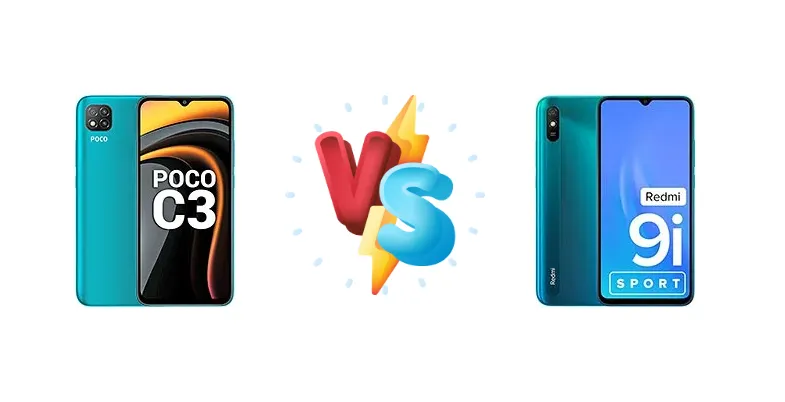
Xiaomi dominates the ultra-budget smartphone space, but navigating their lineup can be tricky. The Poco C3 and Redmi 9i Sport represent two compelling options, both aiming to deliver the most features for the least amount of money. This comparison dissects their key differences, focusing on performance, battery life, and overall value to determine which phone best suits your needs.
🏆 Quick Verdict
For most users, the Poco C3 emerges as the slightly better choice. Its Helio G35 chipset, with higher CPU clock speeds, provides a noticeable performance edge in everyday tasks and light gaming, making it a more responsive experience despite both phones sharing a 10W charging rate.
| Network |
|---|
| 2G bands | GSM 850 / 900 / 1800 / 1900 | GSM 850 / 900 / 1800 / 1900 |
| 3G bands | HSDPA 850 / 900 / 2100 | HSDPA 850 / 900 / 2100 |
| 4G bands | 1, 3, 5, 8, 40, 41 | 1, 3, 5, 8, 40, 41 |
| Speed | HSPA, LTE | HSPA, LTE |
| Technology | GSM / HSPA / LTE | GSM / HSPA / LTE |
| Launch |
|---|
| Announced | 2020, October 06 | 2021, September 28 |
| Status | Available. Released 2020, October 16 | Available. Released 2021, September 28 |
| Body |
|---|
| Dimensions | 164.9 x 77.1 x 9 mm (6.49 x 3.04 x 0.35 in) | 164.9 x 77.1 x 9 mm (6.49 x 3.04 x 0.35 in) |
| SIM | Nano-SIM + Nano-SIM | Nano-SIM + Nano-SIM |
| Weight | 194 g (6.84 oz) | 194 g (6.84 oz) |
| | - | Water-repellent coating |
| Display |
|---|
| Protection | Panda Glass | - |
| Resolution | 720 x 1600 pixels, 20:9 ratio (~270 ppi density) | 720 x 1600 pixels, 20:9 ratio (~269 ppi density) |
| Size | 6.43 inches, 102.1 cm2 (~80.3% screen-to-body ratio) | 6.53 inches, 102.9 cm2 (~81.0% screen-to-body ratio) |
| Type | IPS LCD, 400 nits (typ) | IPS LCD, 400 nits (typ) |
| Platform |
|---|
| CPU | Octa-core (4x2.3 GHz Cortex-A53 & 4x1.8 GHz Cortex-A53) | Octa-core (4x2.0 GHz Cortex-A53 & 4x1.5 GHz Cortex-A53) |
| Chipset | Mediatek MT6765G Helio G35 (12 nm) | Mediatek MT6762G Helio G25 (12 nm) |
| GPU | PowerVR GE8320 | PowerVR GE8320 |
| OS | Android 10, MIUI 12 | Android 10, MIUI 12 |
| Memory |
|---|
| Card slot | microSDXC (dedicated slot) | microSDXC (dedicated slot) |
| Internal | 32GB 3GB RAM, 64GB 4GB RAM | 64GB 4GB RAM, 128GB 4GB RAM |
| | eMMC 5.1 | eMMC 5.1 |
| Main Camera |
|---|
| Features | LED flash, HDR | LED flash, HDR |
| Single | - | 13 MP, f/2.2, 28mm (wide), 1.0µm, PDAF |
| Triple | 13 MP, f/2.2, 28mm (wide), 1.0µm, PDAF
2 MP (macro)
Auxiliary lens | - |
| Video | 1080p@30fps | 1080p@30fps |
| Selfie camera |
|---|
| Features | HDR | HDR |
| Single | 5 MP, f/2.2, (wide), 1.12µm | 5 MP, f/2.2, (wide), 1.12µm |
| Video | 1080p@30fps | 1080p@30fps |
| Sound |
|---|
| 3.5mm jack | Yes | Yes |
| 35mm jack | Yes | Yes |
| Loudspeaker | Yes | Yes |
| Comms |
|---|
| Bluetooth | 5.0, A2DP, LE | 5.0, A2DP, LE |
| NFC | No | No |
| Positioning | GPS, GLONASS, BDS | GPS, GLONASS, BDS |
| Radio | FM radio | FM radio |
| USB | microUSB 2.0, OTG | microUSB 2.0, OTG |
| WLAN | Wi-Fi 802.11 a/b/g/n, Wi-Fi Direct | Wi-Fi 802.11 а/b/g/n, Wi-Fi Direct |
| Features |
|---|
| Sensors | Accelerometer, proximity | Accelerometer, proximity, compass |
| Battery |
|---|
| Charging | 10W wired | 10W wired |
| Type | Li-Po 5000 mAh | Li-Po 5000 mAh |
| Misc |
|---|
| Colors | Arctic Blue, Lime Green, Matte Black | Carbon Black, Coral Green, Metallic Blue |
| Models | M2006C3MII, MZB07RIIN, MZB07RJIN, MZB07QAIN, MZB07RLIN, MZB07RKIN, MZB07RHIN | - |
| Price | About 80 EUR | About 100 EUR |
| SAR | 0.51 W/kg (head) 0.83 W/kg (body) | - |
Xiaomi Poco C3
- Slightly faster processor for smoother performance
- Potentially better gaming experience due to the Helio G35
- More responsive user interface
- 10W charging is slow
- Camera performance is likely similar to the Redmi 9i Sport
Xiaomi Redmi 9i Sport
- Often available at a lower price point
- Decent battery life for basic usage
- Functional for essential smartphone tasks
- Slower processor compared to the Poco C3
- Less responsive user experience
Display Comparison
Both the Poco C3 and Redmi 9i Sport likely feature similar LCD panels, given their price points. Detailed display specs (resolution, brightness) are unavailable, but we can infer they prioritize size over quality. The focus is on providing a viewable experience rather than color accuracy or high peak brightness. Bezels are expected to be substantial on both devices, maximizing screen real estate within a compact form factor. The absence of features like high refresh rates or HDR support is standard for this segment.
Camera Comparison
Camera performance on both devices will be modest. Detailed sensor information is lacking, but it’s safe to assume both rely on a primary sensor paired with auxiliary lenses (likely 2MP depth or macro sensors of limited utility). Image quality will be acceptable in good lighting conditions, but expect significant noise and a lack of detail in low light. The image processing algorithms will likely prioritize sharpening and contrast to compensate for the sensor limitations. The absence of Optical Image Stabilization (OIS) means relying on digital stabilization, which can further degrade image quality.
Performance
The core difference lies in the chipsets. The Poco C3’s MediaTek Helio G35 features an octa-core CPU clocked up to 2.3 GHz, while the Redmi 9i Sport uses the Helio G25 with a maximum clock speed of 2.0 GHz. While both utilize the same Cortex-A53 architecture, the higher clock speeds of the G35 translate to faster processing, particularly in single-core tasks. This means quicker app launches and snappier responsiveness. The G35’s slightly more powerful GPU will also offer a marginally better gaming experience, though both phones are limited to less demanding titles. Both devices likely feature similar RAM configurations, further emphasizing the chipset as the primary performance differentiator.
Battery Life
Both phones are equipped with 10W wired charging, indicating similar charging speeds – expect a full charge to take well over two hours. While battery capacity isn’t specified, both likely house around a 5000mAh battery, typical for this price range. Real-world battery life will depend heavily on usage patterns, but both should comfortably last a full day with moderate use (calls, messaging, light browsing). The lower processing demands of the Redmi 9i Sport *might* translate to slightly longer battery life, but the difference will likely be minimal.
Buying Guide
Buy the Xiaomi Poco C3 if you prioritize a smoother user experience and slightly better performance for basic multitasking and casual gaming. It's ideal for first-time smartphone users or those needing a reliable secondary device. Buy the Xiaomi Redmi 9i Sport if you are looking for the absolute lowest price point and are willing to accept a minor performance trade-off. It's a functional device for essential communication and very light usage.
Frequently Asked Questions
❓ Will the Poco C3 handle popular games like PUBG Mobile or Call of Duty?
While the Helio G35 is a gaming-focused chipset, both phones will struggle with demanding titles like PUBG Mobile or Call of Duty. You'll likely need to play at the lowest graphics settings and accept frame rate drops. They are better suited for less intensive games.
❓ Is the 10W charging a significant drawback?
Yes, 10W charging is quite slow by modern standards. Expect a full charge to take over 2.5 hours. This is a compromise to keep the price low, and you'll need to plan accordingly if you frequently run out of battery.
❓ How much storage do these phones typically come with, and is it expandable?
Both phones typically come with 32GB of internal storage, which is quite limited. Fortunately, both support microSD card expansion, allowing you to add up to 512GB of additional storage for photos, videos, and apps.
❓ Which phone is better for someone who primarily uses WhatsApp and makes calls?
For basic communication like WhatsApp and calls, the Redmi 9i Sport is perfectly adequate. The performance difference won't be noticeable for these tasks, and you'll save some money.