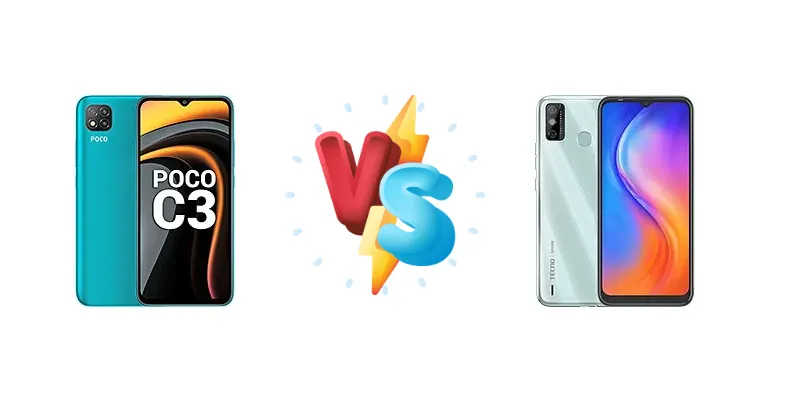
The Xiaomi Poco C3 and Tecno Spark 6 Go represent the extreme end of the budget smartphone market, aiming to deliver essential functionality at the lowest possible price. Both devices target first-time smartphone buyers or those needing a reliable secondary device. This comparison dissects their key specifications to determine which offers the best value for users prioritizing performance, battery life, and overall usability.
🏆 Quick Verdict
For most users, the Xiaomi Poco C3 emerges as the better choice. Its Mediatek Helio G35 chipset, while still entry-level, provides a noticeable performance advantage over the Tecno Spark 6 Go’s Helio A20/A25, making it more responsive for everyday tasks and light gaming. While both offer similar battery capacities, the Poco C3’s slightly more efficient processor contributes to longer real-world usage.
| Network |
|---|
| 2G bands | GSM 850 / 900 / 1800 / 1900 | GSM 850 / 900 / 1800 / 1900 |
| 3G bands | HSDPA 850 / 900 / 2100 | HSDPA 850 / 900 / 2100 |
| 4G bands | 1, 3, 5, 8, 40, 41 | 1, 3, 5, 7, 8, 20, 28, 38, 40, 41 |
| Speed | HSPA, LTE | HSPA 42.2/5.76 Mbps, LTE Cat4 150/50 Mbps |
| Technology | GSM / HSPA / LTE | GSM / HSPA / LTE |
| Launch |
|---|
| Announced | 2020, October 06 | 2020, November 22. Released 2020, November 23 |
| Status | Available. Released 2020, October 16 | Discontinued |
| Body |
|---|
| Dimensions | 164.9 x 77.1 x 9 mm (6.49 x 3.04 x 0.35 in) | 165.6 x 76.3 x 9.1 mm (6.52 x 3.00 x 0.36 in) |
| SIM | Nano-SIM + Nano-SIM | Nano-SIM + Nano-SIM |
| Weight | 194 g (6.84 oz) | - |
| Display |
|---|
| Protection | Panda Glass | Corning Gorilla Glass 3 |
| Resolution | 720 x 1600 pixels, 20:9 ratio (~270 ppi density) | 720 x 1600 pixels, 20:9 ratio (~269 ppi density) |
| Size | 6.43 inches, 102.1 cm2 (~80.3% screen-to-body ratio) | 6.52 inches, 102.6 cm2 (~81.2% screen-to-body ratio) |
| Type | IPS LCD, 400 nits (typ) | IPS LCD |
| Platform |
|---|
| CPU | Octa-core (4x2.3 GHz Cortex-A53 & 4x1.8 GHz Cortex-A53) | Octa-core (4x1.8 GHz Cortex-A53 & 4x1.5 GHz Cortex-A53)Quad-core 1.8 GHz Cortex-A53 |
| Chipset | Mediatek MT6765G Helio G35 (12 nm) | Mediatek MT6761D Helio A20 (12 nm) - 2GB, 3GB modelMediatek MT6762D Helio A25 (12 nm) - 4GB model |
| GPU | PowerVR GE8320 | PowerVR GE8320 |
| OS | Android 10, MIUI 12 | Android 10 (Go edition), HIOS 6.2 |
| Memory |
|---|
| Card slot | microSDXC (dedicated slot) | microSDXC |
| Internal | 32GB 3GB RAM, 64GB 4GB RAM | 32GB 2GB RAM, 32GB 3GB RAM, 64GB 3GB RAM, 64GB 4GB RAM |
| | eMMC 5.1 | eMMC 5.1 |
| Main Camera |
|---|
| Dual | - | 13 MP, f/1.8, AF
Auxiliary lens |
| Features | LED flash, HDR | Dual-LED flash, panorama, HDR |
| Triple | 13 MP, f/2.2, 28mm (wide), 1.0µm, PDAF
2 MP (macro)
Auxiliary lens | - |
| Video | 1080p@30fps | 1080p@30fps |
| Selfie camera |
|---|
| Features | HDR | LED flash |
| Single | 5 MP, f/2.2, (wide), 1.12µm | 8 MP, f/2.0 |
| Video | 1080p@30fps | - |
| Sound |
|---|
| 3.5mm jack | Yes | Yes |
| 35mm jack | Yes | Yes |
| Loudspeaker | Yes | Yes |
| Comms |
|---|
| Bluetooth | 5.0, A2DP, LE | 4.2, A2DP |
| NFC | No | No |
| Positioning | GPS, GLONASS, BDS | GPS |
| Radio | FM radio | FM radio |
| USB | microUSB 2.0, OTG | microUSB 2.0 |
| WLAN | Wi-Fi 802.11 a/b/g/n, Wi-Fi Direct | Wi-Fi 802.11 b/g/n |
| Features |
|---|
| Sensors | Accelerometer, proximity | Fingerprint (rear-mounted), accelerometer, proximity |
| Battery |
|---|
| Charging | 10W wired | - |
| Type | Li-Po 5000 mAh | 5000 mAh |
| Misc |
|---|
| Colors | Arctic Blue, Lime Green, Matte Black | Ice Jadelite, Mystery White, Aqua Blue |
| Models | M2006C3MII, MZB07RIIN, MZB07RJIN, MZB07QAIN, MZB07RLIN, MZB07RKIN, MZB07RHIN | KE5j, KE5k |
| Price | About 80 EUR | About 70 EUR |
| SAR | 0.51 W/kg (head) 0.83 W/kg (body) | - |
Xiaomi Poco C3
- More powerful Helio G35 chipset
- Potentially smoother multitasking
- Better gaming performance (for light titles)
- 10W charging is slow
- Camera performance likely limited
Tecno Spark 6 Go
- Very affordable price point
- Potentially larger RAM option (4GB)
- Large 5000mAh battery
- Less powerful Helio A20/A25 chipset
- Slower performance overall
Display Comparison
Neither the Poco C3 nor the Tecno Spark 6 Go boast impressive displays. Details regarding panel type (IPS is assumed for both) and resolution are not provided, but both likely target a 720p+ resolution. The focus here isn’t on visual fidelity, but on basic usability. Bezels are expected to be substantial on both devices, reflecting their price point. Color accuracy and brightness are likely to be average, sufficient for indoor use but potentially washed out in direct sunlight.
Camera Comparison
Camera performance on both devices will be limited. Details are sparse, but both likely feature a primary camera paired with auxiliary sensors of minimal utility. The focus should not be on image quality, but on basic snapshot capabilities. The Poco C3’s camera specifications are not provided, but it’s reasonable to assume a similar configuration to the Spark 6 Go, which typically includes a 13MP main sensor. Image processing will be basic, and low-light performance will be poor on both. The inclusion of 2MP macro or depth sensors on either device adds little practical value.
Performance
The core difference lies in the chipsets. The Poco C3’s Mediatek Helio G35 (12nm) features an octa-core CPU with a peak clock speed of 2.3 GHz, utilizing Cortex-A53 cores. This is a step up from the Tecno Spark 6 Go’s Mediatek Helio A20 (12nm) with its 1.8 GHz Cortex-A53 cores, or the Helio A25 (also 12nm) with a slightly faster 1.8 GHz quad-core configuration. The G35’s higher clock speed and octa-core design translate to snappier app launches and smoother multitasking. While neither chipset is designed for demanding games, the G35 will handle less intensive titles with greater ease. The Spark 6 Go’s A20/A25 is geared towards basic functionality, and may struggle with multiple apps open simultaneously.
Battery Life
Both the Poco C3 and Tecno Spark 6 Go are equipped with large batteries, typically around 5000mAh. However, battery life isn’t solely determined by capacity. The Poco C3’s more efficient Helio G35 chipset will likely result in slightly longer screen-on time compared to the Spark 6 Go’s Helio A20/A25. Both devices support 10W wired charging, which is slow by modern standards. Expect a full charge to take several hours. The larger battery capacity on both phones is a key advantage, providing all-day battery life for moderate users.
Buying Guide
Buy the Xiaomi Poco C3 if you need a phone capable of handling more than just basic communication – think occasional social media browsing, light gaming, and smoother multitasking. Buy the Tecno Spark 6 Go if your primary need is a very affordable device for calls, texts, and minimal app usage, and you prioritize a potentially larger RAM configuration (4GB model) over raw processing power. The Spark 6 Go is best suited for users who are extremely budget-constrained and have very limited smartphone experience.
Frequently Asked Questions
❓ Will the Poco C3 handle popular games like PUBG Mobile?
While the Poco C3 won't deliver a high-framerate gaming experience, it can run PUBG Mobile at low settings with reduced graphics. The Helio G35 provides a slight advantage over the Spark 6 Go’s chipset, but don’t expect a fluid or visually impressive experience. The Spark 6 Go will likely struggle even at the lowest settings.
❓ Does the Tecno Spark 6 Go support Google’s Android Go edition?
The Tecno Spark 6 Go is often shipped with a customized version of Android based on Android 10 (Go edition) or a full Android version depending on the RAM configuration. The 2GB RAM variant is more likely to run Android Go, which is optimized for devices with limited resources, offering a smoother experience on lower-end hardware.
❓ How long will it take to fully charge either phone?
With both phones supporting only 10W charging, a full charge from 0% to 100% will take approximately 3-4 hours. This is a significant drawback compared to phones with faster charging capabilities.