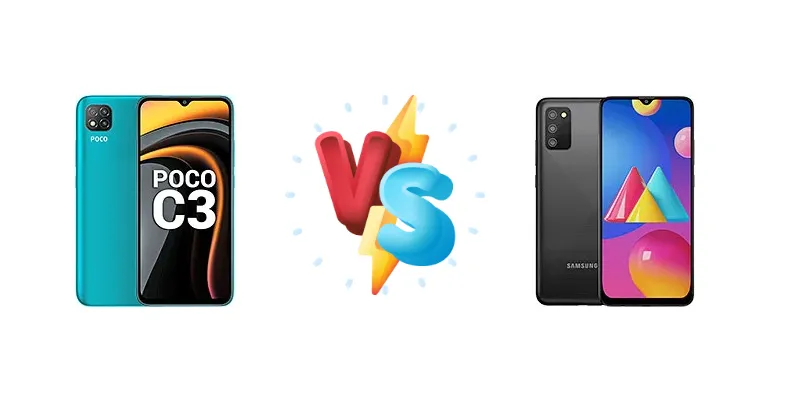
The Xiaomi Poco C3 and Samsung Galaxy M02s represent the extreme end of the budget smartphone spectrum. Both aim to deliver essential smartphone functionality at the lowest possible price point, but they take different approaches to achieving this. This comparison dissects their core components to determine which device offers the best experience for users prioritizing affordability.
🏆 Quick Verdict
For the average user seeking a slightly more responsive experience, the Xiaomi Poco C3 emerges as the better choice. Its Mediatek Helio G35 chipset, built on a smaller 12nm process, provides a modest performance edge over the Samsung Galaxy M02s' Snapdragon 450, despite the latter's 14nm fabrication. However, the M02s' 15W charging offers a quicker top-up.
| Network |
|---|
| 2G bands | GSM 850 / 900 / 1800 / 1900 | GSM 850 / 900 / 1800 / 1900 |
| 3G bands | HSDPA 850 / 900 / 2100 | HSDPA 850 / 900 / 2100 |
| 4G bands | 1, 3, 5, 8, 40, 41 | 1, 3, 5, 7, 8, 20, 28, 38, 40, 41 |
| Speed | HSPA, LTE | HSPA 42.2/5.76 Mbps, LTE Cat4 150/50 Mbps |
| Technology | GSM / HSPA / LTE | GSM / HSPA / LTE |
| Launch |
|---|
| Announced | 2020, October 06 | 2021, January 07 |
| Status | Available. Released 2020, October 16 | Available. Released 2021, January 19 |
| Body |
|---|
| Build | - | Glass front, plastic back, plastic frame |
| Dimensions | 164.9 x 77.1 x 9 mm (6.49 x 3.04 x 0.35 in) | 164.2 x 75.9 x 9.1 mm (6.46 x 2.99 x 0.36 in) |
| SIM | Nano-SIM + Nano-SIM | · Nano-SIM· Nano-SIM + Nano-SIM |
| Weight | 194 g (6.84 oz) | 196 g (6.91 oz) |
| Display |
|---|
| Protection | Panda Glass | - |
| Resolution | 720 x 1600 pixels, 20:9 ratio (~270 ppi density) | 720 x 1600 pixels, 20:9 ratio (~270 ppi density) |
| Size | 6.43 inches, 102.1 cm2 (~80.3% screen-to-body ratio) | 6.5 inches, 102.0 cm2 (~81.8% screen-to-body ratio) |
| Type | IPS LCD, 400 nits (typ) | PLS LCD |
| Platform |
|---|
| CPU | Octa-core (4x2.3 GHz Cortex-A53 & 4x1.8 GHz Cortex-A53) | Octa-core 1.8 GHz Cortex-A53 |
| Chipset | Mediatek MT6765G Helio G35 (12 nm) | Qualcomm SDM450 Snapdragon 450 (14 nm) |
| GPU | PowerVR GE8320 | Adreno 506 |
| OS | Android 10, MIUI 12 | Android 10 |
| Memory |
|---|
| Card slot | microSDXC (dedicated slot) | microSDXC (dedicated slot) |
| Internal | 32GB 3GB RAM, 64GB 4GB RAM | 32GB 3GB RAM, 64GB 4GB RAM |
| | eMMC 5.1 | eMMC 5.1 |
| Main Camera |
|---|
| - | Go |
| Features | LED flash, HDR | LED flash |
| Triple | 13 MP, f/2.2, 28mm (wide), 1.0µm, PDAF
2 MP (macro)
Auxiliary lens | 13 MP, f/2.2, (wide), AF
2 MP (macro)
Auxiliary lens |
| Video | 1080p@30fps | 1080p@30fps |
| Selfie camera |
|---|
| Features | HDR | - |
| Single | 5 MP, f/2.2, (wide), 1.12µm | 5 MP, f/2.2 |
| Video | 1080p@30fps | - |
| Sound |
|---|
| 3.5mm jack | Yes | Yes |
| 35mm jack | Yes | Yes |
| Loudspeaker | Yes | Yes |
| Comms |
|---|
| Bluetooth | 5.0, A2DP, LE | Yes |
| NFC | No | No |
| Positioning | GPS, GLONASS, BDS | GPS, GLONASS, GALILEO, BDS |
| Radio | FM radio | FM radio |
| USB | microUSB 2.0, OTG | Yes |
| WLAN | Wi-Fi 802.11 a/b/g/n, Wi-Fi Direct | Wi-Fi 802.11 b/g/n, Wi-Fi Direct |
| Features |
|---|
| Sensors | Accelerometer, proximity | Accelerometer, proximity |
| Battery |
|---|
| Charging | 10W wired | 15W wired |
| Type | Li-Po 5000 mAh | Li-Po 5000 mAh |
| Misc |
|---|
| Colors | Arctic Blue, Lime Green, Matte Black | Black, Blue, Red |
| Models | M2006C3MII, MZB07RIIN, MZB07RJIN, MZB07QAIN, MZB07RLIN, MZB07RKIN, MZB07RHIN | SM-M025F/DS, SM-M025F |
| Price | About 80 EUR | About 100 EUR |
| SAR | 0.51 W/kg (head) 0.83 W/kg (body) | 0.52 W/kg (head) |
| SAR EU | - | 0.40 W/kg (head) 1.37 W/kg (body) |
Xiaomi Poco C3
- Slightly more powerful CPU due to higher clock speeds.
- More efficient 12nm chipset potentially leading to better battery life.
- Potentially smoother multitasking experience.
- Slower 10W charging.
- Likely similar GPU performance to the M02s.
Samsung Galaxy M02s
- Faster 15W charging for quicker top-ups.
- Qualcomm Snapdragon chipset known for stable performance.
- Potentially wider carrier compatibility (depending on region).
- Less powerful CPU compared to the Poco C3.
- Less efficient 14nm chipset.
Display Comparison
Neither device boasts a particularly impressive display. Details regarding panel type, resolution, and brightness are absent from the provided data, suggesting both utilize basic LCD panels common in this price bracket. Bezels are likely substantial on both, maximizing screen real estate within a compact form factor. Color accuracy is expected to be standard for the segment, prioritizing power efficiency over vibrant visuals.
Camera Comparison
Without sensor size or aperture information, a detailed camera comparison is difficult. Both phones likely feature basic camera setups geared towards casual photography. The absence of details suggests neither device prioritizes camera quality. Any additional lenses (often 2MP macro or depth sensors) are likely to offer limited practical benefit. Image processing will likely be basic, focusing on simplicity rather than advanced features.
Performance
The core difference lies in the chipsets. The Poco C3’s Mediatek Helio G35, fabricated on a 12nm process, features an octa-core configuration split into 4x2.3 GHz Cortex-A53 and 4x1.8 GHz Cortex-A53 cores. This contrasts with the Galaxy M02s’ Qualcomm Snapdragon 450, also octa-core but clocked uniformly at 1.8 GHz Cortex-A53. The 12nm process of the Helio G35 generally translates to better power efficiency compared to the 14nm Snapdragon 450, potentially leading to slightly longer battery life under similar usage. While both CPUs utilize the same Cortex-A53 architecture, the higher clock speeds on the G35 suggest a performance advantage in CPU-bound tasks. However, the Snapdragon 450's Adreno 506 GPU is likely comparable to the G35's integrated GPU, meaning gaming performance will be similar, limited by the overall processing power.
Battery Life
The Poco C3 supports 10W wired charging, while the Galaxy M02s steps it up to 15W. While battery capacity isn't specified, the faster charging on the M02s means a quicker 0-100% charge time. The Helio G35’s potentially better power efficiency in the Poco C3 might offset the slower charging somewhat, resulting in comparable overall battery life depending on usage patterns. Users who frequently need to top up their phone quickly will benefit from the M02s’ 15W charging.
Buying Guide
Buy the Xiaomi Poco C3 if you need a phone capable of handling basic multitasking and light gaming with a bit more fluidity. It's ideal for users who prioritize a slightly snappier user interface and don't mind sacrificing a bit of charging speed. Buy the Samsung Galaxy M02s if you prioritize faster charging and are primarily focused on essential tasks like calls, messaging, and social media. It's a solid option for first-time smartphone users or those on a very tight budget.
Frequently Asked Questions
❓ Will the Snapdragon 450 in the Galaxy M02s struggle with modern app updates?
The Snapdragon 450 is a relatively older chipset. While it can handle basic apps, you might experience slowdowns or compatibility issues with newer, more demanding app updates over time. The Poco C3's Helio G35, being newer, is slightly better positioned to handle future software demands.
❓ Is the 15W charging on the Galaxy M02s a significant advantage over the Poco C3's 10W?
Yes, 15W charging will noticeably reduce the time it takes to fully charge the Galaxy M02s compared to the Poco C3. While the difference won't be dramatic, it's a practical benefit for users who frequently need to quickly top up their battery.
❓ Can either of these phones handle popular mobile games like PUBG Mobile or Call of Duty Mobile?
Both phones will struggle to deliver a smooth gaming experience in PUBG Mobile or Call of Duty Mobile at higher settings. You'll likely need to play at the lowest graphics settings and frame rates to achieve playable performance, and even then, expect occasional stuttering. They are better suited for less demanding games.