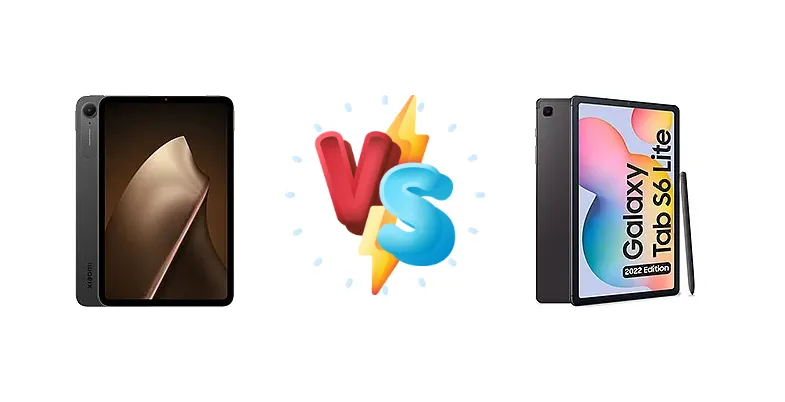
The tablet market offers a compelling middle ground between smartphones and laptops, and the Xiaomi Pad Mini and Samsung Galaxy Tab S6 Lite (2022) represent two popular choices for budget-conscious users. However, they approach this space with vastly different philosophies. The Xiaomi Pad Mini prioritizes raw processing power with its cutting-edge Dimensity 9400+ chipset, while the Samsung Tab S6 Lite (2022) aims for a balanced experience with a more established, though less powerful, Snapdragon platform. This comparison will dissect their key differences to determine which tablet best suits your needs.
🏆 Quick Verdict
For users prioritizing performance and future-proofing, the Xiaomi Pad Mini is the clear winner. Its Dimensity 9400+ chipset and 67W charging significantly outperform the Tab S6 Lite’s Snapdragon 732G and 15W charging. However, the Tab S6 Lite remains a viable option for those seeking a reliable, well-rounded tablet for basic tasks and media consumption.
| Network |
|---|
| 2G bands | N/A | GSM 850 / 900 / 1800 / 1900 |
| 3G bands | N/A | HSDPA 850 / 900 / 1700(AWS) / 1800 / 2100 |
| 4G bands | - | 1, 2, 3, 4, 5, 7, 8, 12, 17, 20, 28, 38, 40, 41, 66 |
| EDGE | N/A | - |
| GPRS | N/A | - |
| Speed | - | HSPA, LTE - cellular model only |
| Technology | No cellular connectivity | GSM / HSPA / LTE |
| Launch |
|---|
| Announced | 2025, September 24 | 2022, May 14 |
| Status | Available. Released 2025, September 24 | Available. Released 2022, May 23 |
| Body |
|---|
| Build | - | Glass front, aluminum back, aluminum frame |
| Dimensions | 205.1 x 132 x 6.5 mm (8.07 x 5.20 x 0.26 in) | 244.5 x 154.3 x 7 mm (9.63 x 6.07 x 0.28 in) |
| SIM | No | Nano-SIM (cellular model only) |
| Weight | 326 g (11.50 oz) | 465/467 g (1.03 lb) |
| | - | Stylus support |
| Display |
|---|
| Resolution | 1880 x 3008 pixels, 16:10 ratio (~403 ppi density) | 1200 x 2000 pixels, 5:3 ratio (~224 ppi density) |
| Size | 8.8 inches, 224.5 cm2 (~82.9% screen-to-body ratio) | 10.4 inches, 307.9 cm2 (~81.6% screen-to-body ratio) |
| Type | IPS LCD, 68B colors, 165Hz, HDR10, Dolby Vision, 700 nits (HBM) | TFT LCD |
| Platform |
|---|
| CPU | Octa-core (1x3.73 GHz Cortex-X925 & 3x3.3 GHz Cortex-X4 & 4x2.4 GHz Cortex-A720) | Octa-core (2x2.3 GHz Kryo 470 Gold & 6x1.8 GHz Kryo 470 Silver)Octa-core (2x2.3 GHz Kryo 465 Gold & 6x1.8 GHz Kryo 465 Silver) |
| Chipset | Mediatek Dimensity 9400+ (3 nm) | Qualcomm SM7150 Snapdragon 732G (8 nm)Qualcomm SM7125 Snapdragon 720G (8 nm) |
| GPU | Immortalis-G925 | Adreno 618 |
| OS | Android 15, HyperOS 2 | Android 12, upgradable to Android 14, One UI 6 |
| Memory |
|---|
| Card slot | No | microSDXC (dedicated slot) |
| Internal | 256GB 8GB RAM, 512GB 12GB RAM | 64GB 4GB RAM, 128GB 4GB RAM |
| Main Camera |
|---|
| Features | LED flash, HDR | HDR, panorama |
| Single | 13 MP, f/2.2, (wide), 1/3.06" 1.12μm, PDAF | 8 MP, (wide), 1/4.0", 1.12µm |
| Video | 4K@30fps, 1080p@30/60fps | 1080p@30fps |
| Selfie camera |
|---|
| Features | HDR | - |
| Single | 8 MP, f/2.3, (wide), 1/4" 1.12μm | 5 MP, (wide), 1/5.0", 1.12µm |
| Video | 1080p@30fps | 1080p@30fps |
| Sound |
|---|
| 3.5mm jack | - | Yes |
| 35mm jack | No | Yes |
| Loudspeaker | Yes, with stereo speakers (with Dolby Atmos) | Yes, with stereo speakers |
| | - | Tuned by AKG |
| Comms |
|---|
| Bluetooth | 5.4, A2DP, LE, LHDC 5.0, ASHA | 5.0, A2DP, LE |
| Infrared port | Yes | - |
| NFC | No | No |
| Positioning | No | GPS, GLONASS, BDS, GALILEO, QZSS - cellular model only |
| Radio | No | No |
| USB | 1x USB Type-C 3.2, 1x USB Type-C 2.0, Display Port 1.4, accessory connector | USB Type-C |
| WLAN | Wi-Fi 802.11 a/b/g/n/ac/6/7, dual-band, Wi-Fi Direct | Wi-Fi 802.11 a/b/g/n/ac, dual-band, Wi-Fi Direct |
| Features |
|---|
| Sensors | Accelerometer, gyro, proximity, compass | Accelerometer, proximity, gyro |
| | - | ANT+ |
| Battery |
|---|
| Charging | 67W wired, PD3.0, QC3+
18W reverse wired
Bypass charging | 15W wired |
| Type | 7500 mAh | Li-Po 7040 mAh |
| Misc |
|---|
| Colors | Gray, Purple | Chiffon Pink, Angora Blue, Oxford Gray |
| Models | 25079RPDCG | SM-P613, SM-P619 |
| Price | About 370 EUR | About 400 EUR |
| SAR | - | 1.01 W/kg (body) |
Xiaomi Pad Mini
- Significantly more powerful Dimensity 9400+ chipset
- Ultra-fast 67W charging with PD3.0/QC3+
- Potential for longer software support due to flagship chipset
- Display specifications currently unknown
- Brand recognition may be lower than Samsung
Samsung Galaxy Tab S6 Lite (2022)
- Established brand reputation and software support
- Balanced performance for everyday tasks
- More readily available accessories
- Significantly slower Snapdragon 732G chipset
- Slow 15W charging
- Less future-proofed compared to the Xiaomi Pad Mini
Display Comparison
While display specifications are missing for the Xiaomi Pad Mini, its compact form factor suggests a focus on portability. The Samsung Galaxy Tab S6 Lite (2022) features a 10.4-inch TFT LCD. The Snapdragon 732G’s capabilities are sufficient for driving this display smoothly, but the TFT panel lacks the vibrancy and contrast of more advanced technologies like AMOLED. The Xiaomi Pad Mini’s potential for a higher resolution or refresh rate display, given its chipset, could offer a superior visual experience, though this remains unconfirmed. Bezels are a key consideration in this segment, and a comparison would require physical measurements.
Camera Comparison
Neither tablet is positioned as a photography powerhouse. Camera specifications are limited, but the focus should be on video conferencing and occasional snapshots. The Samsung Tab S6 Lite (2022) likely features a standard rear camera setup, but details are scarce. The Xiaomi Pad Mini’s camera specifications are also unavailable. Given the target market, image quality is unlikely to be a major differentiator, and the emphasis should be on functionality rather than photographic excellence.
Performance
The performance gap between these tablets is substantial. The Xiaomi Pad Mini’s Mediatek Dimensity 9400+ (3nm) is a flagship-level chipset featuring an octa-core configuration with a Cortex-X925 prime core clocked at 3.73 GHz. This architecture, built on a 3nm process, delivers significantly higher performance and efficiency compared to the Samsung Galaxy Tab S6 Lite (2022)’s Qualcomm SM7150 Snapdragon 732G (8nm). The Snapdragon 732G’s octa-core CPU, with Kryo 470 Gold cores peaking at 2.3 GHz, is adequate for everyday tasks, but will struggle with demanding games or multitasking. The 3nm node of the Dimensity 9400+ translates to better thermal management, reducing the likelihood of performance throttling during extended use. The Xiaomi Pad Mini is likely to offer a noticeably smoother and more responsive experience.
Battery Life
The Xiaomi Pad Mini boasts an impressive active use battery life of 13:39 hours, suggesting efficient power management despite its powerful chipset. Crucially, it supports 67W wired charging with PD3.0 and QC3+, enabling incredibly fast charging times. The Samsung Galaxy Tab S6 Lite (2022) is limited to 15W wired charging, resulting in significantly longer recharge times. While battery capacity isn’t specified for either device, the Xiaomi Pad Mini’s faster charging capability mitigates any potential capacity disadvantage. The inclusion of 18W reverse wired charging on the Xiaomi Pad Mini adds further versatility, allowing it to charge other devices.
Buying Guide
Buy the Xiaomi Pad Mini if you need a tablet capable of handling demanding applications, gaming, or content creation, and value fast charging speeds. Its advanced chipset ensures longevity and a smoother user experience. Buy the Samsung Galaxy Tab S6 Lite (2022) if you prioritize a familiar Android experience, a more established brand reputation, and are primarily focused on everyday tasks like browsing, video streaming, and note-taking, and aren't concerned with pushing the tablet's performance limits.
Frequently Asked Questions
❓ Will the Dimensity 9400+ in the Xiaomi Pad Mini overheat during prolonged gaming sessions?
The Dimensity 9400+'s 3nm process node is designed for improved thermal efficiency. While demanding games will generate heat, the chipset is expected to manage it effectively, minimizing throttling and maintaining consistent performance. The Xiaomi Pad Mini's thermal design will be crucial, but the underlying chipset architecture is a positive indicator.
❓ Is the 15W charging on the Samsung Galaxy Tab S6 Lite (2022) slow enough to be a major inconvenience?
Yes, 15W charging is considerably slower than the 67W charging on the Xiaomi Pad Mini. Expect significantly longer recharge times, potentially taking several hours to fully charge from 0%. This is a notable drawback for users who rely on quick top-ups throughout the day.
❓ Can the Xiaomi Pad Mini handle demanding tasks like video editing or graphic design?
The Dimensity 9400+ chipset is well-equipped to handle demanding tasks like video editing and graphic design. Its powerful CPU and GPU, combined with ample RAM (specifications not provided, but likely sufficient), should provide a smooth and responsive experience. However, the tablet's display quality will also play a role in the overall workflow.