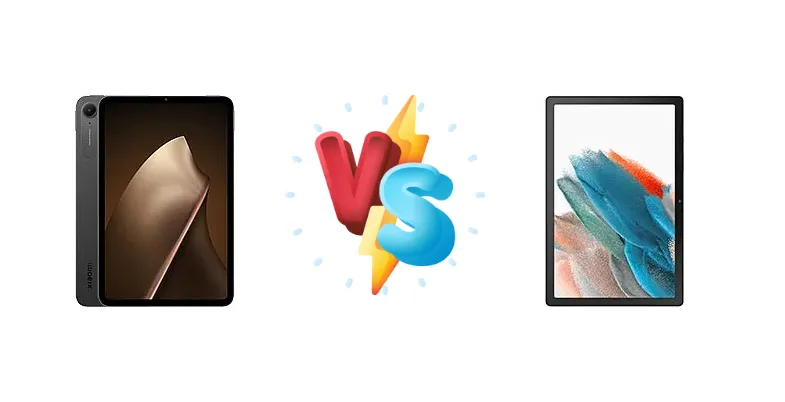
The Android tablet market offers a wide range of options, but finding the right balance between price and performance can be challenging. We pit the Xiaomi Pad Mini, a newcomer boasting a flagship-level chipset, against the established Samsung Galaxy Tab A8 10.5 (2021) to determine which tablet delivers the best experience for your money. This comparison focuses on the core differences in processing power, battery life, and charging capabilities.
🏆 Quick Verdict
For users prioritizing performance and future-proofing, the Xiaomi Pad Mini is the clear winner. Its Mediatek Dimensity 9400+ chipset offers a substantial leap in processing power over the Samsung Galaxy Tab A8 10.5’s Unisoc Tiger T618. While the Tab A8 remains a viable option for basic tasks, the Pad Mini’s superior speed and 67W charging justify the price difference for demanding users.
| Network |
|---|
| 2G bands | N/A | GSM 850 / 900 / 1800 / 1900 |
| 3G bands | N/A | HSDPA 850 / 900 / 1700(AWS) / 1900 / 2100 |
| 4G bands | - | 1, 2, 3, 4, 5, 7, 8, 12, 17, 20, 28, 38, 40, 41, 66 |
| EDGE | N/A | - |
| GPRS | N/A | - |
| Speed | - | HSPA, LTE - cellular model only |
| Technology | No cellular connectivity | GSM / HSPA / LTE |
| Launch |
|---|
| Announced | 2025, September 24 | 2021, December 15 |
| Status | Available. Released 2025, September 24 | Available. Released 2022, January 17 |
| Body |
|---|
| Dimensions | 205.1 x 132 x 6.5 mm (8.07 x 5.20 x 0.26 in) | 246.8 x 161.9 x 6.9 mm (9.72 x 6.37 x 0.27 in) |
| SIM | No | Nano-SIM (cellular model only) |
| Weight | 326 g (11.50 oz) | 508 g (1.12 lb) |
| Display |
|---|
| Resolution | 1880 x 3008 pixels, 16:10 ratio (~403 ppi density) | 1200 x 1920 pixels, 16:10 ratio (~216 ppi density) |
| Size | 8.8 inches, 224.5 cm2 (~82.9% screen-to-body ratio) | 10.5 inches, 319.7 cm2 (~80.0% screen-to-body ratio) |
| Type | IPS LCD, 68B colors, 165Hz, HDR10, Dolby Vision, 700 nits (HBM) | TFT LCD |
| Platform |
|---|
| CPU | Octa-core (1x3.73 GHz Cortex-X925 & 3x3.3 GHz Cortex-X4 & 4x2.4 GHz Cortex-A720) | Octa-core (2x2.0 GHz Cortex-A75 & 6x2.0 GHz Cortex-A55) |
| Chipset | Mediatek Dimensity 9400+ (3 nm) | Unisoc Tiger T618 (12 nm) |
| GPU | Immortalis-G925 | Mali G52 MP2 |
| OS | Android 15, HyperOS 2 | Android 11, upgradable to Android 14, One UI 6 |
| Memory |
|---|
| Card slot | No | microSDXC (dedicated slot) |
| Internal | 256GB 8GB RAM, 512GB 12GB RAM | 32GB 2GB RAM, 32GB 3GB RAM, 64GB 2GB RAM, 64GB 3GB RAM, 64GB 4GB RAM, 128GB 3GB RAM, 128GB 4GB RAM |
| Main Camera |
|---|
| Features | LED flash, HDR | - |
| Single | 13 MP, f/2.2, (wide), 1/3.06" 1.12μm, PDAF | 8 MP, AF |
| Video | 4K@30fps, 1080p@30/60fps | 1080p@30fps |
| Selfie camera |
|---|
| Features | HDR | - |
| Single | 8 MP, f/2.3, (wide), 1/4" 1.12μm | 5 MP |
| Video | 1080p@30fps | 1080p@30fps |
| Sound |
|---|
| 3.5mm jack | - | Yes |
| 35mm jack | No | Yes |
| Loudspeaker | Yes, with stereo speakers (with Dolby Atmos) | Yes, with stereo speakers (4 speakers) |
| Comms |
|---|
| Bluetooth | 5.4, A2DP, LE, LHDC 5.0, ASHA | 5.0, A2DP, LE |
| Infrared port | Yes | - |
| NFC | No | No |
| Positioning | No | GPS, GLONASS, BDS, GALILEO, QZSS - cellular model only |
| Radio | No | No |
| USB | 1x USB Type-C 3.2, 1x USB Type-C 2.0, Display Port 1.4, accessory connector | USB Type-C 2.0 |
| WLAN | Wi-Fi 802.11 a/b/g/n/ac/6/7, dual-band, Wi-Fi Direct | Wi-Fi 802.11 a/b/g/n/ac, dual-band, Wi-Fi Direct |
| Features |
|---|
| Sensors | Accelerometer, gyro, proximity, compass | Accelerometer, gyro, proximity, compass |
| Battery |
|---|
| Charging | 67W wired, PD3.0, QC3+
18W reverse wired
Bypass charging | 15W wired |
| Type | 7500 mAh | Li-Po 7040 mAh |
| Misc |
|---|
| Colors | Gray, Purple | Gray, Silver, Pink Gold |
| Models | 25079RPDCG | SM-X200, SM-X205 |
| Price | About 370 EUR | About 230 EUR |
| SAR EU | - | 0.92 W/kg (body) |
Xiaomi Pad Mini
- Significantly faster processor with the Mediatek Dimensity 9400+
- Ultra-fast 67W charging with multiple charging standards
- Potentially better display quality due to premium positioning
- Likely higher price point
- Battery capacity not specified, potential for shorter runtime than Tab A8
Samsung Galaxy Tab A8 10.5 (2021)
- More affordable price
- Familiar Samsung One UI experience
- Decent battery life for basic tasks
- Significantly slower processor
- Slow 15W charging
- Limited performance for demanding applications
Display Comparison
While both tablets feature 10.5-inch displays, the provided data doesn't detail display specifications like resolution or panel type. However, given the price points, we can infer the Tab A8 likely uses a standard IPS LCD. The Pad Mini, positioned as a more premium device, may incorporate a higher-quality panel with improved color accuracy and viewing angles. The absence of refresh rate information suggests both likely operate at 60Hz. Bezels are likely comparable, typical of tablets in this price bracket.
Camera Comparison
Neither tablet is positioned as a photography powerhouse, and the provided data doesn't offer detailed camera specifications. It's safe to assume both feature basic camera setups suitable for video calls and casual snapshots. Without sensor size or aperture information, a direct comparison is difficult. However, given the Pad Mini’s overall premium positioning, it’s reasonable to expect a slightly more capable camera system.
Performance
The performance gap between these tablets is significant. The Xiaomi Pad Mini’s Mediatek Dimensity 9400+ (3nm) is a modern, high-performance chipset featuring an octa-core configuration with a Cortex-X925 prime core clocked at 3.73 GHz. This contrasts sharply with the Samsung Galaxy Tab A8 10.5’s Unisoc Tiger T618 (12nm), which utilizes older Cortex-A75 and A55 cores clocked at 2.0 GHz. The 3nm fabrication process of the Dimensity 9400+ offers superior power efficiency and thermal performance, translating to sustained performance under load. The Pad Mini will excel in demanding tasks like gaming and video editing, while the Tab A8 will likely struggle with more intensive applications.
Battery Life
The Xiaomi Pad Mini achieves an impressive 13:39 hours of active use, suggesting efficient power management despite its powerful chipset. This is further enhanced by its 67W wired charging, supporting PD3.0 and QC3+, allowing for incredibly fast charging times. The Tab A8 10.5 is limited to 15W wired charging, resulting in significantly slower charging speeds. While battery capacity isn't specified, the Pad Mini’s faster charging effectively mitigates any potential capacity disadvantage, offering greater convenience for users.
Buying Guide
Buy the Xiaomi Pad Mini if you need a tablet capable of handling demanding applications, gaming, or multitasking without slowdowns, and if fast charging is a priority. Its advanced chipset and charging technology cater to power users. Buy the Samsung Galaxy Tab A8 10.5 (2021) if you primarily need a tablet for basic media consumption, web browsing, and light productivity tasks, and are looking for a more affordable option with a familiar Samsung interface.
Frequently Asked Questions
❓ Will the Unisoc Tiger T618 in the Tab A8 struggle with graphically intensive games like Genshin Impact?
Yes, the Unisoc Tiger T618 is a budget-oriented chipset and will likely struggle to run Genshin Impact at playable frame rates, even on low settings. Expect significant frame drops and potential stuttering. The Xiaomi Pad Mini’s Dimensity 9400+ is far better equipped to handle such games.
❓ How long does it realistically take to fully charge the Xiaomi Pad Mini with the 67W charger?
With 67W charging, the Xiaomi Pad Mini should be able to charge from 0% to 100% in approximately 45-60 minutes, depending on the battery capacity. This is a significant improvement over the several hours required to fully charge the Samsung Galaxy Tab A8 10.5 with its 15W charger.
❓ Does the Xiaomi Pad Mini support external storage via microSD card?
This information is not provided in the context data. However, given the Pad Mini's focus on performance, it's possible that microSD card support is not included to optimize internal storage speeds. Check official specifications for confirmation.