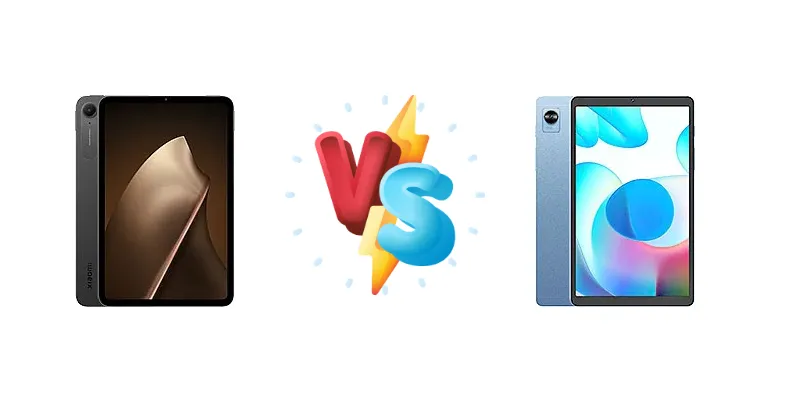
The compact tablet market is heating up, with both Xiaomi and Realme offering compelling options. The Xiaomi Pad Mini aims for near-flagship performance in a small form factor, while the Realme Pad Mini focuses on affordability. This comparison dissects their key differences to determine which tablet best suits your needs.
🏆 Quick Verdict
For users prioritizing performance and future-proofing, the Xiaomi Pad Mini is the clear winner. Its Mediatek Dimensity 9400+ chipset delivers a substantial performance advantage over the Realme Pad Mini’s Unisoc Tiger T616. While the Realme Pad Mini offers a lower entry price, the Xiaomi Pad Mini’s superior processing power and faster charging justify the cost for demanding users.
| Network |
|---|
| 2G bands | N/A | GSM 850 / 900 / 1800 / 1900 |
| 3G bands | N/A | HSDPA 850 / 900 / 2100 |
| 4G bands | - | 1, 3, 5, 7, 8, 20, 28, 38, 40, 41 |
| EDGE | N/A | - |
| GPRS | N/A | - |
| Speed | - | HSPA, LTE - cellular model only |
| Technology | No cellular connectivity | GSM / HSPA / LTE |
| Launch |
|---|
| Announced | 2025, September 24 | 2022, April 04 |
| Status | Available. Released 2025, September 24 | Available. Released 2022, April 08 |
| Body |
|---|
| Dimensions | 205.1 x 132 x 6.5 mm (8.07 x 5.20 x 0.26 in) | 211.8 x 124.5 x 7.6 mm (8.34 x 4.90 x 0.30 in) |
| SIM | No | Nano-SIM (cellular model only) |
| Weight | 326 g (11.50 oz) | 372 g (13.12 oz) |
| Display |
|---|
| Resolution | 1880 x 3008 pixels, 16:10 ratio (~403 ppi density) | 800 x 1340 pixels, 5:3 ratio (~179 ppi density) |
| Size | 8.8 inches, 224.5 cm2 (~82.9% screen-to-body ratio) | 8.7 inches, 214.9 cm2 (~81.5% screen-to-body ratio) |
| Type | IPS LCD, 68B colors, 165Hz, HDR10, Dolby Vision, 700 nits (HBM) | IPS LCD |
| Platform |
|---|
| CPU | Octa-core (1x3.73 GHz Cortex-X925 & 3x3.3 GHz Cortex-X4 & 4x2.4 GHz Cortex-A720) | Octa-core (2x2.0 GHz Cortex-A75 & 6x1.8 GHz Cortex-A55) |
| Chipset | Mediatek Dimensity 9400+ (3 nm) | Unisoc Tiger T616 (12 nm) |
| GPU | Immortalis-G925 | Mali-G57 MP1 |
| OS | Android 15, HyperOS 2 | Android 11 |
| Memory |
|---|
| Card slot | No | microSDXC (uses shared SIM slot) |
| Internal | 256GB 8GB RAM, 512GB 12GB RAM | 32GB 3GB RAM, 64GB 4GB RAM, 128GB 6GB RAM |
| | - | UFS 2.1 |
| Main Camera |
|---|
| Features | LED flash, HDR | - |
| Single | 13 MP, f/2.2, (wide), 1/3.06" 1.12μm, PDAF | 8 MP, f/2.0 |
| Video | 4K@30fps, 1080p@30/60fps | 1080p@30fps |
| Selfie camera |
|---|
| Features | HDR | - |
| Single | 8 MP, f/2.3, (wide), 1/4" 1.12μm | 5 MP, f/2.2 |
| Video | 1080p@30fps | - |
| Sound |
|---|
| 3.5mm jack | - | Yes |
| 35mm jack | No | Yes |
| Loudspeaker | Yes, with stereo speakers (with Dolby Atmos) | Yes, with stereo speakers |
| Comms |
|---|
| Bluetooth | 5.4, A2DP, LE, LHDC 5.0, ASHA | 5.0, A2DP, LE |
| Infrared port | Yes | - |
| NFC | No | No |
| Positioning | No | GPS, GLONASS, BDS - cellular model only |
| Radio | No | No |
| USB | 1x USB Type-C 3.2, 1x USB Type-C 2.0, Display Port 1.4, accessory connector | USB Type-C 2.0, OTG |
| WLAN | Wi-Fi 802.11 a/b/g/n/ac/6/7, dual-band, Wi-Fi Direct | Wi-Fi 802.11 a/b/g/n/ac, dual-band, Wi-Fi Direct |
| Features |
|---|
| Sensors | Accelerometer, gyro, proximity, compass | Accelerometer, proximity |
| Battery |
|---|
| Charging | 67W wired, PD3.0, QC3+
18W reverse wired
Bypass charging | 18W wired
5W reverse wired |
| Type | 7500 mAh | 6400 mAh |
| Misc |
|---|
| Colors | Gray, Purple | Gray, Blue |
| Models | 25079RPDCG | RMP2105, RMP2106 |
| Price | About 370 EUR | About 180 EUR |
Xiaomi Pad Mini
- Significantly more powerful processor (Dimensity 9400+)
- Faster 67W charging with PD3.0/QC3+ support
- Reverse wired charging capability
- Likely higher price point
- Potentially shorter battery life under heavy load (despite efficient chipset)
Realme Pad Mini
- More affordable price
- Potentially longer battery life under light usage
- Compact and portable design
- Significantly weaker processor (Unisoc Tiger T616)
- Slower 18W charging
- Limited performance for demanding tasks
Display Comparison
While both tablets are 'Mini' in size, details on display specs are missing. However, given the Xiaomi Pad Mini’s positioning, we can infer a higher-quality panel with potentially better color accuracy and brightness. The Realme Pad Mini, targeting a lower price point, likely utilizes a more basic LCD panel. Bezels are likely comparable given the form factor, but the Xiaomi Pad Mini may benefit from a higher resolution to match its processing power.
Camera Comparison
Camera details are absent for both devices. Given the budget nature of both tablets, we can expect modest camera performance. It’s unlikely either tablet will excel in photography. The Xiaomi Pad Mini, however, may benefit from the image signal processor (ISP) integrated within the more advanced Dimensity 9400+ chipset, potentially offering slightly better image processing capabilities.
Performance
The performance disparity is the most significant difference. The Xiaomi Pad Mini’s Mediatek Dimensity 9400+ (3nm) is a powerhouse, featuring an octa-core configuration with a high-clocked Cortex-X925 prime core at 3.73 GHz. This contrasts sharply with the Realme Pad Mini’s Unisoc Tiger T616 (12nm), which utilizes older Cortex-A75 and A55 cores clocked at 2.0 GHz and 1.8 GHz respectively. The 3nm process node of the Dimensity 9400+ offers vastly improved power efficiency and thermal performance, meaning sustained performance under load will be significantly higher on the Xiaomi Pad Mini. The Xiaomi Pad Mini will excel in demanding applications and multitasking, while the Realme Pad Mini will struggle with resource-intensive tasks.
Battery Life
The Xiaomi Pad Mini boasts a reported active use battery life of 13:39 hours. While the Realme Pad Mini’s battery life isn’t specified, its less powerful chipset and larger 12nm process likely result in comparable or slightly longer battery life under *light* usage. However, the Xiaomi Pad Mini’s 67W wired charging (with PD3.0 and QC3+ support) is a game-changer, offering significantly faster charging speeds than the Realme Pad Mini’s 18W charging. The Xiaomi Pad Mini also offers 18W reverse wired charging, a feature absent on the Realme Pad Mini. The Xiaomi Pad Mini’s bypass charging feature is also a plus, allowing it to be used while charging without damaging the battery.
Buying Guide
Buy the Xiaomi Pad Mini if you need a tablet capable of handling demanding tasks like video editing, gaming, or multitasking. Its powerful processor and fast charging will significantly enhance your productivity and entertainment. Buy the Realme Pad Mini if you prioritize extreme affordability and basic tablet functionality – web browsing, light media consumption, and simple note-taking. It’s a suitable option for casual users on a tight budget.
Frequently Asked Questions
❓ Will the Unisoc Tiger T616 in the Realme Pad Mini struggle with graphically intensive games like Genshin Impact?
Yes, the Unisoc Tiger T616 is a low-end chipset and will likely struggle to run Genshin Impact smoothly, even at the lowest settings. Expect significant frame drops and lag. The Xiaomi Pad Mini’s Dimensity 9400+ is far better equipped to handle such games.
❓ How much faster is the 67W charging on the Xiaomi Pad Mini compared to the 18W charging on the Realme Pad Mini?
The 67W charging on the Xiaomi Pad Mini will significantly reduce charging times. While exact 0-100% times aren't available, expect the Xiaomi Pad Mini to charge fully in under an hour, while the Realme Pad Mini will likely take over 3 hours. This makes a substantial difference for users who need to quickly top up their tablet.
❓ Does the Xiaomi Pad Mini's Dimensity 9400+ chipset generate a lot of heat during prolonged use?
The Dimensity 9400+’s 3nm process node is designed for improved thermal efficiency. While it will generate some heat under heavy load, it’s significantly less prone to overheating and throttling compared to the Realme Pad Mini’s 12nm Unisoc Tiger T616. The Xiaomi Pad Mini is better equipped to maintain sustained performance.