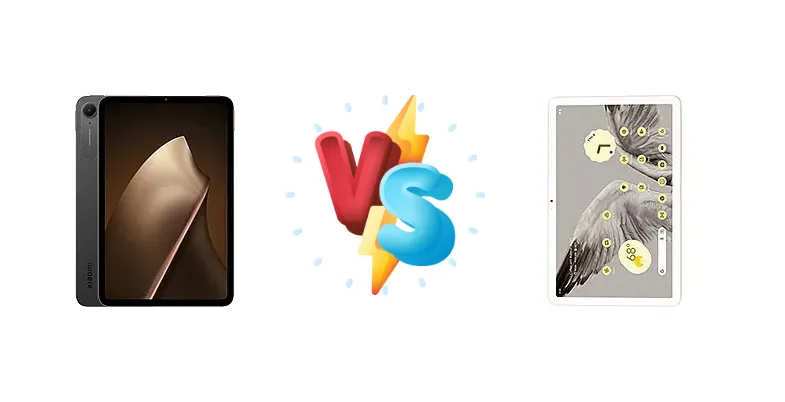
The Android tablet market is heating up, with the Xiaomi Pad Mini and Google Pixel Tablet offering compelling options at different price points. The Pad Mini aims for aggressive value with its cutting-edge Mediatek Dimensity 9400+ chipset, while the Pixel Tablet focuses on a seamless Google ecosystem experience powered by the Tensor G2. This comparison dissects their strengths and weaknesses to determine which tablet reigns supreme.
🏆 Quick Verdict
For most users, the Xiaomi Pad Mini emerges as the stronger choice. Its significantly faster charging (67W vs 15W) and more powerful CPU, based on the Dimensity 9400+’s architecture, deliver a superior user experience, especially for demanding tasks and gaming. The Pixel Tablet’s integration with the Google ecosystem is a plus, but doesn’t outweigh the Pad Mini’s raw performance and value.
| Network |
|---|
| 2G bands | N/A | N/A |
| 3G bands | N/A | N/A |
| 4G bands | - | N/A |
| EDGE | N/A | No |
| GPRS | N/A | No |
| Technology | No cellular connectivity | No cellular connectivity |
| Launch |
|---|
| Announced | 2025, September 24 | 2023, May 10 |
| Status | Available. Released 2025, September 24 | Available. Released 2023, June 20 |
| Body |
|---|
| Build | - | Glass front, aluminum frame, aluminum back |
| Dimensions | 205.1 x 132 x 6.5 mm (8.07 x 5.20 x 0.26 in) | 258 x 169 x 8.1 mm (10.16 x 6.65 x 0.32 in) |
| SIM | No | No |
| Weight | 326 g (11.50 oz) | 493 g (1.09 lb) |
| | - | Stylus support |
| Display |
|---|
| Resolution | 1880 x 3008 pixels, 16:10 ratio (~403 ppi density) | 1600 x 2560 pixels, 16:10 ratio (~276 ppi density) |
| Size | 8.8 inches, 224.5 cm2 (~82.9% screen-to-body ratio) | 10.95 inches, 347.7 cm2 (~79.7% screen-to-body ratio) |
| Type | IPS LCD, 68B colors, 165Hz, HDR10, Dolby Vision, 700 nits (HBM) | IPS LCD |
| Platform |
|---|
| CPU | Octa-core (1x3.73 GHz Cortex-X925 & 3x3.3 GHz Cortex-X4 & 4x2.4 GHz Cortex-A720) | Octa-core (2x2.85 GHz Cortex-X1 & 2x2.35 GHz Cortex-A78 & 4x1.80 GHz Cortex-A55) |
| Chipset | Mediatek Dimensity 9400+ (3 nm) | Google Tensor G2 (5 nm) |
| GPU | Immortalis-G925 | Mali-G710 MP7 |
| OS | Android 15, HyperOS 2 | Android 13, upgradable to Android 15 |
| Memory |
|---|
| Card slot | No | No |
| Internal | 256GB 8GB RAM, 512GB 12GB RAM | 128GB 8GB RAM, 256GB 8GB RAM |
| | - | UFS 3.1 |
| Main Camera |
|---|
| Features | LED flash, HDR | HDR, panorama |
| Single | 13 MP, f/2.2, (wide), 1/3.06" 1.12μm, PDAF | 8 MP, f/2.0, 24mm (wide), 1/4.0", 1.12µm |
| Video | 4K@30fps, 1080p@30/60fps | 1080p@30fps |
| Selfie camera |
|---|
| Features | HDR | HDR, panorama |
| Single | 8 MP, f/2.3, (wide), 1/4" 1.12μm | 8 MP, f/2.0, 24mm (wide), 1/4.0", 1.12µm |
| Video | 1080p@30fps | 1080p@30fps |
| Sound |
|---|
| 3.5mm jack | - | No |
| 35mm jack | No | No |
| Loudspeaker | Yes, with stereo speakers (with Dolby Atmos) | Yes, with stereo speakers (4 speakers) |
| Comms |
|---|
| Bluetooth | 5.4, A2DP, LE, LHDC 5.0, ASHA | 5.2, A2DP, LE |
| Infrared port | Yes | - |
| NFC | No | No |
| Positioning | No | No |
| Radio | No | No |
| USB | 1x USB Type-C 3.2, 1x USB Type-C 2.0, Display Port 1.4, accessory connector | USB Type-C 3.2 (Gen 1), magnetic connector |
| WLAN | Wi-Fi 802.11 a/b/g/n/ac/6/7, dual-band, Wi-Fi Direct | Wi-Fi 802.11 a/b/g/n/ac/6, dual-band |
| Features |
|---|
| Sensors | Accelerometer, gyro, proximity, compass | Accelerometer, gyro, compass, proximity (accessories only) |
| | - | Ultra Wideband (UWB) support |
| Battery |
|---|
| Charging | 67W wired, PD3.0, QC3+
18W reverse wired
Bypass charging | 15W wired |
| Type | 7500 mAh | Li-Po 7020 mAh (27 Wh) |
| Misc |
|---|
| Colors | Gray, Purple | Porcelain, Hazel, Rose |
| Models | 25079RPDCG | GA06156-EU, GA06157-EU, GA06158-EU |
| Price | About 370 EUR | About 670 EUR |
Xiaomi Pad Mini
- Significantly faster 67W charging
- More powerful CPU (Dimensity 9400+)
- Potentially better thermal management due to 3nm process
- Display specs are unknown
- Camera quality likely basic
Google Pixel Tablet
- Seamless Google ecosystem integration
- Optimized for Google’s AI features
- Clean Android software experience
- Slower 15W charging
- Less powerful CPU (Tensor G2)
- Potentially more throttling under sustained load
Display Comparison
While display specs are missing for the Xiaomi Pad Mini, the Google Pixel Tablet features a 10.95-inch LCD. The key difference lies under the hood: the Xiaomi Pad Mini leverages a 3nm chipset, potentially allowing for more efficient display driving. The Pixel Tablet’s 15W charging suggests a more conservative power budget, which could impact sustained brightness. The Dimensity 9400+’s processing power could also enable more advanced display features, such as higher refresh rates, if the panel supports it.
Camera Comparison
Camera details are absent for both devices in the provided data. However, given the market positioning, it’s safe to assume neither tablet prioritizes camera quality. Both are likely to feature basic camera setups suitable for video calls and casual snapshots. Without specific sensor information, a meaningful comparison is impossible.
Performance
The Xiaomi Pad Mini’s Mediatek Dimensity 9400+ (3nm) is a clear winner on paper. Its octa-core configuration, featuring a high-clocked Cortex-X925 prime core (3.73 GHz), alongside X4 and A720 cores, promises significantly higher performance than the Google Pixel Tablet’s Tensor G2 (5nm). The Tensor G2, while optimized for AI tasks, utilizes older Cortex-X1 and A78 cores clocked at lower frequencies (2.85 GHz and 2.35 GHz respectively). The 3nm process node of the Dimensity 9400+ also translates to improved thermal efficiency, reducing the likelihood of throttling during extended gaming or demanding applications. The Pixel Tablet’s Tensor G2 excels in machine learning tasks, but the Pad Mini’s CPU architecture is geared towards raw processing power.
Battery Life
The Xiaomi Pad Mini boasts a significant advantage in charging speed with its 67W wired charging, supporting PD3.0 and QC3+, alongside 18W reverse wired charging. This allows for incredibly fast top-ups, minimizing downtime. In contrast, the Google Pixel Tablet is limited to 15W wired charging. While the Pad Mini’s active use battery score is 13:39h, the faster charging mitigates concerns about battery life, allowing users to quickly replenish power. The Pixel Tablet’s slower charging could be a drawback for users who frequently use their tablet on the go.
Buying Guide
Buy the Xiaomi Pad Mini if you prioritize raw performance, fast charging, and value for money. It’s ideal for students, gamers, and anyone who needs a capable tablet without breaking the bank. Buy the Google Pixel Tablet if you are deeply invested in the Google ecosystem, value seamless integration with other Google devices, and prioritize software support over peak performance. It’s a good choice for casual users and those who appreciate a clean Android experience.
Frequently Asked Questions
❓ Does the Mediatek Dimensity 9400+ in the Xiaomi Pad Mini get hot during extended gaming sessions?
The Dimensity 9400+’s 3nm process node is designed for improved thermal efficiency. While any processor will generate heat under load, the 3nm architecture should result in less throttling compared to the 5nm Tensor G2 in the Pixel Tablet, allowing for more sustained performance during gaming.
❓ How long does it take to fully charge the Xiaomi Pad Mini with the 67W charger?
While a precise 0-100% time isn't provided, 67W charging is exceptionally fast. Expect a full charge in under an hour, potentially around 45-60 minutes, significantly faster than the Google Pixel Tablet’s 15W charging.
❓ Is the Google Tensor G2’s AI capabilities useful on a tablet?
The Tensor G2 excels at AI tasks like voice recognition and image processing. On the Pixel Tablet, this translates to features like improved voice assistant responsiveness and potentially enhanced photo editing capabilities, though the tablet form factor doesn't necessarily maximize these benefits compared to a phone.
❓ Will the Xiaomi Pad Mini receive regular software updates?
Xiaomi’s software update track record is improving, but generally lags behind Google’s Pixel devices. While the Pad Mini will likely receive Android version updates, the frequency and duration of security patches may be less consistent than on the Pixel Tablet.