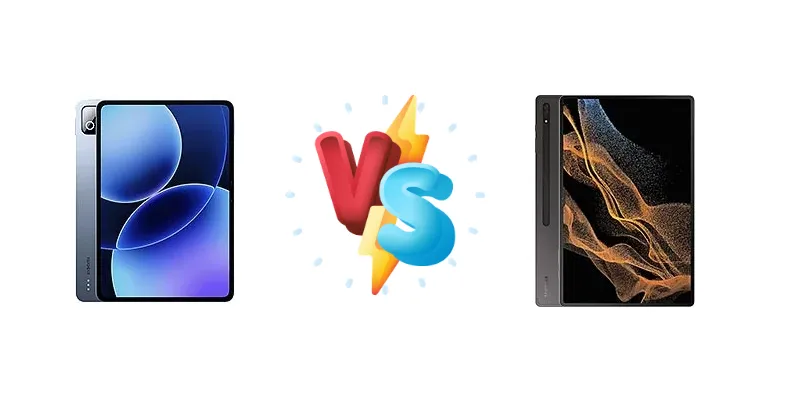
The Android tablet market is heating up, with Xiaomi aggressively challenging Samsung's dominance. We're comparing the recently released Xiaomi Pad 8, powered by the Snapdragon 8s Gen 4, against the established flagship, the Samsung Galaxy Tab S8 Ultra, featuring the Snapdragon 8 Gen 1. This isn't just a spec sheet comparison; it's a look at how these chips translate to real-world performance and value.
🏆 Quick Verdict
For the average user prioritizing a balance of performance and affordability, the Xiaomi Pad 8 emerges as the winner. While the Tab S8 Ultra boasts a more powerful (though older) chipset, the Pad 8’s Snapdragon 8s Gen 4 delivers excellent performance at a significantly lower price point, making it the smarter buy for most.
| Network |
|---|
| 2G bands | N/A | GSM 850 / 900 / 1800 / 1900 |
| 3G bands | N/A | HSDPA 850 / 900 / 1700(AWS) / 1900 / 2100 |
| 4G bands | - | LTE |
| 5G bands | - | SA/NSA |
| EDGE | N/A | - |
| GPRS | N/A | - |
| Speed | - | HSPA, LTE, 5G - cellular model only |
| Technology | No cellular connectivity | GSM / HSPA / LTE / 5G |
| Launch |
|---|
| Announced | 2025, September 25 | 2022, February 09 |
| Status | Available. Released 2025, September 25 | Available. Released 2022, April 30 |
| Body |
|---|
| Build | Glass front, aluminum frame, aluminum back | - |
| Dimensions | 251.2 x 173.4 x 5.8 mm (9.89 x 6.83 x 0.23 in) | 326.4 x 208.6 x 5.5 mm (12.85 x 8.21 x 0.22 in) |
| SIM | No | Nano-SIM (cellular model only) |
| Weight | 485 g or 494 g (1.07 lb) | 726 g (Wi-Fi), 728 g (5G) (1.60 lb) |
| | - | Stylus, 2.8ms latency (Bluetooth integration, accelerometer, gyro) |
| Display |
|---|
| Protection | - | Corning Gorilla Glass 5 |
| Resolution | 2136 x 3200 pixels, 3:2 ratio (~344 ppi density) | 1848 x 2960 pixels, 16:10 ratio (~240 ppi density) |
| Size | 11.2 inches, 373.7 cm2 (~85.8% screen-to-body ratio) | 14.6 inches, 612.6 cm2 (~90.0% screen-to-body ratio) |
| Type | IPS LCD, 68B colors, 144Hz, HDR10, Dolby Vision, HDR Vivid, 800 nits (peak) | Super AMOLED, 120Hz, HDR10+ |
| Platform |
|---|
| CPU | Octa-core (1x3.21 GHz Cortex-X4 & 3x3.0 GHz Cortex-A720 & 2x2.8 GHz Cortex-A720 & 2x2.0 GHz Cortex-A720) | Octa-core (1x3.00 GHz Cortex-X2 & 3x2.50 GHz Cortex-A710 & 4x1.80 GHz Cortex-A510) |
| Chipset | Qualcomm SM8735 Snapdragon 8s Gen 4 (4 nm) | Qualcomm SM8450 Snapdragon 8 Gen 1 (4 nm) |
| GPU | Adreno 825 | Adreno 730 |
| OS | Android 16, HyperOS 3 | Android 12, up to 4 major Android upgrades, One UI 6.1.1 |
| Memory |
|---|
| Card slot | No | microSDXC (dedicated slot) |
| Internal | 128GB 8GB RAM, 256GB 8GB RAM, 256GB 12GB RAM | 128GB 8GB RAM, 256GB 8GB RAM, 256GB 12GB RAM, 256GB 16GB RAM, 512GB 12GB RAM, 512GB 16GB RAM |
| | - | UFS |
| Main Camera |
|---|
| Dual | - | 13 MP, f/2.0, 26mm (wide), 1/3.4", 1.0µm, AF
6 MP, f/2.2, (ultrawide) |
| Features | LED flash, HDR | LED flash, HDR, panorama |
| Single | 13 MP, f/2.2, (wide), 1/3.06", 1.12µm, PDAF | - |
| Video | 4K@30fps, 1080p@30/60fps | 4K@30/60fps, 1080p@30fps |
| Selfie camera |
|---|
| Dual | - | 12 MP, f/2.2, 26mm (wide)
12 MP, f/2.4, 120˚ (ultrawide) |
| Features | HDR | HDR |
| Single | 8 MP, f/2.3, (wide), 1/4.0", 1.12µm | - |
| Video | 1080p@30fps | 4K@30/60fps, 1080p@30fps |
| Sound |
|---|
| 3.5mm jack | - | No |
| 35mm jack | No | No |
| Loudspeaker | Yes, with stereo speakers, Dolby Atmos (4 speakers) | Yes, with stereo speakers (4 speakers) |
| | - | Tuned by AKG |
| Comms |
|---|
| Bluetooth | 5.4, LHDC 5 | 5.2, A2DP, LE |
| Infrared port | Yes | - |
| NFC | No | No |
| Positioning | No | GPS, GLONASS, BDS, GALILEO - cellular model only |
| Radio | No | No |
| USB | USB Type-C 3.2, accessory connector | USB Type-C 3.2, magnetic connector |
| WLAN | Wi-Fi 802.11 a/b/g/n/ac/6/7, dual-band, Wi-Fi Direct | Wi-Fi 802.11 a/b/g/n/ac/6e, dual-band, Wi-Fi Direct |
| Features |
|---|
| Sensors | Accelerometer, gyro, proximity, compass | Fingerprint (under display, optical), accelerometer, gyro, proximity, compass |
| | - | Wireless Samsung DeX |
| Battery |
|---|
| Charging | 45W wired, PD3.0, QC3+
22.5 reverse wireless charging | 45W wired, 100% in 82 min |
| Type | 9200 mAh | Li-Po 11200 mAh |
| Misc |
|---|
| Colors | Black, Blue, Green | Graphite |
| Models | - | SM-X900, SM-X906, SM-X906B, SM-X906U, SM-X906N |
| Price | About 260 EUR | About 1150 EUR |
| SAR EU | 0.99 W/kg (body) | 0.69 W/kg (body) |
Xiaomi Pad 8
- More modern CPU architecture (Cortex-X4)
- Potentially better battery life due to efficient chipset
- Reverse wireless charging capability
- Likely less powerful GPU than the Tab S8 Ultra
- Display specs currently unknown
Samsung Galaxy Tab S8 Ultra
- Larger, high-quality Super AMOLED display
- More established brand reputation
- Potentially higher peak GPU performance
- Older generation chipset (Snapdragon 8 Gen 1)
- Higher price point
- Faster battery drain due to larger display and processor
Display Comparison
While display specs aren't provided for the Xiaomi Pad 8, Samsung’s Galaxy Tab S8 Ultra features a massive 14.6-inch Super AMOLED display. Both tablets support 45W charging, but the Tab S8 Ultra’s larger display demands more power. The Snapdragon 8 Gen 1 in the Tab S8 Ultra will need to drive significantly more pixels, potentially impacting battery life. The Xiaomi Pad 8, likely with a smaller, high-resolution LCD, will benefit from the Snapdragon 8s Gen 4’s efficiency.
Camera Comparison
Camera details are absent for the Xiaomi Pad 8. The Samsung Galaxy Tab S8 Ultra features a 13MP main camera and a 12MP ultrawide, but tablet cameras are rarely a primary purchasing factor. Image quality will likely be comparable, with Samsung’s image processing offering a more polished look. Neither tablet is designed for serious photography.
Performance
The core difference lies in the chipsets. The Samsung Galaxy Tab S8 Ultra’s Snapdragon 8 Gen 1 (1x3.00 GHz Cortex-X2, 3x2.50 GHz Cortex-A710, 4x1.80 GHz Cortex-A510) was a flagship processor, but is now a generation behind. The Xiaomi Pad 8’s Snapdragon 8s Gen 4 (1x3.21 GHz Cortex-X4, 3x3.0 GHz Cortex-A720, 2x2.8 GHz Cortex-A720, 2x2.0 GHz Cortex-A720) utilizes newer CPU core designs – specifically the Cortex-X4 – which offer improved single-core performance and efficiency. While the Gen 1 has a slight edge in raw GPU power, the 8s Gen 4’s architecture is more modern, potentially leading to better sustained performance and thermal management. Both utilize a 4nm process, but the architectural improvements in the 8s Gen 4 are significant.
Battery Life
Battery capacity isn't specified for either device. However, the Samsung Galaxy Tab S8 Ultra’s larger display and more powerful processor will likely result in faster battery drain. Both support 45W wired charging, with Samsung claiming a 100% charge in 82 minutes. The Xiaomi Pad 8’s more efficient Snapdragon 8s Gen 4 and potentially smaller display could translate to longer battery life, even with a similar capacity. The Pad 8 also offers 22.5W reverse wireless charging, a feature absent on the Tab S8 Ultra.
Buying Guide
Buy the Xiaomi Pad 8 if you need a powerful tablet for everyday tasks, media consumption, and light gaming, all without breaking the bank. It’s ideal for students, casual users, and those seeking a versatile device. Buy the Samsung Galaxy Tab S8 Ultra if you demand the absolute best performance for demanding tasks like video editing, professional creative work, or intensive gaming, and are willing to pay a premium for a larger screen and more refined features.
Frequently Asked Questions
❓ Does the Snapdragon 8s Gen 4 in the Xiaomi Pad 8 throttle under sustained load, like during extended gaming sessions?
The Snapdragon 8s Gen 4's newer architecture and 4nm process are designed for improved thermal efficiency. While throttling is always possible, the 8s Gen 4 is expected to handle sustained loads better than the Snapdragon 8 Gen 1 in the Tab S8 Ultra, which was known to get warm under pressure. The Xiaomi Pad 8’s potentially smaller display also contributes to lower heat generation.
❓ Is the difference in GPU performance between the Snapdragon 8 Gen 1 and 8s Gen 4 noticeable in demanding games?
While the Snapdragon 8 Gen 1 has a theoretical GPU advantage, the 8s Gen 4’s architectural improvements and potentially better thermal management could lead to more consistent frame rates over longer gaming sessions. The difference will likely be most noticeable in graphically intensive titles at maximum settings.
❓ How does the 45W charging speed translate to real-world usage on both tablets?
Samsung claims 100% charge in 82 minutes for the Tab S8 Ultra. The Xiaomi Pad 8 should achieve a similar charge time, potentially slightly faster due to its potentially smaller battery. Both tablets support PD3.0 and QC3+, ensuring compatibility with a wide range of chargers.