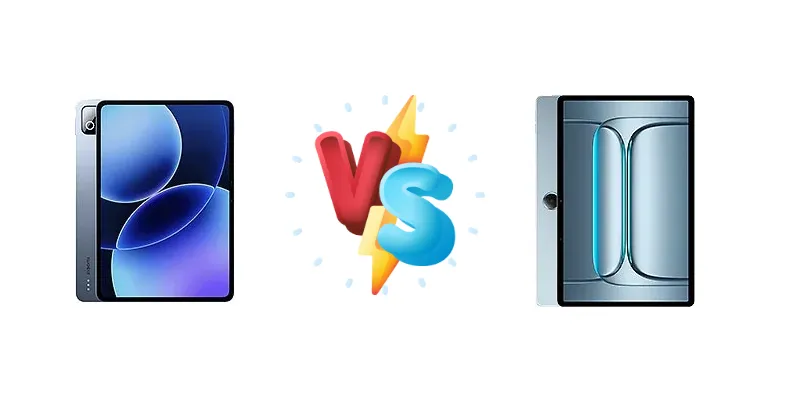
The Android tablet market is heating up, with Xiaomi and OnePlus offering compelling options at competitive price points. The Xiaomi Pad 8, powered by the Snapdragon 8s Gen 4, aims for near-flagship performance. Meanwhile, the OnePlus Pad Lite leverages the MediaTek Helio G100 to deliver a solid experience at a more accessible price. This comparison dissects the key differences to help you choose the right tablet for your needs.
🏆 Quick Verdict
For users prioritizing performance and future-proofing, the Xiaomi Pad 8 is the clear winner. Its Snapdragon 8s Gen 4 chipset offers a significant leap in processing power and efficiency. However, the OnePlus Pad Lite provides excellent value for those seeking a capable tablet for everyday tasks and media consumption.
| Network |
|---|
| 2G bands | N/A | GSM 850 / 900 / 1800 / 1900 - cellular model only |
| 3G bands | N/A | HSDPA 850 / 900 / 2100 - cellular model only |
| 4G bands | - | LTE - cellular model only |
| EDGE | N/A | - |
| GPRS | N/A | - |
| Speed | - | HSPA, LTE - cellular model only |
| Technology | No cellular connectivity | GSM / HSPA / LTE |
| Launch |
|---|
| Announced | 2025, September 25 | 2025, July 08 |
| Status | Available. Released 2025, September 25 | Available. Released 2025, August 14 |
| Body |
|---|
| Build | Glass front, aluminum frame, aluminum back | - |
| Dimensions | 251.2 x 173.4 x 5.8 mm (9.89 x 6.83 x 0.23 in) | 254.9 x 166.5 x 7.4 mm (10.04 x 6.56 x 0.29 in) |
| SIM | No | Yes - cellular model only |
| Weight | 485 g or 494 g (1.07 lb) | 530 g (1.17 lb) |
| Display |
|---|
| Resolution | 2136 x 3200 pixels, 3:2 ratio (~344 ppi density) | 1200 x 1920 pixels, 16:10 ratio (~207 ppi density) |
| Size | 11.2 inches, 373.7 cm2 (~85.8% screen-to-body ratio) | 11.0 inches, 347.5 cm2 (~81.9% screen-to-body ratio) |
| Type | IPS LCD, 68B colors, 144Hz, HDR10, Dolby Vision, HDR Vivid, 800 nits (peak) | IPS LCD, 1B colors, 90Hz, 500 nits |
| Platform |
|---|
| CPU | Octa-core (1x3.21 GHz Cortex-X4 & 3x3.0 GHz Cortex-A720 & 2x2.8 GHz Cortex-A720 & 2x2.0 GHz Cortex-A720) | Octa-core (2x2.2 GHz Cortex-A76 & 6x2.0 GHz Cortex-A55) |
| Chipset | Qualcomm SM8735 Snapdragon 8s Gen 4 (4 nm) | Mediatek Helio G100 (6 nm) |
| GPU | Adreno 825 | Mali-G57 MC2 |
| OS | Android 16, HyperOS 3 | Android 15, OxygenOS 15 |
| Memory |
|---|
| Card slot | No | Unspecified |
| Internal | 128GB 8GB RAM, 256GB 8GB RAM, 256GB 12GB RAM | 128GB 6GB RAM, 128GB 8GB RAM |
| Main Camera |
|---|
| Features | LED flash, HDR | - |
| Single | 13 MP, f/2.2, (wide), 1/3.06", 1.12µm, PDAF | 5 MP |
| Video | 4K@30fps, 1080p@30/60fps | 1080p@30fps |
| Selfie camera |
|---|
| Features | HDR | - |
| Single | 8 MP, f/2.3, (wide), 1/4.0", 1.12µm | 5 MP |
| Video | 1080p@30fps | 1080p@30fps |
| Sound |
|---|
| 35mm jack | No | No |
| Loudspeaker | Yes, with stereo speakers, Dolby Atmos (4 speakers) | Yes, with stereo speakers (4 speakers, Hi-Res audio) |
| Comms |
|---|
| Bluetooth | 5.4, LHDC 5 | 5.2, A2DP, LE, aptX HD |
| Infrared port | Yes | - |
| NFC | No | No |
| Positioning | No | GPS, (cellular model only) - unconfirmed |
| Radio | No | No |
| USB | USB Type-C 3.2, accessory connector | USB Type-C 2.0 |
| WLAN | Wi-Fi 802.11 a/b/g/n/ac/6/7, dual-band, Wi-Fi Direct | Wi-Fi 802.11 a/b/g/n/ac, dual-band |
| Features |
|---|
| Sensors | Accelerometer, gyro, proximity, compass | Unspecified |
| Battery |
|---|
| Charging | 45W wired, PD3.0, QC3+
22.5 reverse wireless charging | 33W wired |
| Type | 9200 mAh | Li-Po 9340 mAh |
| Misc |
|---|
| Colors | Black, Blue, Green | Aero Blue |
| Models | - | OPD2480 |
| Price | About 260 EUR | About 200 EUR |
| SAR EU | 0.99 W/kg (body) | - |
Xiaomi Pad 8
- Significantly more powerful Snapdragon 8s Gen 4 chipset
- Faster 45W charging with PD3.0/QC3+ support
- 22.5W reverse wireless charging capability
- Likely higher price point
- Battery capacity currently unknown
OnePlus Pad Lite
- More affordable price
- Decent performance for everyday tasks
- Potentially longer battery life (depending on capacity)
- Less powerful MediaTek Helio G100 chipset
- Slower 33W charging
- No reverse wireless charging
Display Comparison
Both tablets are expected to feature LCD panels, a common choice in this price bracket. However, detailed display specs (resolution, refresh rate, peak brightness) are currently unavailable for either device. The absence of LTPO technology suggests neither will offer adaptive refresh rates for power saving. Bezels will likely be a differentiating factor, with a closer inspection needed to determine which offers a more immersive viewing experience. Color accuracy is also unknown, but both brands typically aim for acceptable sRGB coverage.
Camera Comparison
Given the tablet form factor, camera performance isn't a primary concern for most users. However, details on camera sensors are currently limited. It's reasonable to expect both tablets to feature a single main camera and potentially a front-facing camera for video calls. Without specific sensor size or aperture information, it’s difficult to assess image quality. The focus should be on video call clarity rather than photographic prowess.
Performance
The core difference lies in the chipsets. The Xiaomi Pad 8’s Qualcomm Snapdragon 8s Gen 4 (4nm) is a significant upgrade over the OnePlus Pad Lite’s MediaTek Helio G100 (6nm). The Snapdragon 8s Gen 4 boasts a more advanced CPU configuration – an octa-core setup with a Cortex-X4 prime core clocked at 3.21 GHz, alongside A720 cores – compared to the Helio G100’s Cortex-A76 and A55 cores. This translates to substantially faster processing speeds and improved multitasking capabilities. The 4nm process node of the Snapdragon also contributes to better thermal efficiency, potentially reducing throttling during sustained workloads. While the Helio G100 is a capable chip for everyday tasks, it won’t match the Snapdragon’s performance in demanding games or applications.
Battery Life
Battery capacity details are currently unavailable for either tablet. However, the charging speeds offer a clear distinction. The Xiaomi Pad 8 supports 45W wired charging with PD3.0 and QC3+ standards, alongside 22.5W reverse wireless charging. This allows for significantly faster charging times compared to the OnePlus Pad Lite’s 33W wired charging. While a larger battery capacity on the OnePlus Pad Lite could offset the slower charging, the Xiaomi Pad 8’s faster charging and reverse wireless charging capabilities provide greater convenience and flexibility.
Buying Guide
Buy the Xiaomi Pad 8 if you need a tablet for demanding tasks like gaming, video editing, or multitasking. The Snapdragon 8s Gen 4 provides the headroom for these workloads. Buy the OnePlus Pad Lite if you prioritize affordability and a streamlined experience for media consumption, web browsing, and light productivity. It’s an ideal choice for students or casual users.
Frequently Asked Questions
❓ Will the Snapdragon 8s Gen 4 in the Xiaomi Pad 8 handle demanding games like Genshin Impact at high settings?
Yes, the Snapdragon 8s Gen 4 is a powerful chipset capable of running demanding games like Genshin Impact at high settings. Its advanced CPU and GPU architecture, combined with the 4nm process, provide the necessary performance and thermal headroom for a smooth gaming experience. However, sustained performance will depend on the tablet's cooling solution.
❓ Is the MediaTek Helio G100 in the OnePlus Pad Lite sufficient for streaming video and browsing the web?
Absolutely. The MediaTek Helio G100 is more than capable of handling everyday tasks like streaming video (Netflix, YouTube) and web browsing. It provides a smooth and responsive experience for these common use cases. However, it may struggle with more demanding applications or multitasking.
❓ Does the Xiaomi Pad 8 support expandable storage via microSD card?
This information is currently unavailable. Xiaomi often omits microSD card slots on their tablets, so it's unlikely the Pad 8 will include one. Consider the internal storage options carefully before purchasing.
❓ What kind of display technology is used in the OnePlus Pad Lite, and what is its expected color accuracy?
The OnePlus Pad Lite is expected to feature an LCD panel, but detailed specifications like resolution, refresh rate, and color accuracy are currently unknown. Based on the price point, it's reasonable to expect acceptable sRGB coverage, but professional color work may require a different device.