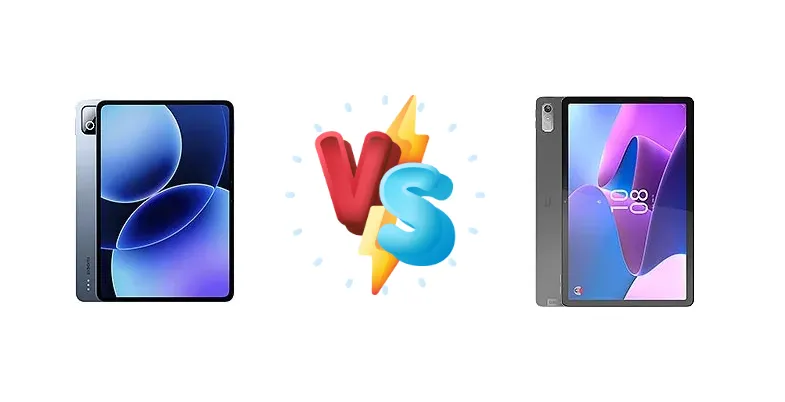
The Android tablet market is heating up, with Xiaomi and Lenovo offering compelling options at competitive price points. The Xiaomi Pad 8, powered by the latest Snapdragon 8s Gen 4, aims for near-flagship performance. Meanwhile, the Lenovo Tab P11 Pro Gen 2 leverages the Mediatek Kompanio 1300T, focusing on a balance of features and affordability. This comparison dissects the key differences to determine which tablet best suits your needs.
🏆 Quick Verdict
For users prioritizing performance and future-proofing, the Xiaomi Pad 8 is the clear winner. Its Snapdragon 8s Gen 4 chipset delivers a substantial performance advantage over the Lenovo Tab P11 Pro Gen 2’s Kompanio 1300T. While the Lenovo offers a more mature software experience and slightly faster charging, the Xiaomi’s raw power makes it the better choice for demanding tasks.
| Network |
|---|
| 2G bands | N/A | GSM 850 / 900 / 1800 / 1900 |
| 3G bands | N/A | HSDPA 850 / 900 / 1900 / 2100 |
| 4G bands | - | LTE |
| EDGE | N/A | - |
| GPRS | N/A | - |
| Speed | - | HSPA, LTE - cellular model only |
| Technology | No cellular connectivity | GSM / HSPA / LTE |
| Launch |
|---|
| Announced | 2025, September 25 | 2022, September 01 |
| Status | Available. Released 2025, September 25 | Available. Released 2022, September 01 |
| Body |
|---|
| Build | Glass front, aluminum frame, aluminum back | Glass front, plastic back, plastic frame |
| Dimensions | 251.2 x 173.4 x 5.8 mm (9.89 x 6.83 x 0.23 in) | 263.7 x 166.7 x 6.8 mm (10.38 x 6.56 x 0.27 in) |
| SIM | No | Nano-SIM (cellular model only) |
| Weight | 485 g or 494 g (1.07 lb) | 480 g (1.06 lb) |
| | - | Stylus support (magnetic) |
| Display |
|---|
| Resolution | 2136 x 3200 pixels, 3:2 ratio (~344 ppi density) | 1536 x 2560 pixels, 5:3 ratio (~267 ppi density) |
| Size | 11.2 inches, 373.7 cm2 (~85.8% screen-to-body ratio) | 11.2 inches, 357.0 cm2 (~81.2% screen-to-body ratio) |
| Type | IPS LCD, 68B colors, 144Hz, HDR10, Dolby Vision, HDR Vivid, 800 nits (peak) | OLED, HDR10+, Dolby Vision, 120Hz, 420 nits (typ), 600 nits (peak) |
| Platform |
|---|
| CPU | Octa-core (1x3.21 GHz Cortex-X4 & 3x3.0 GHz Cortex-A720 & 2x2.8 GHz Cortex-A720 & 2x2.0 GHz Cortex-A720) | Octa-core (4x2.6 GHz Cortex-A78 & 4x2.0 GHz Cortex-A55) |
| Chipset | Qualcomm SM8735 Snapdragon 8s Gen 4 (4 nm) | Mediatek MT8797 Kompanio 1300T (6 nm) |
| GPU | Adreno 825 | Mali-G77 MC9 |
| OS | Android 16, HyperOS 3 | Android 12, upgradable to Android 13 |
| Memory |
|---|
| Card slot | No | microSDXC (dedicated slot) |
| Internal | 128GB 8GB RAM, 256GB 8GB RAM, 256GB 12GB RAM | 128GB 4GB RAM, 128GB 6GB RAM, 256GB 8GB RAM |
| | - | UFS 3.1 |
| Main Camera |
|---|
| Features | LED flash, HDR | LED flash |
| Single | 13 MP, f/2.2, (wide), 1/3.06", 1.12µm, PDAF | 13 MP, f/2.4, (wide), AF |
| Video | 4K@30fps, 1080p@30/60fps | 1080p@30fps |
| Selfie camera |
|---|
| Features | HDR | - |
| Single | 8 MP, f/2.3, (wide), 1/4.0", 1.12µm | 8 MP |
| Video | 1080p@30fps | 1080p@30fps |
| Sound |
|---|
| 3.5mm jack | - | No |
| 35mm jack | No | No |
| Loudspeaker | Yes, with stereo speakers, Dolby Atmos (4 speakers) | Yes, with stereo speakers (4 speakers) |
| | - | Tuned by JBL |
| Comms |
|---|
| Bluetooth | 5.4, LHDC 5 | 5.1, A2DP, LE |
| Infrared port | Yes | - |
| NFC | No | No |
| Positioning | No | GPS, GLONASS - cellular model only |
| Radio | No | No |
| USB | USB Type-C 3.2, accessory connector | USB Type-C 3.0, OTG, magnetic connector, video output |
| WLAN | Wi-Fi 802.11 a/b/g/n/ac/6/7, dual-band, Wi-Fi Direct | Wi-Fi 802.11 a/b/g/n/ac/6, dual-band, Wi-Fi Direct |
| Features |
|---|
| Sensors | Accelerometer, gyro, proximity, compass | Accelerometer, gyro, proximity, compass |
| Battery |
|---|
| Charging | 45W wired, PD3.0, QC3+
22.5 reverse wireless charging | 20W wired, QC3 |
| Type | 9200 mAh | Li-Po 8200 mAh |
| Misc |
|---|
| Colors | Black, Blue, Green | Storm Grey, Oat |
| Models | - | ZAB50194GB, ZAB50043SE |
| Price | About 260 EUR | About 500 EUR |
| SAR EU | 0.99 W/kg (body) | - |
| Tests |
|---|
| Performance | - |
AnTuTu: 616573 (v9)
GeekBench: 2827 (v5.1) |
Xiaomi Pad 8
- Significantly faster processor with Snapdragon 8s Gen 4
- Faster 45W charging with PD3.0/QC3+
- 22.5W reverse wireless charging
- Software experience may be less refined than Lenovo
- Potential for higher price
Lenovo Tab P11 Pro Gen 2
- Potentially more affordable price point
- Mature software experience
- Decent performance for everyday tasks
- Slower processor compared to Snapdragon 8s Gen 4
- Slower 20W charging
- No reverse wireless charging
Display Comparison
While both tablets likely feature LCD panels (spec not provided), the core difference lies in the processing power driving them. Display quality details like resolution and refresh rate are missing, but the chipset’s ability to smoothly render graphics is crucial for a good visual experience. The Xiaomi Pad 8’s Snapdragon 8s Gen 4 will ensure a fluid experience even with complex animations, while the Lenovo’s Kompanio 1300T may exhibit occasional stuttering in graphically intensive applications.
Camera Comparison
Camera specifications are not provided for either device, making a direct comparison difficult. However, given the tablet market segment, it’s safe to assume both will feature modest camera setups primarily intended for video calls and casual snapshots. Image processing capabilities will largely depend on the ISP integrated within each chipset; the Snapdragon 8s Gen 4 likely has a more advanced ISP, potentially resulting in better image quality in challenging lighting conditions.
Performance
The Xiaomi Pad 8’s Qualcomm SM8735 Snapdragon 8s Gen 4 (4nm) is a significant leap ahead of the Lenovo Tab P11 Pro Gen 2’s Mediatek MT8797 Kompanio 1300T (6nm). The Snapdragon 8s Gen 4’s Cortex-X4 prime core, clocked at 3.21 GHz, provides a substantial performance boost over the Lenovo’s Cortex-A78 cores at 2.6 GHz. The 4nm process node of the Snapdragon also translates to improved thermal efficiency, reducing the likelihood of performance throttling during sustained workloads. The Xiaomi’s CPU configuration (1+3+2+2) is also more modern and efficient than the Lenovo’s 4+4 setup. This difference will be most noticeable in gaming and demanding applications.
Battery Life
The Xiaomi Pad 8’s 45W wired charging with PD3.0 and QC3+ support offers a significant advantage over the Lenovo Tab P11 Pro Gen 2’s 20W charging. While battery capacity isn’t specified, the faster charging speed of the Xiaomi will result in significantly quicker top-ups. The Xiaomi also includes 22.5W reverse wireless charging, a feature absent on the Lenovo, allowing it to charge other devices wirelessly. The 6nm process of the Kompanio 1300T *may* offer slightly better battery life under light loads, but the Snapdragon 8s Gen 4’s efficiency gains will likely close the gap during more intensive use.
Buying Guide
Buy the Xiaomi Pad 8 if you need a tablet capable of handling demanding games, video editing, or multitasking without slowdowns. Its superior chipset and faster processing speeds will provide a smoother, more responsive experience. Buy the Lenovo Tab P11 Pro Gen 2 if you prioritize a more refined software experience, a potentially lower price point, and are less concerned with pushing the tablet to its absolute performance limits. It’s a solid all-rounder for everyday tasks.
Frequently Asked Questions
❓ Will the Snapdragon 8s Gen 4 in the Xiaomi Pad 8 overheat during extended gaming sessions?
The Snapdragon 8s Gen 4’s 4nm process node and optimized thermal design should mitigate overheating. While some throttling is possible during prolonged, intense gaming, it’s likely to be less severe than with older, less efficient chipsets. The Xiaomi Pad 8 is expected to maintain higher sustained performance levels than the Lenovo Tab P11 Pro Gen 2.
❓ Is the Mediatek Kompanio 1300T in the Lenovo Tab P11 Pro Gen 2 sufficient for multitasking and productivity?
The Kompanio 1300T is capable of handling everyday multitasking and productivity tasks like web browsing, email, and document editing. However, it may struggle with more demanding workloads such as video editing or running multiple resource-intensive applications simultaneously. Users prioritizing smooth performance in these scenarios should opt for the Xiaomi Pad 8.
❓ Does the Xiaomi Pad 8 support external displays or accessories?
While not explicitly stated, Xiaomi tablets generally support USB-C display output and Bluetooth accessories like keyboards and styluses. Check official specifications for confirmed compatibility with specific accessories.