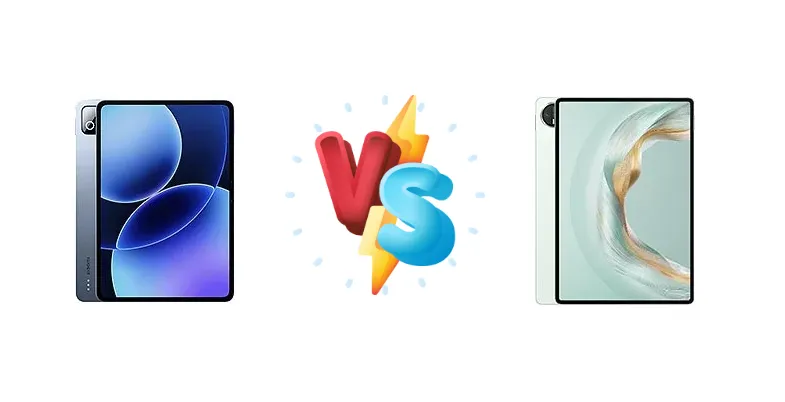
The tablet market is heating up, with Xiaomi and Huawei offering compelling options at different price points and with distinct philosophies. The Xiaomi Pad 8 arrives with the latest Snapdragon 8s Gen 4, aiming for top-tier performance, while the Huawei MatePad Pro 12.2 (2025) focuses on maximizing battery life and offering a larger, immersive display. This comparison dissects these two tablets to determine which best suits your needs.
🏆 Quick Verdict
For users prioritizing raw processing power and gaming performance, the Xiaomi Pad 8 is the clear winner thanks to its Snapdragon 8s Gen 4. However, the Huawei MatePad Pro 12.2 (2025) takes the crown for battery endurance, boasting an 11:24 hour active use score and significantly faster 100W charging, making it ideal for extended productivity or media consumption.
| Network |
|---|
| 2G bands | N/A | N/A |
| 3G bands | N/A | N/A |
| 4G bands | - | N/A |
| EDGE | N/A | No |
| GPRS | N/A | No |
| Technology | No cellular connectivity | No cellular connectivity |
| Launch |
|---|
| Announced | 2025, September 25 | 2025, May 15 |
| Status | Available. Released 2025, September 25 | Available. Released 2025, May 15 |
| Body |
|---|
| Build | Glass front, aluminum frame, aluminum back | - |
| Dimensions | 251.2 x 173.4 x 5.8 mm (9.89 x 6.83 x 0.23 in) | 271.3 x 182.5 x 5.5 mm (10.68 x 7.19 x 0.22 in) |
| SIM | No | No |
| Weight | 485 g or 494 g (1.07 lb) | 508 g (1.12 lb) |
| Display |
|---|
| Resolution | 2136 x 3200 pixels, 3:2 ratio (~344 ppi density) | 2800 x 1840 pixels, 3:2 ratio (~275 ppi density) |
| Size | 11.2 inches, 373.7 cm2 (~85.8% screen-to-body ratio) | 12.2 inches, 440.7 cm2 (~89.0% screen-to-body ratio) |
| Type | IPS LCD, 68B colors, 144Hz, HDR10, Dolby Vision, HDR Vivid, 800 nits (peak) | Double-layer OLED, 1B colors, 144Hz, 2000 nits (peak), HDR Vivid |
| Platform |
|---|
| CPU | Octa-core (1x3.21 GHz Cortex-X4 & 3x3.0 GHz Cortex-A720 & 2x2.8 GHz Cortex-A720 & 2x2.0 GHz Cortex-A720) | Octa-core (1x2.4 GHz & 3x2.00 GHz & 4x1.6GHz) |
| Chipset | Qualcomm SM8735 Snapdragon 8s Gen 4 (4 nm) | Kirin T92A (7 nm) |
| GPU | Adreno 825 | Maleoon 920 |
| OS | Android 16, HyperOS 3 | HarmonyOS 4.3 |
| Memory |
|---|
| Card slot | No | No |
| Internal | 128GB 8GB RAM, 256GB 8GB RAM, 256GB 12GB RAM | 256GB 12GB RAM, 512GB 12GB RAM, 1TB 16GB RAM |
| Main Camera |
|---|
| Dual | - | 50 MP, f/1.8, (wide), PDAF
8 MP, f/2.2, (ultrawide) |
| Features | LED flash, HDR | LED flash, HDR, panorama |
| Single | 13 MP, f/2.2, (wide), 1/3.06", 1.12µm, PDAF | - |
| Video | 4K@30fps, 1080p@30/60fps | 4K@30fps, 1080p@30fps |
| Selfie camera |
|---|
| Features | HDR | - |
| Single | 8 MP, f/2.3, (wide), 1/4.0", 1.12µm | 8 MP, f/2.0 |
| Video | 1080p@30fps | 1080p@30fps |
| Sound |
|---|
| 35mm jack | No | No |
| Loudspeaker | Yes, with stereo speakers, Dolby Atmos (4 speakers) | Yes, with stereo speakers (4 speakers) |
| Comms |
|---|
| Bluetooth | 5.4, LHDC 5 | 5.2, A2DP, LE |
| Infrared port | Yes | - |
| NFC | No | No |
| Positioning | No | GPS, GLONASS, BDS, GALILEO, QZSS |
| Radio | No | No |
| USB | USB Type-C 3.2, accessory connector | USB Type-C 3.1, OTG |
| WLAN | Wi-Fi 802.11 a/b/g/n/ac/6/7, dual-band, Wi-Fi Direct | Wi-Fi 802.11 a/b/g/n/ac/6/7, dual-band |
| Features |
|---|
| Sensors | Accelerometer, gyro, proximity, compass | Fingerprint (side-mounted), accelerometer, gyro, proximity (accessories only), compass |
| Battery |
|---|
| Charging | 45W wired, PD3.0, QC3+
22.5 reverse wireless charging | 100W wired, 85% in 40 min, 100% in 55 min
7.5W reverse wired |
| Type | 9200 mAh | Li-Po 10100 mAh |
| Misc |
|---|
| Colors | Black, Blue, Green | Black, Green |
| Models | - | MRDI-W09 |
| Price | About 260 EUR | About 850 EUR |
| SAR EU | 0.99 W/kg (body) | - |
Xiaomi Pad 8
- Superior processing power with Snapdragon 8s Gen 4
- More efficient 4nm manufacturing process
- Faster CPU clock speeds for demanding tasks
- Likely shorter battery life compared to Huawei
- Slower charging speeds (45W vs 100W)
Huawei MatePad Pro 12.2 (2025)
- Exceptional battery life (11:24h active use)
- Ultra-fast 100W charging
- Larger 12.2-inch display for immersive viewing
- Less powerful Kirin T92A chipset
- 7nm manufacturing process less efficient than 4nm
Display Comparison
The Huawei MatePad Pro 12.2 (2025) boasts a substantial advantage in display size, offering a 12.2-inch canvas compared to the Xiaomi Pad 8’s smaller form factor. More importantly, the Huawei panel achieves a measured peak brightness of 1045 nits, ensuring excellent visibility even in bright outdoor conditions. While the Xiaomi Pad 8’s display specs are currently unknown, the larger size and higher brightness of the Huawei panel make it superior for media consumption and creative work. The absence of LTPO information for either device means we can't assess adaptive refresh rate capabilities, a growing trend in premium tablets.
Camera Comparison
Given the tablet form factor, camera performance isn't a primary concern. Neither device’s camera specifications are provided, making a direct comparison impossible. However, based on brand trends, we can expect the Xiaomi Pad 8 to lean towards a more vibrant, social-media-ready image processing style, while Huawei typically aims for more natural color reproduction. Without sensor details or sample images, this remains speculative.
Performance
The core difference lies in the chipsets. The Xiaomi Pad 8’s Qualcomm Snapdragon 8s Gen 4 (4nm) is built on a more advanced manufacturing process than the Huawei MatePad Pro 12.2’s Kirin T92A (7nm). This 4nm node translates to improved thermal efficiency and potentially higher sustained performance under load. The Snapdragon 8s Gen 4’s octa-core configuration, featuring a Cortex-X4 prime core clocked at 3.21 GHz, is architecturally more advanced than the Kirin T92A’s 2.4 GHz core. This suggests the Xiaomi Pad 8 will excel in CPU-bound tasks and gaming. However, the Kirin T92A’s efficiency could contribute to the Huawei’s longer battery life.
Battery Life
The Huawei MatePad Pro 12.2 (2025) demonstrably leads in battery performance, achieving 11 hours and 24 minutes of active use. This is a significant advantage over what we might expect from the Xiaomi Pad 8, given its focus on performance. Furthermore, the Huawei supports 100W wired charging, capable of reaching 85% charge in just 40 minutes and 100% in 55 minutes. The Xiaomi Pad 8’s 45W charging, while supporting PD3.0 and QC3+, is considerably slower. The Huawei also offers 7.5W reverse wired charging, a niche feature for topping up accessories, while the Xiaomi Pad 8 provides 22.5W reverse wireless charging, offering more versatility.
Buying Guide
Buy the Xiaomi Pad 8 if you need a tablet for demanding tasks like gaming, video editing, or running resource-intensive applications. Its Snapdragon 8s Gen 4 chipset delivers a significant performance advantage. Buy the Huawei MatePad Pro 12.2 (2025) if you prioritize all-day battery life, a larger screen for multitasking and media viewing, and incredibly fast charging speeds. It’s the better choice for professionals and entertainment enthusiasts on the go.
Frequently Asked Questions
❓ Will the Kirin T92A in the Huawei MatePad Pro 12.2 (2025) struggle with graphically intensive games?
While the Kirin T92A is a capable chipset, the Snapdragon 8s Gen 4 in the Xiaomi Pad 8 offers a clear performance advantage, particularly in GPU-intensive tasks. Expect to potentially need to lower graphics settings on the Huawei for optimal frame rates in demanding titles.
❓ How does the 100W charging on the Huawei MatePad Pro 12.2 (2025) compare to typical tablet charging speeds?
100W charging is exceptionally fast for a tablet. Most tablets top out at 45W or 65W. The Huawei’s 100W support allows for a full charge in under an hour, minimizing downtime and maximizing usability, especially for users who rely on their tablet throughout the day.
❓ Does the Xiaomi Pad 8 support external displays or accessories for productivity?
While not explicitly stated, Xiaomi tablets typically offer support for external displays via USB-C. Given the Snapdragon 8s Gen 4’s capabilities, it’s likely the Pad 8 will also support accessories like keyboards and styluses, enhancing its productivity potential.
❓ What type of storage does the Huawei MatePad Pro 12.2 (2025) use, and is it expandable?
Unfortunately, storage type and expandability information are currently unavailable. However, Huawei often utilizes proprietary storage solutions. It's unlikely to support microSD card expansion, so choosing the appropriate storage capacity at purchase is crucial.